

Every year, as the new student admission season approaches, many parents in Sidenreng Rappang start typing the same phrases into their phones: "pesantren in Sidrap", "a good pesantren in Sidrap", or "tahfizh pesantren near Pangkajene". Behind that simple search lies a much bigger question: where will our child grow up over the next three to six years?
This article is written for parents who are looking for a pesantren (Islamic boarding school) in Sidrap or the surrounding area. We invite you to get to know Sidrap as a land that holds a tradition of learning and justice, to understand the kinds of pesantren you are likely to find, to prepare a checklist before choosing, and then to take a closer look at Pondok Pesantren Tahfizhul Qur'an (PPTQ) Ibrahim in Uluale, Watang Pulu, including its programs, costs, and how to register.
Looking for a pesantren in Sidrap means looking for a place for your child to grow: close to home, close to the values we know.
Sidrap: Land of Nene Mallomo, Rice Barn, and City of Wind
Sidenreng Rappang Regency, popularly known as Sidrap, lies in the heart of South Sulawesi. Its capital is Pangkajene Sidenreng, and the regency is divided into eleven districts: Panca Lautang, Tellu Limpoe, Watang Pulu, Baranti, Panca Rijang, Kulo, Maritengngae, Watang Sidenreng, Pitu Riawa, Dua Pitue, and Pitu Riase. Its vast rice fields have made Sidrap known as one of the rice barns of South Sulawesi.
In recent years, Sidrap has also become nationally known for the Sidrap Wind Power Plant (PLTB Sidrap), Indonesia's first commercial wind farm. The plant, with 30 turbines and a capacity of 75 megawatts, was inaugurated by the President in July 2018. Rice fields that feed and wind that lights: two things that capture the character of this region, hardworking and open to progress.
Yet long before it was known for rice and wind, Sidenreng was known for one name: Nene Mallomo.
The Legacy of Nene Mallomo: Justice That Knows No Children or Grandchildren
Nene Mallomo was a scholar and adviser to the Kingdom of Sidenreng who is believed to have lived in the 16th century. He is remembered for his firmness in upholding the law. His famous saying, "Naiya ade'e temmakkeana' temmakkeappo", means that custom and law recognize neither children nor grandchildren. The law must be applied to everyone, without favoritism.
It is told that when Sidenreng was struck by a long drought, Nene Mallomo searched for its cause and found that his own son had once taken a piece of wood belonging to someone else, without permission, to repair his plow. He did not cover it up. He imposed a heavy punishment on his own son, even though the king asked him to show leniency. This story has been passed down from generation to generation as an example of honesty and justice.
The Qur'an teaches the same value in very firm terms:
يَا أَيُّهَا الَّذِينَ آمَنُوا كُونُوا قَوَّامِينَ بِالْقِسْطِ شُهَدَاءَ لِلَّهِ وَلَوْ عَلَىٰ أَنْفُسِكُمْ أَوِ الْوَالِدَيْنِ وَالْأَقْرَبِينَ
"O you who believe, stand firm for justice as witnesses for Allah, even if it be against yourselves, your parents, or your relatives." (Qur'an, an-Nisa' 4:135)
There is something beautiful in this meeting: the local wisdom of Sidenreng and the teaching of the Qur'an point in the same direction. Good education in this land should produce not only clever children, but also children who are honest and just, even when honesty feels heavy.
From Rice Barn to Knowledge Barn
Sidrap has long been a rice barn. Every harvest season, grain from its fields flows to many regions and sustains many families. We are proud of that reputation. But there is one aspiration we should nurture together: to make Sidrap a barn of knowledge as well.
A rice barn keeps the stomach from hunger. A barn of knowledge keeps the heart from drying out. Both are built in similar ways: patience in planting, diligence in tending, and willingness to wait for results that do not come overnight. A farmer does not plant today and harvest tomorrow morning, and a memorizer of the Qur'an does not complete 30 juz in a month.
The pesantren of Sidrap, large and small, are part of the effort to build that barn of knowledge. Every student who returns home with memorization and good character is a seed that will grow again in his village: becoming an imam at the mosque, a Qur'an teacher at home, or simply a child who is more courteous to his parents.
Islam and the Tradition of Learning in the Land of Sidenreng
Islam was widely embraced by the Bugis kingdoms, including Sidenreng, in the early 17th century. Since then, religious learning has been part of everyday life. Children learned to recite the Qur'an at their teacher's house, then went on to study classical texts at the mosque, sitting cross-legged before the teacher, a tradition known as mangaji tudang. From this tradition, madrasahs and pesantren later grew throughout South Sulawesi. We have told the full story in our article From Mangaji Tudang to the Tahfizh Pesantren.
The Messenger of Allah ﷺ said:
طَلَبُ الْعِلْمِ فَرِيضَةٌ عَلَى كُلِّ مُسْلِمٍ
"Seeking knowledge is an obligation upon every Muslim." (Narrated by Ibn Majah, no. 224; graded authentic by hadith scholars)
For the people of Sidrap, this hadith is not just a sentence to memorize. It lives in the habit of parents who willingly set aside part of their harvest to send their children to pesantren, and in a family's pride when their child comes home carrying the Qur'an in memory.
Why Do Many Parents Look for a Pesantren in Sidrap?
Some parents choose to send their children to pesantren in big cities or outside the province. That is a good choice when it fits. But many others deliberately look for a pesantren in Sidrap or the surrounding area. Some of the reasons:
- Reachable distance. Parents can visit on scheduled days without long journeys and high costs. If the child falls ill or something urgent arises, the family can come quickly.
- The same language and culture. Children do not have to adapt to an entirely new culture. The values of siri', lempu', and getteng taught at home are still felt at the pesantren.
- Lower costs. Beyond the school fees, travel and visiting costs are also much lower.
- Easier monitoring. Parents can more easily come to ask questions in person, attend pesantren events, or talk with the mentors.
- Children stay close to their roots. Students who study in their homeland often return later as Qur'an teachers, imams, or drivers of good in their own villages.
There is a saying we often hear: "Water flows to the lowest place." Knowledge is the same; it flows most abundantly to those who are close to their teachers and humble before them. Physical closeness is not everything, but it often makes closeness of heart between home, student, and pesantren easier.
A Pesantren in Sidrap or in Another City? Weighing It Calmly
Some parents are unsure: is it better to send their child far away to a big city, or simply to choose a pesantren in Sidrap close to home? There is no answer that fits every family. A distant pesantren may build independence faster, but it also demands more emotional readiness from the child and higher travel costs. A nearby pesantren makes monitoring and visiting easier, but parents need to hold back from visiting too often outside the schedule.
The more important question is perhaps not "far or near", but "where is our child most likely to flourish?" Distance is only one consideration. The program, the mentors, the environment, and the child's fit remain the main deciding factors.
Getting to Know the Types of Pesantren
Before choosing, it helps to know the types of pesantren commonly found in South Sulawesi. Each has its own strengths:
- Tahfizh pesantren. The main focus is memorizing the Qur'an, with targets, daily recitation, review (muraja'ah), and memorization exams. Many tahfizh pesantren now combine memorization with formal madrasah education.
- Salafiyah or classical-text pesantren. These emphasize the study of classical works in jurisprudence, Arabic grammar, morphology, exegesis, and hadith, often through the mangaji tudang method.
- Modern pesantren. These emphasize Arabic and English, dormitory discipline, and a curriculum integrated with general education.
- Integrated pesantren. These combine several of the elements above, for example tahfizh with junior and senior madrasah.
No single type is right for every child. The most suitable is the one that matches the family's goals and the child's character. A child who enjoys memorizing and is diligent may thrive in a tahfizh pesantren, while a child who loves discussion may shine in a classical-text pesantren.
A Checklist for Choosing a Pesantren in Sidrap
To help you, here is a checklist you can bring when visiting any pesantren in Sidrap:
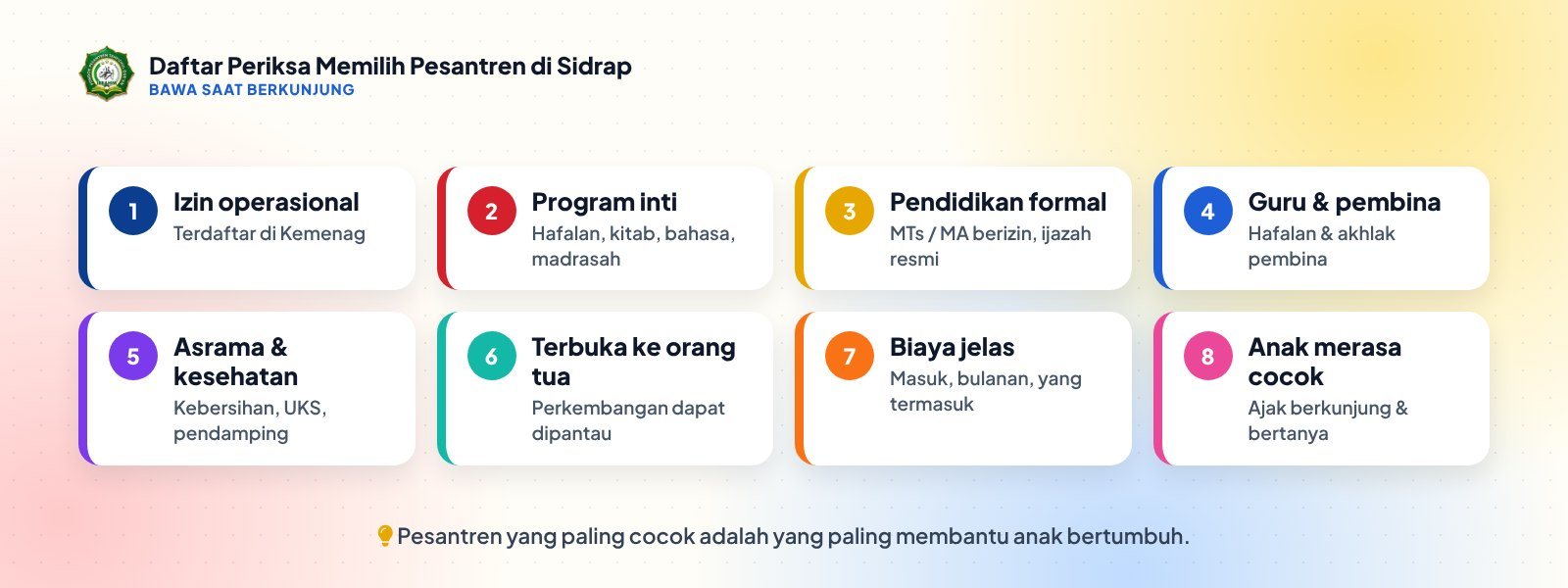
- Operating license. Make sure the pesantren holds an operating license from the Ministry of Religious Affairs. This ensures the institution is officially registered and supervised.
- Core program. What is truly the focus: memorization, classical texts, languages, or formal madrasah? How is the program carried out each day?
- Formal education. Is there a licensed junior or senior madrasah, so that your child receives an official diploma?
- Teachers and mentors. Who teaches and accompanies the students? What is the quality of the mentors' memorization and character?
- Dormitory and health. How clean are the rooms, bathrooms, and kitchen? Is there a health service if a student falls ill?
- Openness to parents. How can parents follow their child's progress?
- Clear costs. What is included in the admission fee and monthly fee? Are there additional costs beyond these?
- The child's own sense of fit. Take your child along and let him ask his own questions. A child's comfort strongly determines his resilience later.
A fuller discussion of how to choose a pesantren can be found in our article Choosing a Pesantren for Your Child: Nine Questions Parents Should Answer.
Tips for Visiting a Pesantren in Sidrap
A visit in person often answers what is not written in brochures or on websites. A few suggestions to make your visit more meaningful:
- Arrive shortly before prayer time. Notice whether the students hurry to the mosque and whether the mentors pray in congregation with them.
- Bring your child along. Let him see the rooms, the classrooms, and the study circles. Ask for his opinion afterwards.
- Prepare written questions. Use the checklist above so that nothing is missed.
- Pay attention to small things. The cleanliness of the bathrooms, the neatness of posted schedules, and the way students greet guests often say a lot about a pesantren's culture.
- Ask about its shortcomings too. An honest pesantren does not mind explaining what it is still working to improve.
Getting to Know PPTQ Ibrahim: A Tahfizh Pesantren in Uluale, Watang Pulu
Pondok Pesantren Tahfizhul Qur'an (PPTQ) Ibrahim is an educational institution under the Ibrahim La Useng Foundation that holds an operating license from the Ministry of Religious Affairs of the Republic of Indonesia. It is located on Jalan Jenderal Ahmad Yani, on the Rappang–Parepare road at kilometer 11, Uluale, Watang Pulu District, Sidenreng Rappang Regency.
Within the same foundation are Raudhatul Athfal (kindergarten), Madrasah Tsanawiyah (junior high), and Madrasah Aliyah (senior high) Ibrahim. As a result, the students' tahfizh program runs hand in hand with formal education, and graduates receive both a pesantren diploma and a madrasah diploma.
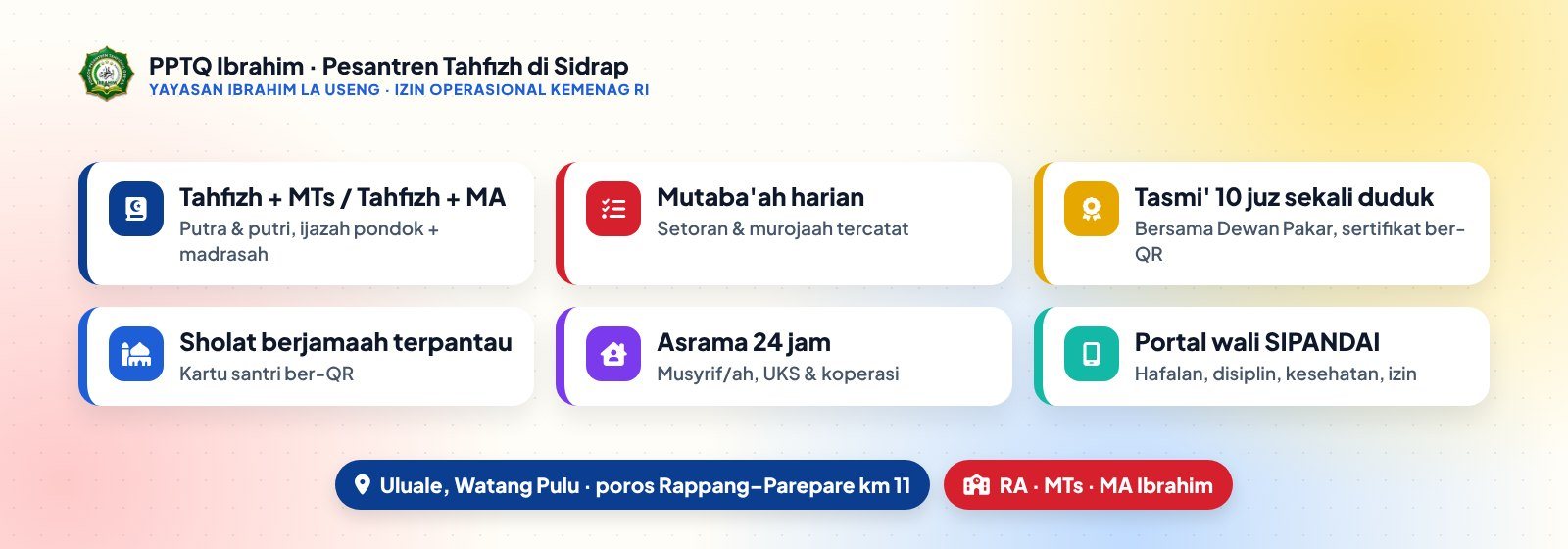
We do not wish to call ourselves the best pesantren in Sidrap. We would rather you judge for yourself after visiting. What we can share is what we are currently doing:
- Tahfizh + Madrasah Tsanawiyah and Tahfizh + Madrasah Aliyah programs for boys and girls.
- A measurable tahfizh program. New memorization and review are recorded every day in a mutaba'ah log, with targets adjusted to each student's ability.
- A tasmi' examination of 10 juz in a single sitting before a Board of Experts to test the quality of memorization, with certificates whose authenticity can be checked by QR code.
- Monitored congregational prayer with QR-coded student cards at the mosque door.
- 24-hour dormitory guidance by male and female mentors, supported by a health clinic (UKS) and a cooperative shop.
- The SIPANDAI parent portal, where parents follow memorization, discipline, health, leave permissions, and payments directly from their phones.
To learn how students' character is nurtured alongside their memorization, you can read our article Character That Grows Alongside Memorization.
What a Student Takes Home
Many parents ask, "After graduating from the pesantren, what will my child become?" It is a fair question. The answer is not a single one, because every child has his own path. Yet there are a few provisions that students who study sincerely almost always take home.
First, the Qur'an in the heart. However much memorization is preserved, it is a provision that accompanies a person for life. The Messenger of Allah ﷺ said:
خَيْرُكُمْ مَنْ تَعَلَّمَ الْقُرْآنَ وَعَلَّمَهُ
"The best of you are those who learn the Qur'an and teach it." (Narrated by al-Bukhari, no. 5027)
Second, orderly habits: waking early, praying on time, and managing oneself. These habits prove very useful when they later go to university or work far from their parents.
Third, the ability to speak and lead. Activities such as muhadharah (public speaking practice), student organizations, and dormitory duties train confidence and responsibility.
Fourth, doors to education that remain open. Because the tahfizh program runs alongside formal madrasah education, graduates hold official diplomas to continue to the next level. A number of universities also offer admission tracks or scholarships for those who have memorized the Qur'an, so memorization can be an added advantage in pursuing further education.
And no less important, a network of brotherhood. Dormitory friends often become lifelong brothers and sisters who support one another long after they leave the pesantren.
Location and Access from All Directions
Its location on the Rappang–Parepare road makes the pesantren fairly easy to reach. From districts in Sidrap such as Watang Pulu, Baranti, Panca Rijang, Maritengngae, and Tellu Limpoe, it can be reached by private vehicle or by public transport along the main road. It is also easily reached from neighboring regencies and cities such as Parepare, Pinrang, Enrekang, Soppeng, and Wajo.
For families from Makassar or farther away, the overland journey to Sidrap is a familiar route. For convenience, the pesantren can be found on Google Maps by searching "Pondok Pesantren Tahfizhul Quran Ibrahim Sidenreng Rappang".
We strongly encourage you to visit in person before registering. See the atmosphere of the mosque at prayer time, listen to the students reciting their memorization, and sense whether this place suits your child.
A Day at the Pesantren: A Brief Picture
A student's day begins before Fajr. After congregational prayer, students sit in their study circles to recite new memorization. From morning until midday they attend madrasah classes. After Asr, the circles meet again for review. The evening is filled with religious study and a final circle before rest. In between, there is time for meals, sports, and enough rest.
This rhythm may sound full, and it is. But with a regular schedule and patient mentors, most students adjust within the first few months. A fuller picture can be found in A Day with a Student Who Memorizes the Qur'an.
The Qur'an promises ease to anyone who sincerely draws near to it:
وَلَقَدْ يَسَّرْنَا الْقُرْآنَ لِلذِّكْرِ فَهَلْ مِنْ مُدَّكِرٍ
"And We have certainly made the Qur'an easy to remember. So is there anyone who will take heed?" (Qur'an, al-Qamar 54:17)
Life for Boys and Girls
At PPTQ Ibrahim, the boys' and girls' dormitories are separate, each accompanied by its own male or female mentors. Besides study circles and madrasah classes, students take part in activities such as muhadharah (public speaking practice), extracurriculars, sports, and celebrations of Islamic holidays. Students are also involved in small duties in the dormitory, from cleaning rotas to helping younger students with review.
We believe students also need to be happy. Laughing with friends, playing on the field, and eating together are part of a healthy life. A heart at ease receives knowledge more readily.
Pesantren Admission Costs in Sidrap: An Example from PPTQ Ibrahim
Cost is often a key consideration. To give you a picture, here are the costs at PPTQ Ibrahim for the 2027/2028 intake at the time of writing. The latest details are always available on the new student registration page.
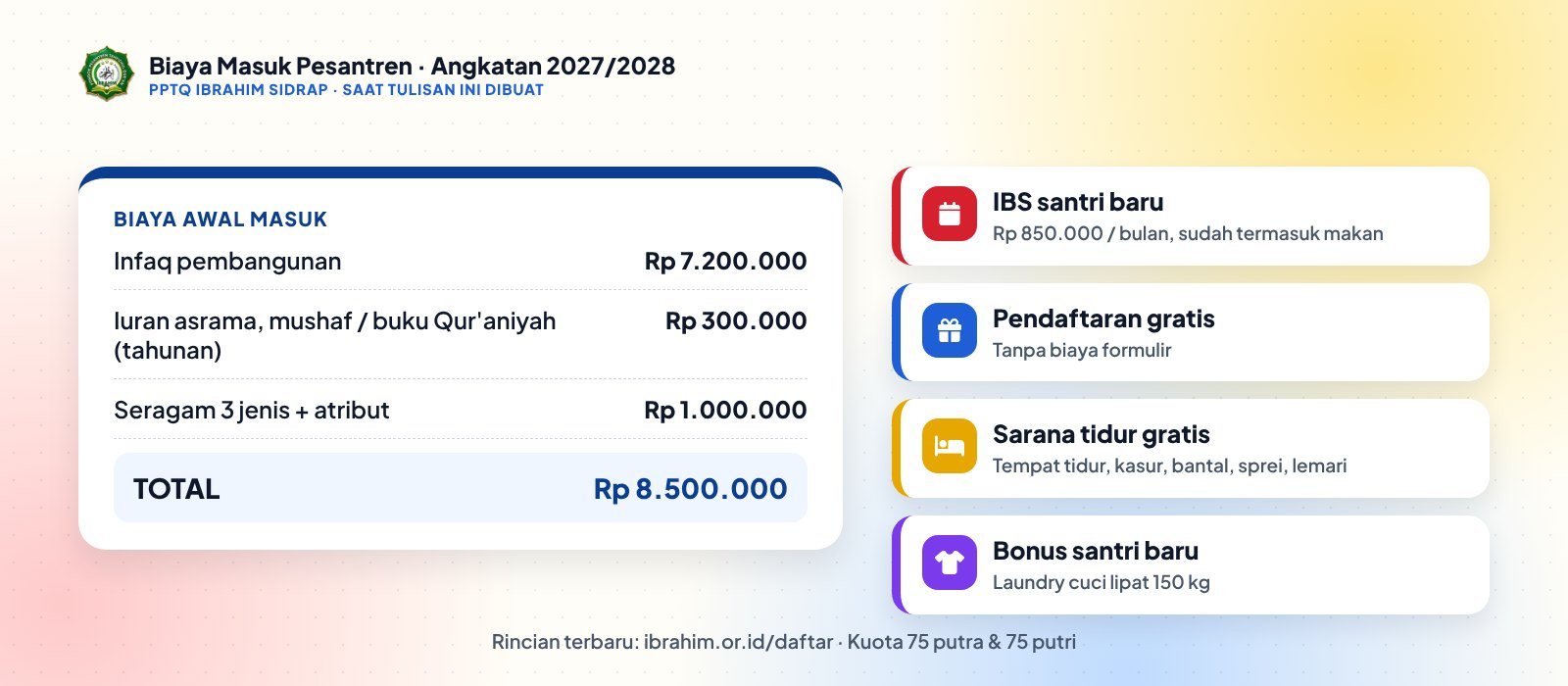
- Registration fee: free.
- Building contribution (infaq): IDR 7,200,000.
- Dormitory fee, mushaf / Qur'anic books (annual): IDR 300,000.
- Three sets of uniforms and attributes: IDR 1,000,000.
- Total initial admission cost: IDR 8,500,000.
- Monthly boarding fee (IBS) for new students: IDR 850,000 per month, including meals.
- Bedding and furniture: bed, mattress, pillow, bolster, sheets, and wardrobe are provided at no extra cost.
- New student bonus: free wash-and-fold laundry up to 150 kg.
The quota for the 2027/2028 intake is 150 students: 75 boys and 75 girls.
How to Register
Registration can be done in two ways:
- Online: fill in the form on the registration page without having to come to the pesantren.
- Offline: come directly to the main building of the pesantren, Monday to Friday, 08.00–16.00 WITA (Central Indonesia Time). The committee will assist you with the whole process.
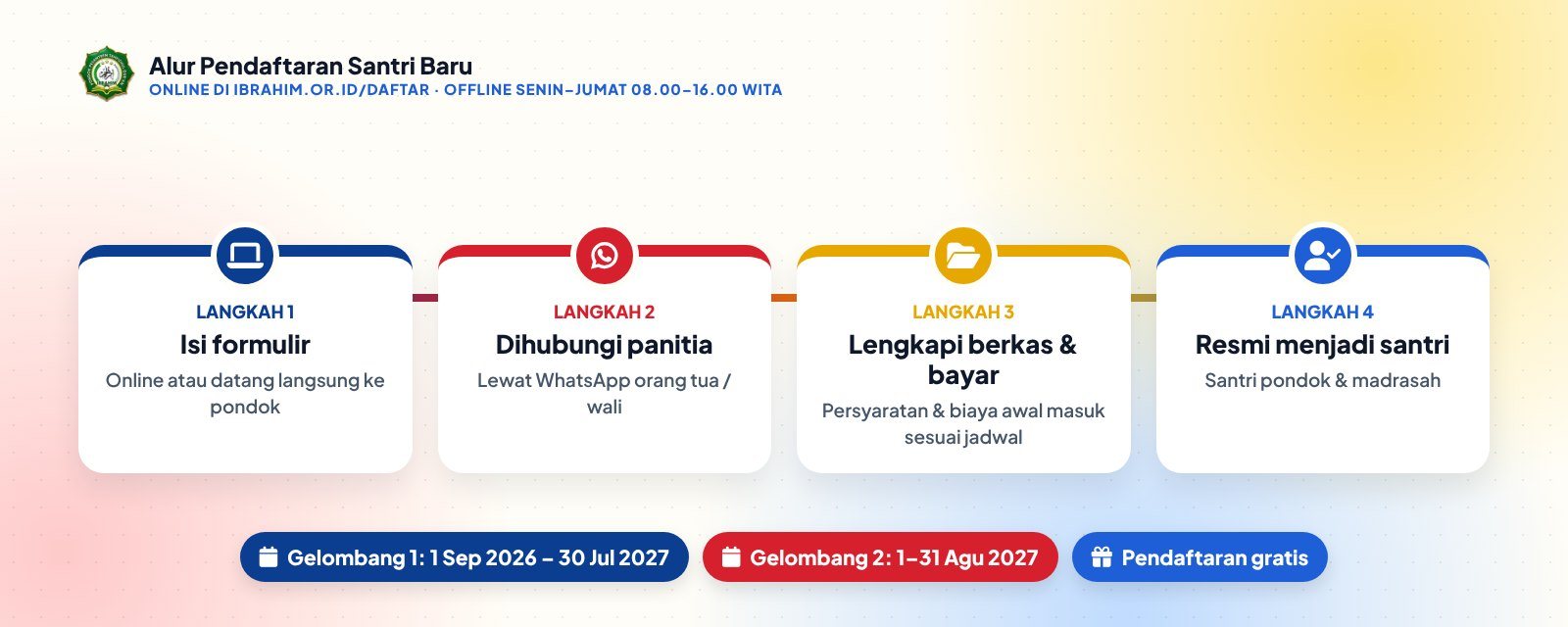
Once the form is received, the steps are as follows:
- The committee contacts the parent or guardian via WhatsApp.
- Parents complete the administrative requirements according to the schedule.
- Parents complete payment of the initial admission cost.
- The prospective student officially becomes a student of the pesantren and the madrasah.
The first registration wave runs from 1 September 2026 to 30 July 2027, and the second wave from 1 to 31 August 2027.
Parents' Natural Worries
Sending a child to a pesantren almost always comes with worries. That is a sign of love, not a mistaken doubt. Here are some of the worries we hear most often, and how we see them.
"My child is not ready to be apart from us." Hardly any child is truly ready on the first day. Homesickness usually peaks in the first weeks, then eases as the child finds friends and a new rhythm. What helps most is a calm and encouraging attitude from parents. We have written a guide to this in our article When a New Student Misses Home.
"What if my child falls ill?" The pesantren provides a health clinic (UKS) and dormitory mentors who look after the students. If treatment outside is needed, there is a clear leave procedure, and parents are informed. Through the parent portal, a child's health records can also be followed.
"My child memorizes slowly." Memorization targets are adjusted to each student's ability. What is assessed is not only speed, but sincerity and quality. Many students who start slowly become strong memorizers precisely because they have learned patience.
"Will his school lessons fall behind?" Students attend formal madrasah classes every day, so general subjects continue alongside memorization.
Worries need not disappear entirely; they only need to be talked about. Share them with the pesantren from the start, so that support can be planned to fit your child's needs.
The Role of Parents After Admission
A child's admission to a pesantren is not the end of the parents' task, but the start of a new partnership. Prayers, regular visits, and encouraging words on the phone mean a great deal to students, especially in the first months.
يَا أَيُّهَا الَّذِينَ آمَنُوا قُوا أَنْفُسَكُمْ وَأَهْلِيكُمْ نَارًا
"O you who believe, protect yourselves and your families from a Fire." (Qur'an, at-Tahrim 66:6)
A few simple things you can do: keep the rhythm of worship and review during holidays, ask about your child's character and not only the amount memorized, and speak calmly with the mentors if problems arise. A pesantren and a home moving in the same direction are the best environment for a child to grow.
Frequently Asked Questions
Is there a tahfizh pesantren in Sidrap?
Yes. One of them is PPTQ Ibrahim in Uluale, Watang Pulu District, which combines a tahfizh program with Madrasah Tsanawiyah and Madrasah Aliyah for boys and girls.
Which pesantren in Sidrap is most suitable for my child?
It depends on your family's goals and your child's character. Use the checklist above, visit several pesantren, and involve your child in the decision. The most suitable pesantren is the one that best helps your child grow.
How much does it cost to enter a pesantren in Sidrap?
Costs differ from one pesantren to another. At PPTQ Ibrahim, at the time of writing, the total initial admission cost is IDR 8,500,000 and the monthly fee (IBS) for new students is IDR 850,000, including meals. Registration is free.
Does PPTQ Ibrahim accept girls?
Yes. PPTQ Ibrahim accepts boys and girls, with separate dormitories and their own mentors.
Is this pesantren officially licensed?
Yes. PPTQ Ibrahim is run by the Ibrahim La Useng Foundation and holds an operating license from the Ministry of Religious Affairs of the Republic of Indonesia.
May parents visit before registering?
Absolutely, and we encourage it. Please come during the committee's working hours or contact the committee on WhatsApp beforehand so that you can be properly welcomed.
What is the difference between "Sidrap" and "Sidenreng Rappang"?
Both refer to the same regency. "Sidrap" is the popular abbreviation of Sidenreng Rappang, a combination of the names of two old kingdoms in this area, Sidenreng and Rappang.
Can prospective students from outside Sidrap apply?
Certainly. The pesantren is open to prospective students from any regency in South Sulawesi as well as from other provinces.
Closing: Choose with Clarity, Step Forward with Prayer
Nene Mallomo left Sidenreng a timeless lesson: the truth must be upheld, even when it touches those we love most. Perhaps this is what we truly hope for from any pesantren: a place where our children learn to love the Qur'an, and at the same time learn to be honest and just.
Whichever pesantren you finally choose, we pray that the choice brings goodness to your child and family. If you would like to get to know PPTQ Ibrahim more closely, please open the registration page or contact the new student admissions committee on WhatsApp at +62 823 4544 9699. We would be delighted to welcome your visit to Uluale.