In many villages of South Sulawesi, the sound of children reciting the Qur'an after Maghrib used to be the sign that day had turned to night. An oil lamp would glow beneath a house on stilts, a Qur'an teacher would sit cross-legged, and the children would take turns reading in halting voices. Many of today's parents first came to know the Qur'an in exactly that kind of setting.
This article invites you to trace the long path of religious learning in the land of the Bugis: from reciting at the teacher's house and mangaji tudang in the mosque, to the rise of great madrasahs and pesantren, to the Islamic boarding schools of Sidrap and South Sulawesi today that combine Qur'an memorization, formal schooling, and technology. Much has changed, but there are values we hope to keep.
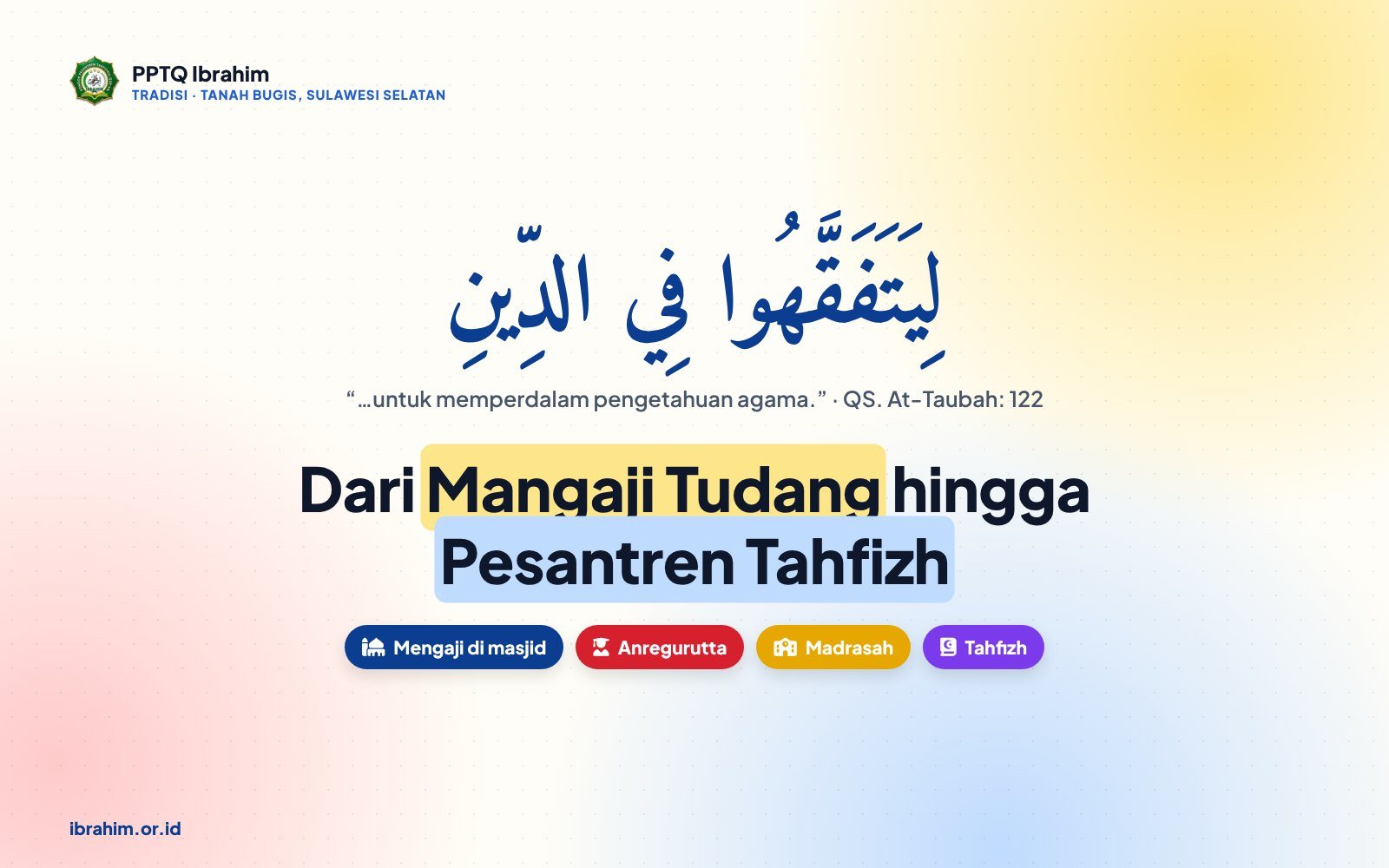
"Why should not a party from every group go forth to gain understanding of the religion?" (Qur'an, At-Tawbah 9:122)
A Command to Gain Deep Understanding of the Religion
The love of religious learning in Muslim societies is rooted in the words of Allah the Exalted:
فَلَوْلَا نَفَرَ مِنْ كُلِّ فِرْقَةٍ مِنْهُمْ طَائِفَةٌ لِيَتَفَقَّهُوا فِي الدِّينِ وَلِيُنْذِرُوا قَوْمَهُمْ إِذَا رَجَعُوا إِلَيْهِمْ لَعَلَّهُمْ يَحْذَرُونَ
"Why should not a party from every group of them go forth to gain understanding of the religion and to warn their people when they return to them, so that they may be cautious?" (Qur'an, At-Tawbah 9:122)
This verse describes exactly what pesantren have done for centuries: some young people leave home to seek knowledge, then return to their villages as imams, Qur'an teachers, and guides for their communities. The Messenger of Allah ﷺ also said:
مَنْ يُرِدِ اللَّهُ بِهِ خَيْرًا يُفَقِّهْهُ فِي الدِّينِ
"Whomever Allah wills good for, He grants him understanding of the religion." (Narrated by al-Bukhari and Muslim)
It Began at the Qur'an Teacher's House
Before there were madrasah buildings, the Qur'an teacher's house was the first school for many Bugis children. They came carrying a mushaf or a copy of Juz 'Amma, sat in a circle, and read one by one before the teacher. The teacher listened, corrected their pronunciation, and now and then rebuked them, firmly but with affection.
In many places this stage closed with the mappatamma, a khatam celebration held when a child finished reading the entire Qur'an. The family prepared food, relatives were invited, and the child recited the final verses before everyone. The tradition shows how highly the community valued the ability to read the holy book.
Mangaji Tudang: Studying While Seated Cross-Legged
Those who wished to study further joined a tradition known as mangaji tudang, literally "studying while sitting". Students sat cross-legged around an anregurutta, the honorific given to great scholars in Bugis society, in the mosque or at his home. The teacher read an Arabic text, translated it word by word into Bugis, and explained its meaning, while the students wrote the meanings between the lines of their books.
The method resembles the bandongan system of Javanese pesantren. Subjects included Arabic grammar and morphology, fiqh, theology, tafsir, and hadith. From these simple study circles came many scholars who went on to found educational institutions, so the tradition of religious learning in South Sulawesi has continued from one generation to the next.
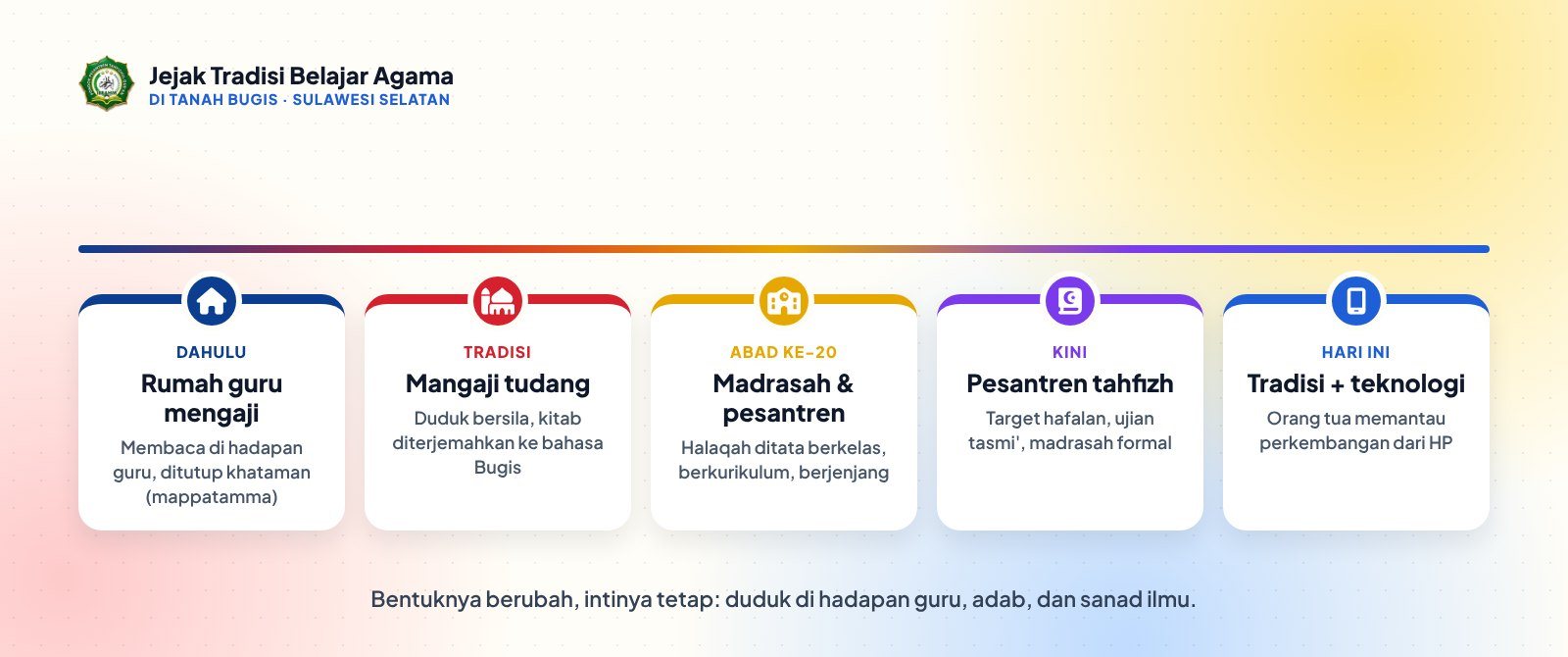
From the Qur'an teacher's house to the tahfizh pesantren: an unbroken tradition.
From Study Circles to Madrasahs and Pesantren
In the twentieth century, several great scholars of South Sulawesi began to organize study circles into more structured institutions with classes, curricula, and levels. Two names are especially well known: the As'adiyah institution in Sengkang, Wajo, which grew from a madrasah founded by Anregurutta H. Muhammad As'ad in the 1930s, and Darud Da'wah wal Irsyad (DDI), which grew from a madrasah in Mangkoso, Barru, under the guidance of Anregurutta H. Abdurrahman Ambo Dalle.
The students of these scholars later spread throughout the regencies, founding madrasahs and pesantren in their home villages, including in the Ajatappareng region that covers Sidrap, Pinrang, Parepare, Barru, and their surroundings. Today South Sulawesi has hundreds of pesantren of many kinds: traditional (salaf), modern, integrated, and Qur'an memorization schools.
This history reminds us that the pesantren of South Sulawesi did not appear overnight. They grew out of the community's love of knowledge, the sincerity of its teachers, and the willingness of parents to let their children study far from home.
Values Woven Into Bugis Culture
Pesantren education in Bugis land is closely intertwined with local cultural values. Among them:
- Siri': a sense of shame and dignity. Framed by religion, siri' makes a person ashamed to sin and ashamed to neglect obligations.
- Pesse: compassion and empathy for others. In the dormitory it grows through sharing food, visiting sick friends, and helping younger students.
- Lempu': honesty. Students are trained to be honest in their recitation, examinations, and daily affairs.
- Getteng: firmness in principle. Memorizing the Qur'an and rising before Fajr every day requires exactly this steadfastness.
These values are in harmony with Islamic teachings on modesty as part of faith, mercy among Muslims, honesty, and steadfastness. A good pesantren in South Sulawesi does not uproot students from their culture; it strengthens those roots with the light of knowledge.
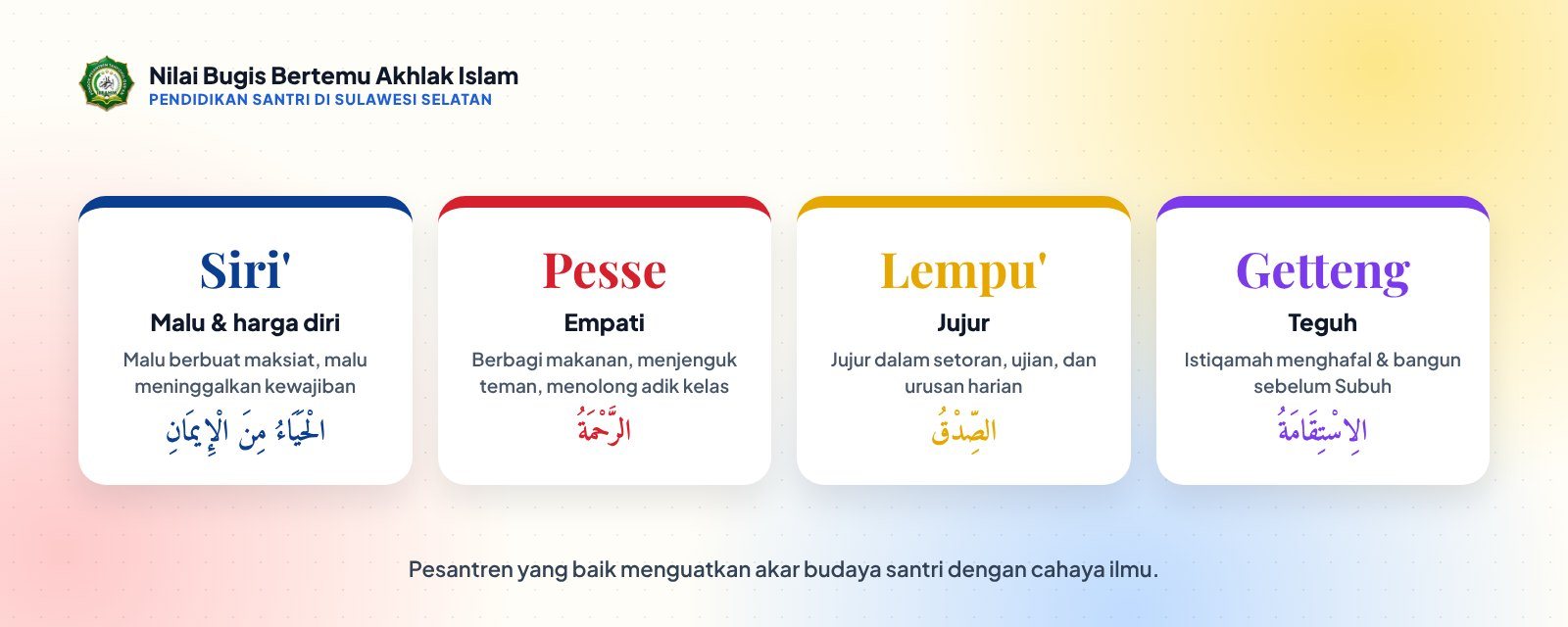
Four Bugis values that meet Islamic character in the pesantren.
Scholars: Heirs Who Guard the Light
The Messenger of Allah ﷺ said:
إِنَّ الْعُلَمَاءَ وَرَثَةُ الْأَنْبِيَاءِ، وَإِنَّ الْأَنْبِيَاءَ لَمْ يُوَرِّثُوا دِينَارًا وَلَا دِرْهَمًا، وَإِنَّمَا وَرَّثُوا الْعِلْمَ، فَمَنْ أَخَذَهُ أَخَذَ بِحَظٍّ وَافِرٍ
"The scholars are the heirs of the prophets. The prophets did not leave behind dinars or dirhams; they left knowledge. Whoever takes it has taken an abundant share." (Narrated by Abu Dawud and at-Tirmidhi)
The anregurutta of the past did not only teach in class. People came to them with questions, they reconciled disputes, and they advised leaders. That is why Bugis society honours its teachers so deeply. This respect must be preserved, for good manners towards teachers are the gateway to blessed knowledge.
Sidrap: A Rice Granary That Also Grows Knowledge
Sidenreng Rappang is known as one of the rice granaries of South Sulawesi. Its wide paddy fields, its lake, and the main road linking Parepare with the eastern part of the province make Sidrap a busy crossroads. Amid the hard-working lives of farmers who start at dawn, the tradition of Qur'an recitation has stayed alive in village mosques.
The pesantren of Sidrap today carry that tradition forward in a more organized form. Many families of farmers, traders, teachers, and civil servants in Sidrap and neighbouring regencies choose a pesantren close to home, so their children remain near the family while learning to live independently.
The Tahfizh Pesantren: A New Chapter of an Old Tradition
In recent decades, interest in tahfizh (Qur'an memorization) pesantren has grown steadily across South Sulawesi. Memorizing the Qur'an is nothing new; the scholars of the past generally memorized it before studying other sciences. What is new is how it is managed: measurable targets, an orderly recitation schedule, examinations heard by examiners, and integration with formal madrasah education.
Allah the Exalted guarantees the preservation of the Qur'an:
إِنَّا نَحْنُ نَزَّلْنَا الذِّكْرَ وَإِنَّا لَهُ لَحَافِظُونَ
"Indeed, it is We who sent down the Reminder, and indeed, We will be its guardian." (Qur'an, Al-Hijr 15:9)
Scholars mention that one of the ways Allah preserves the Qur'an is through the hearts of those who memorize it in every generation. The children memorizing in tahfizh pesantren today are taking part in that sublime guardianship.
Tradition Meets Technology
Where news of a child at the pondok once arrived only by letter or during a parents' visit, many pesantren now use technology to bridge the distance. At Pondok Pesantren Tahfizhul Qur'an Ibrahim in Uluale, Watang Pulu, Sidrap, for instance, daily recitation records, congregational prayer attendance, health, and discipline can be followed by parents through the SIPANDAI portal on their phones.
Yet technology is only a tool. The heart of education remains the same as in the days of mangaji tudang: a student sits before a teacher, reads and recites, receives correction and advice, then strives to act on what he has learned. A chain of knowledge (sanad) cannot be downloaded. It is passed on through meeting, patience, and good manners.
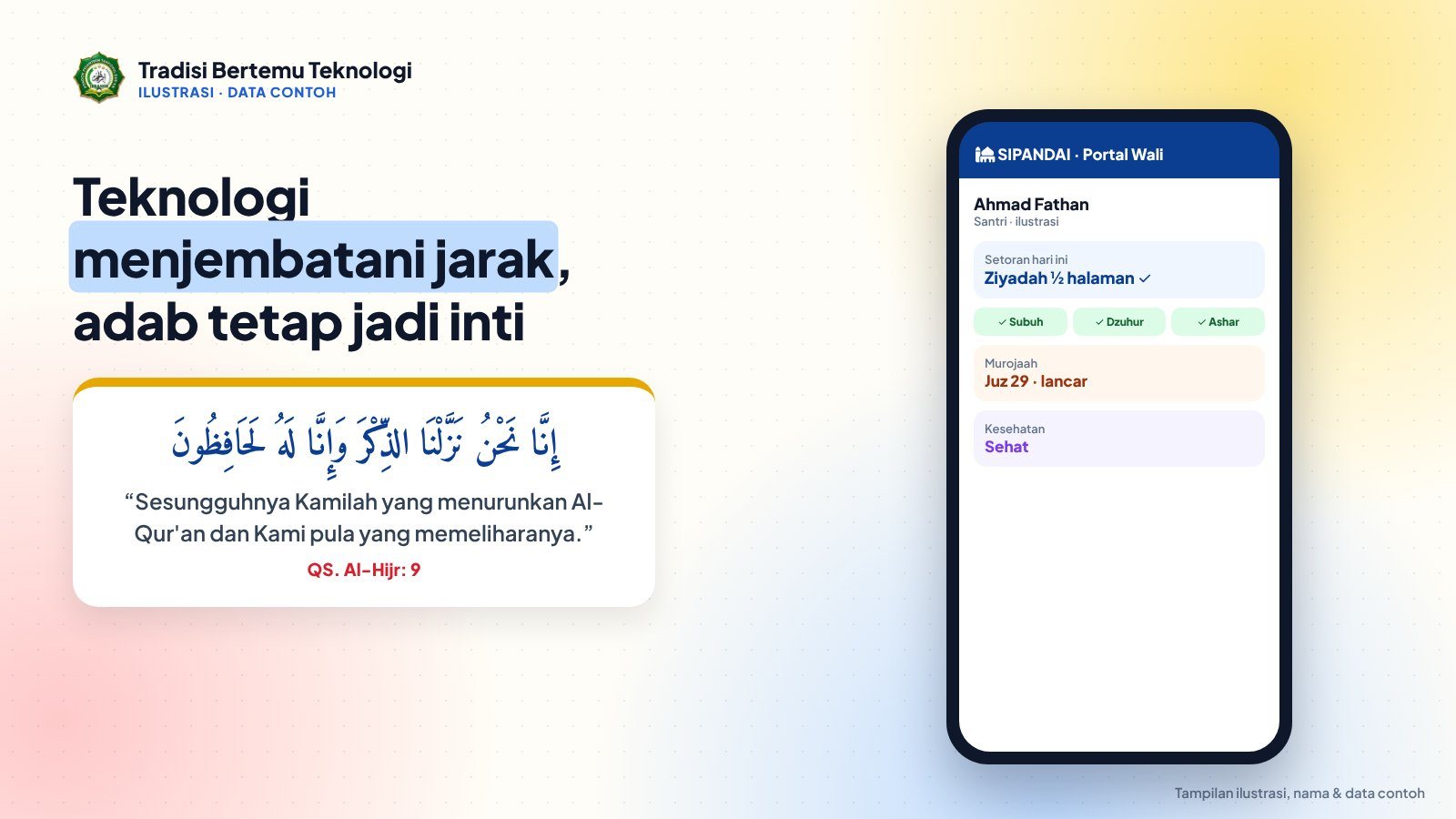
Technology bridges distance; manners and sanad remain at the core (illustration).
What We Should Preserve Together
So that this beautiful tradition does not fade, families and pesantren can preserve several things together:
- Keep Qur'an recitation alive at home. The pesantren continues, not replaces, education at home. Reciting after Maghrib at home remains precious.
- Honour teachers. Teach children that their Qur'an teachers and ustadz are second parents.
- Cherish the local language. Much of the wisdom of Bugis scholars is stored in sayings in the regional language. A child who knows his mother tongue will grasp that wisdom more easily.
- Support those who memorize. A community's support for its young memorizers is an investment in the village's future.
Frequently Asked Questions
What does mangaji tudang mean?
Mangaji tudang is the Bugis tradition of studying classical texts, in which students sit cross-legged around a teacher who reads the text and translates it into Bugis.
What is an anregurutta?
Anregurutta is an honorific used by the Bugis for great scholars who serve as teachers and role models.
Do pesantren in Sidrap combine Qur'an memorization with formal schooling?
Some pesantren in Sidrap and South Sulawesi run formal madrasahs (MTs and MA) alongside a tahfizh program. Ask the pesantren you are considering how its timetable is divided.
Closing
From oil lamps beneath stilt houses to phone screens in parents' hands, the tradition of religious learning in Bugis land carries on. Its form changes, but its spirit stays the same: seeking knowledge for the sake of Allah, honouring teachers, and returning home to benefit one's village.
May Allah have mercy on the Qur'an teachers and anregurutta who have gone before us, and make our children the bearers of that light. For parents who wish their children to continue this tradition in a pesantren environment, admission information is available on the Admissions page.