

"I want my child to memorize the Qur'an. But honestly, what I hope for most is that he grows up to be a good person." We often hear words like these from parents who visit our pesantren. They are usually spoken softly, as if the parent worries that the wish might sound like too much.
It is not too much at all. That hope goes straight to the heart of Qur'anic education. Memorization is a noble trust, yet the Qur'an was not revealed merely to be stored in memory. It was revealed to shape the way a person thinks, speaks, treats others, and faces life. This article invites you to look at a side of a tahfizh pesantren that is rarely discussed: how character and good conduct grow slowly, alongside a growing memorization of the Qur'an.
Memorization and character are like two wings: a student needs both to fly high.
The Qur'an Was Revealed to Shape Human Beings
When Sa'd ibn Hisham asked the Mother of the Believers, 'A'ishah (may Allah be pleased with her), about the character of the Messenger of Allah ﷺ, she answered with a remarkably brief sentence:
فَإِنَّ خُلُقَ نَبِيِّ اللَّهِ ﷺ كَانَ الْقُرْآنَ
"Indeed, the character of the Prophet of Allah ﷺ was the Qur'an." (Narrated by Muslim, no. 746)
That answer carries a deep lesson. The Qur'an was not only recited by the Messenger of Allah ﷺ; it lived within him. His patience, his honesty, his gentleness with children, and his firmness in what is right were all the Qur'an walking among people.
The Messenger of Allah ﷺ also described the refinement of character as one of the central purposes of his mission:
إِنَّمَا بُعِثْتُ لِأُتَمِّمَ صَالِحَ الْأَخْلَاقِ
"I was sent only to perfect good character." (Narrated by Ahmad and by al-Bukhari in al-Adab al-Mufrad; graded authentic by hadith scholars)
From this we understand that the goal of a tahfizh pesantren is not simply to produce children who can recite 30 juz without looking at the mushaf. That is an extraordinary achievement, and we value it deeply. But memorization without good manners is like a bright lamp that lights up nothing on the road. True knowledge always leaves its mark on behavior.
Character Is Harder to Measure Than Memorization
Memorization can be counted. We can say that a student has memorized 5 juz, 12 juz, or 30 juz. We can test it, grade it, and print it on a certificate. Character is not so simple. No written exam can measure a child's patience when a friend mocks him, or his honesty when he finds money lying on the dormitory floor.
Because it is hard to measure, character often receives less attention. Parents ask "How many juz now?" far more often than "How does he treat his friends?" A pesantren, too, can be tempted to chase only the numbers that are easy to show off.
We believe the two must go together. The number of juz matters as a sign of earnest effort, but it is not the only measure of success. Our mentors record not only daily recitations but also attendance at congregational prayer, discipline, care for others, and changes in attitude. These small notes, read over a long period, often say more about a child than the numbers on a report card.
Perhaps the most honest measure of character is what a person does when no one is watching.
Why the Teenage Years Matter So Much
Most students come to the pesantren between the ages of 12 and 15, an age many parents describe as "the hardest to predict." It turns out there is a scientific explanation for this.
Several decades of neuroscience research show that the part of the brain responsible for judgment, planning, and self-control, the prefrontal cortex, continues to develop into the mid-twenties. Meanwhile, the parts of the brain associated with emotion and the drive to seek new experiences are already very active from early adolescence. As a result, teenagers are easily excited, easily influenced by their peers, and not always able to hold themselves back.
The good news is that the brain at this stage is also highly adaptable. Habits practiced repeatedly during adolescence tend to become a strong part of who a person is. This is one reason why the environment at this age matters so much: what a child sees, hears, and does every day will shape who he or she becomes.
This is where the pesantren plays its part. Not by suppressing a teenager's enthusiasm, but by giving it direction. That great energy is channeled into study circles, sports, student organizations, and small acts of service in the dormitory. The wish to be recognized by friends is turned into eagerness to compete in doing good.
Small Habits, Repeated: How Character Is Formed
Character is rarely born from one long lecture. It is born from small things done again and again: waking before Fajr, making the bed, queuing for meals, reciting new memorization every day even if only a few lines.
The Messenger of Allah ﷺ taught this principle more than fourteen centuries ago:
أَحَبُّ الْأَعْمَالِ إِلَى اللَّهِ أَدْوَمُهَا وَإِنْ قَلَّ
"The deeds most beloved to Allah are those done most consistently, even if they are few." (Narrated by al-Bukhari, no. 6464, and Muslim, no. 783)
Interestingly, modern psychology has reached a similar conclusion. A study at University College London published in 2010 followed how people form new habits. On average it took about 66 days for a behavior to feel automatic, with a very wide range, from 18 to 254 days, depending on the person and the type of habit. More importantly, the researchers noted that missing a day now and then did not ruin the process, as long as the person quickly returned to the habit.
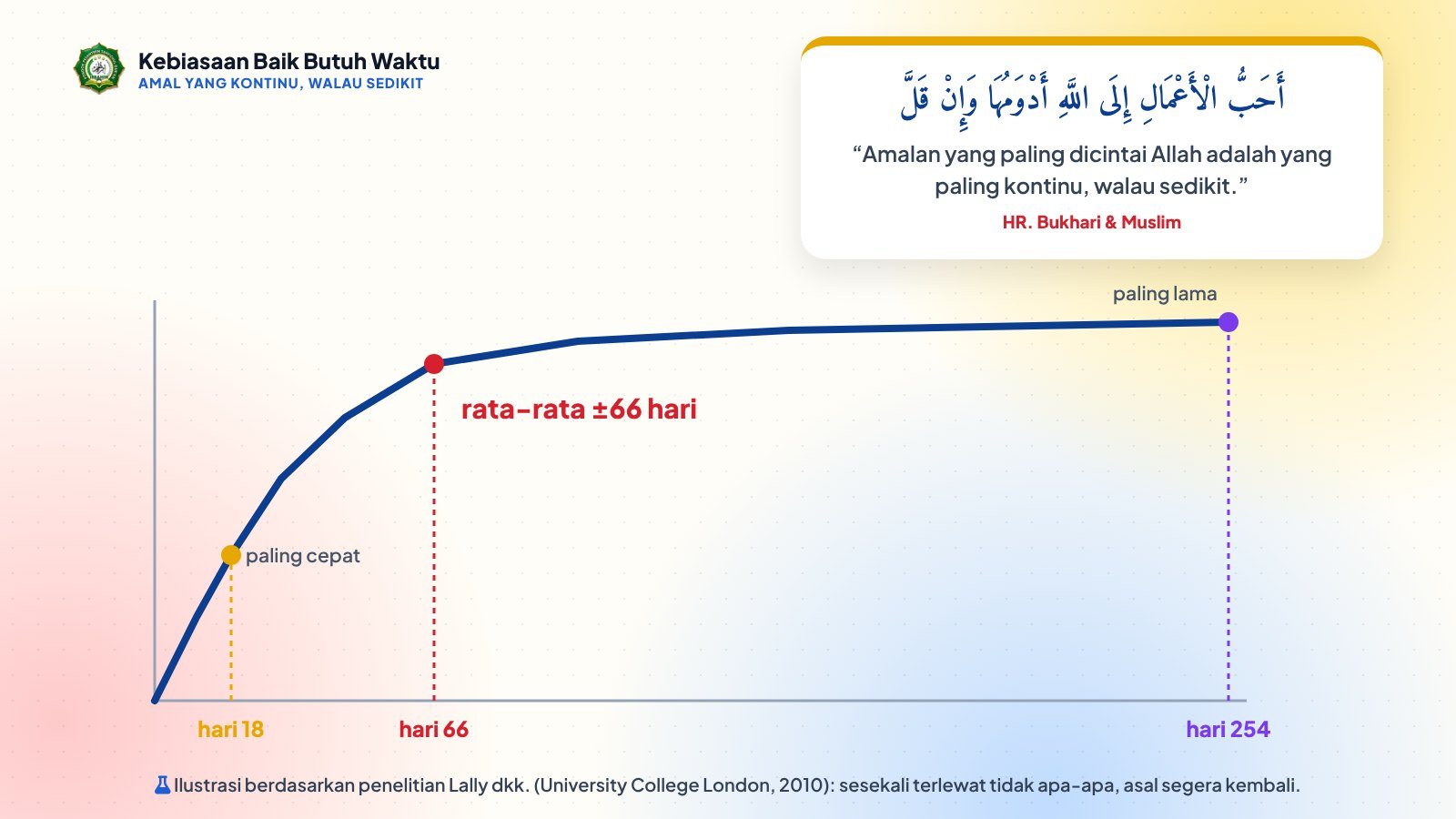
Illustration: good habits feel heavy at first, then slowly become part of who we are.
For parents, this finding brings reassurance. The first two or three months at the pesantren are indeed hard. A child is learning a new rhythm: sleeping earlier, waking earlier, taking care of himself. It is natural for him to complain. But if that rhythm is lived patiently, one day he will wake before the call to Fajr without being woken, and he may not even notice when the change happened.
We often overvalue big transformations and underestimate small repetitions. Yet the life story of most good people is written precisely by small repetitions, faithfully kept.
Six Character Traits That Grow in a Tahfizh Pesantren
Every pesantren has its own way of nurturing students. Yet from our experience accompanying them, certain traits almost always grow when a child lives the tahfizh life sincerely.

1. Discipline with time
A tahfizh student's life moves with the prayer times. A memorization circle after Fajr, school in the morning, another circle in the afternoon, and review at night. Over time, a child learns that time is a trust. Arriving five minutes late to the circle means losing the chance to recite, and lost chances cannot be bought back.
This kind of discipline is not built by shouting. It is built through a clear schedule, the example of the teachers, and fair consequences. Children used to this rhythm are usually better prepared for university or work later on.
2. Patience and perseverance
Memorizing the Qur'an is a very real lesson in patience. Some days a whole page feels light; other days even three lines refuse to stay. Some verses look alike and are easily confused. Some old memorization turns out to be fading.
A student who endures all of this is learning something that is not written on any report card: that precious things are not gained quickly. Education researchers describe this kind of long-term perseverance as one of the factors that often matters more for success than intelligence alone.
3. Honesty
Memorization cannot be faked. In front of a teacher who is listening, a student can recite only what he has truly memorized. When he forgets, he must admit it. When he is not ready, he must say so. Every day he learns that honesty is more honorable than pretending.
عَلَيْكُمْ بِالصِّدْقِ، فَإِنَّ الصِّدْقَ يَهْدِي إِلَى الْبِرِّ، وَإِنَّ الْبِرَّ يَهْدِي إِلَى الْجَنَّةِ
"Hold fast to truthfulness, for truthfulness leads to righteousness, and righteousness leads to Paradise." (Narrated by al-Bukhari and Muslim)
4. Independence
Washing one's own plate, managing pocket money, looking after personal belongings, taking care of oneself when feeling unwell: all of this seems trivial. But for a child who used to be served at home, these are big steps toward maturity. Many parents tell us that during the first holiday, their child began tidying his room without being asked. Small things like that are often a sign that something is growing inside.
5. Respect for teachers and elders
In the pesantren tradition, adab (good manners) comes before knowledge. Students learn to listen when the teacher speaks, to sit politely in the circle, and to respect senior students. The Messenger of Allah ﷺ said:
لَيْسَ مِنَّا مَنْ لَمْ يَرْحَمْ صَغِيرَنَا وَيَعْرِفْ شَرَفَ كَبِيرِنَا
"He is not one of us who does not show mercy to our young and does not recognize the honor of our elders." (Narrated by at-Tirmidhi, graded authentic)
This does not mean students are forbidden from asking questions or expressing opinions. On the contrary, adab teaches how to ask well and how to disagree without belittling others.
6. Caring and brotherhood
Living together with dozens of friends from different backgrounds teaches what is hard to teach in a classroom: sharing, giving way, forgiving, and helping. Students who memorize faster usually help their friends review. When a friend falls ill, they take turns bringing food. Bonds like these often last for decades after graduation.
Away from Screens, Learning to Be Fully Present
One of the most noticeable differences between life at home and life at the pesantren is the distance from screens. At the pesantren, students are not free to bring and use personal phones; their use is regulated and requires permission. For some children, the first weeks with so few gadgets feel very lonely. But after a while, many of them rediscover something they had long lost: the ability to be truly present.
A study published in 2017 found that the mere presence of a smartphone nearby, even when it is not touched, can reduce the attention available for a task. Scientists are still testing this finding, but the daily experience of many tahfizh teachers agrees with it: memorization requires full attention, and full attention is hard to find when the mind keeps waiting for the next notification.
Distance from screens also makes room for things that build character: face-to-face conversations with friends, the chance to feel bored and then discover something useful to do, and the calm to reflect on a verse just memorized. This does not mean technology is bad. Technology is still used at the pesantren, for example to record memorization progress and to connect the pesantren with parents. What we guard against is a child being controlled by it.
In an age when attention is the most fiercely contested resource, the ability to focus may be one of the best provisions we can give our children.
Memorization and Memory: What Science Says
The Qur'an teaches us to pray, "My Lord, increase me in knowledge":
وَقُلْ رَبِّ زِدْنِي عِلْمًا
"And say: My Lord, increase me in knowledge." (Qur'an, Taha 20:114)
This prayer goes hand in hand with effort. One of the most important efforts in memorization is understanding how memory works. In 1885, the German psychologist Hermann Ebbinghaus experimented on himself and discovered what is now known as the forgetting curve. New memories fade quickly in the first hours and days, and then the fading slows. But each time something is reviewed, the forgetting curve becomes flatter. The memory lasts longer.
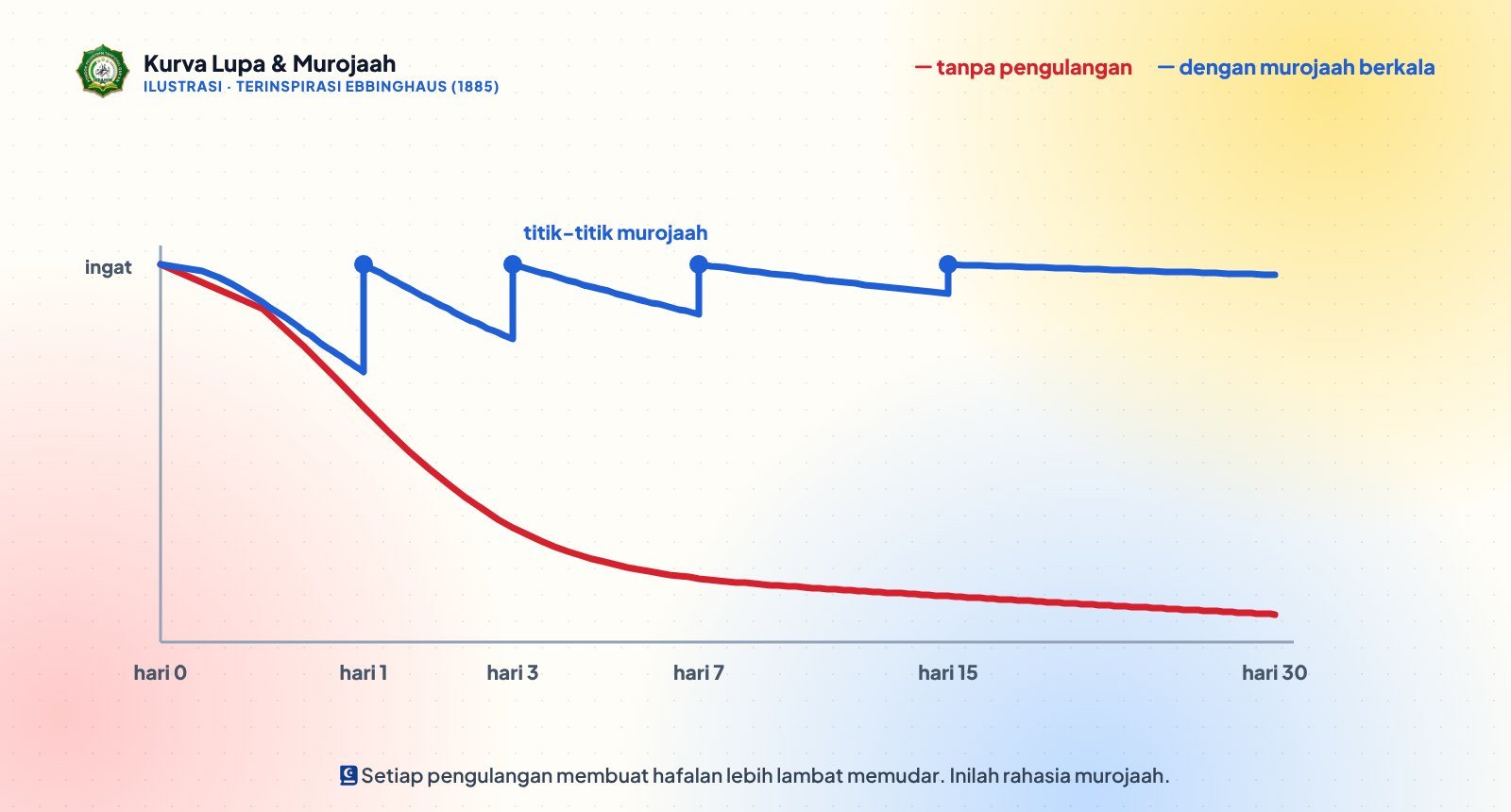
A simple illustration: without review, memorization fades quickly; with regular muraja'ah, it grows firmer.
The tradition of tahfizh pesantren has long practiced this principle through muraja'ah (review). New memorization is repeated the next day, the last few days' memorization is reviewed within the same week, and older memorization is rotated in turn. The scholars of the past did not know the term spaced repetition, but they practiced it with remarkable discipline.
Research on sleep also shows that the brain strengthens new memories while we sleep. That is why we do not encourage students to stay up late chasing targets. Enough sleep at night and waking in the last third of the night or before Fajr is a pattern that follows the Sunnah and is also kind to memory.
There is a deeper lesson here. Memorization that is not looked after will fade, and character that is not cared for can also wear away. Both need attention every day, not just now and then.
Daily Worship as a School of Character
We often see worship only as an obligation. Yet every act of worship is also a very subtle training of character.
Praying the five daily prayers in congregation, for example, trains punctuality and the willingness to follow the imam. In the rows, the son of an official stands shoulder to shoulder with the son of a farmer; there is no special place for the rich or the clever. This lesson in equality is repeated five times a day, without the need for a long sermon.
Voluntary fasting trains the ability to delay one's desires. The Messenger of Allah ﷺ said:
الصِّيَامُ جُنَّةٌ
"Fasting is a shield." (Narrated by al-Bukhari, no. 1894, and Muslim, no. 1151)
A shield against what? The scholars explain: a shield against sin in this world and against the Fire in the Hereafter. A teenager who is used to holding back hunger and thirst for the sake of Allah is learning to control greater urges, including anger and unworthy desires.
Morning and evening remembrance, the etiquette of eating, of sleeping, and of entering the mosque are other small exercises. One by one they look simple. Together they shape a person who is used to remembering Allah in every situation.
Caring for Students' Bodies and Hearts
Character building will not go well if students' bodies and hearts are not cared for. A child who lacks sleep, lacks food, or is carrying sadness alone will struggle to memorize, let alone to grow.
That is why students' basic needs receive attention: regular meals, enough rest, health services at the school clinic (UKS), and mentors they can talk to. We also encourage students to look out for one another and to report it when a friend seems gloomy or unwell. A heart that feels safe grows more easily than a heart that feels alone.
Falling Behind and Falling Down: Learning to Rise
Not every student's journey is smooth. Some fall behind their targets, some break the rules, some at one point want to go home and quit. We want to be honest with you: such things are normal. What matters most is not whether a child has ever fallen, but how he is helped to get up.
The Messenger of Allah ﷺ gave us a deeply strengthening guide:
احْرِصْ عَلَى مَا يَنْفَعُكَ، وَاسْتَعِنْ بِاللَّهِ وَلَا تَعْجَزْ
"Strive for what benefits you, seek help from Allah, and do not give up." (Narrated by Muslim, no. 2664)
And Allah comforts the heart of everyone who is struggling:
فَإِنَّ مَعَ الْعُسْرِ يُسْرًا إِنَّ مَعَ الْعُسْرِ يُسْرًا
"So surely with hardship comes ease. Surely with hardship comes ease." (Qur'an, al-Inshirah 94:5–6)
In our guidance, we try to separate the deed from the child. Mistakes are recorded and followed up, but the child is not labeled a "bad kid." Guidance is given in stages: advice, mentoring, communication with parents, and the opportunity to make things right. Students who fall behind their targets receive extra support and targets adjusted to their ability, without being excessively compared with their friends.
Perhaps this is one of the most important lessons of pesantren life: failure is not the end of the story, but part of the process of becoming strong.
An Example: One Student's Journey
To illustrate how this process unfolds, allow us to tell the story of one student. Let us call him Ahmad Fathan (an illustrative name; the story is simplified from the experiences of several students).
Fathan came to the pesantren after finishing primary school. At home, he was bright but quick-tempered, and used to staying up late playing games. His first month at the pesantren was hard. He was often late to the Fajr circle, called his parents several times asking to come home, and his recitations fell far short of his target.
His mentor did not scold him in front of his friends. He invited Fathan to talk privately, listened to his complaints, and then made a small agreement with him: no staying up past the set time, and for now, only half a page to recite each morning. His parents, after discussing with the mentor, agreed not to promise him a trip home and instead to offer words of encouragement every time they called.
Change did not come overnight. But by the third month, Fathan began waking up before anyone woke him. By the sixth month, he had become one of the most diligent students in review. What moved his parents most was not the amount he had memorized, but that during the holiday he apologized to his younger sibling for the times he used to snap at him.
Stories like this do not always run so smoothly, and every child has his own path. Yet the pattern is often similar: a patient mentor, cooperative parents, and small habits faithfully kept.
Teachers, Mentors, and the Power of Example
In the 1970s, psychologist Albert Bandura introduced the theory that people, especially children, learn a great deal by observing and imitating the behavior of those around them. Parents and teachers have long sensed this: children imitate what we do far more than they listen to what we say.
That is why, in a pesantren, the role of teachers and dormitory mentors does not end in the study circle. The way they speak to students, the way they solve problems, how punctually they come to the mosque: all of it is a lesson. A mentor who arrives early at the mosque teaches discipline more powerfully than a hundred reprimands.
We realize this responsibility is heavy. That is why the mentors themselves are also continually guided: their attendance at every memorization session is recorded, the progress of the students they supervise is monitored, and evaluations are carried out together. A good example does not appear on its own. It too must be cared for and nurtured.
Home Remains the First School
There is a mistaken belief that once a child enters a pesantren, the task of education passes entirely to the school. Yet Allah still entrusts that responsibility to parents:
يَا أَيُّهَا الَّذِينَ آمَنُوا قُوا أَنْفُسَكُمْ وَأَهْلِيكُمْ نَارًا
"O you who believe, protect yourselves and your families from a Fire." (Qur'an, at-Tahrim 66:6)
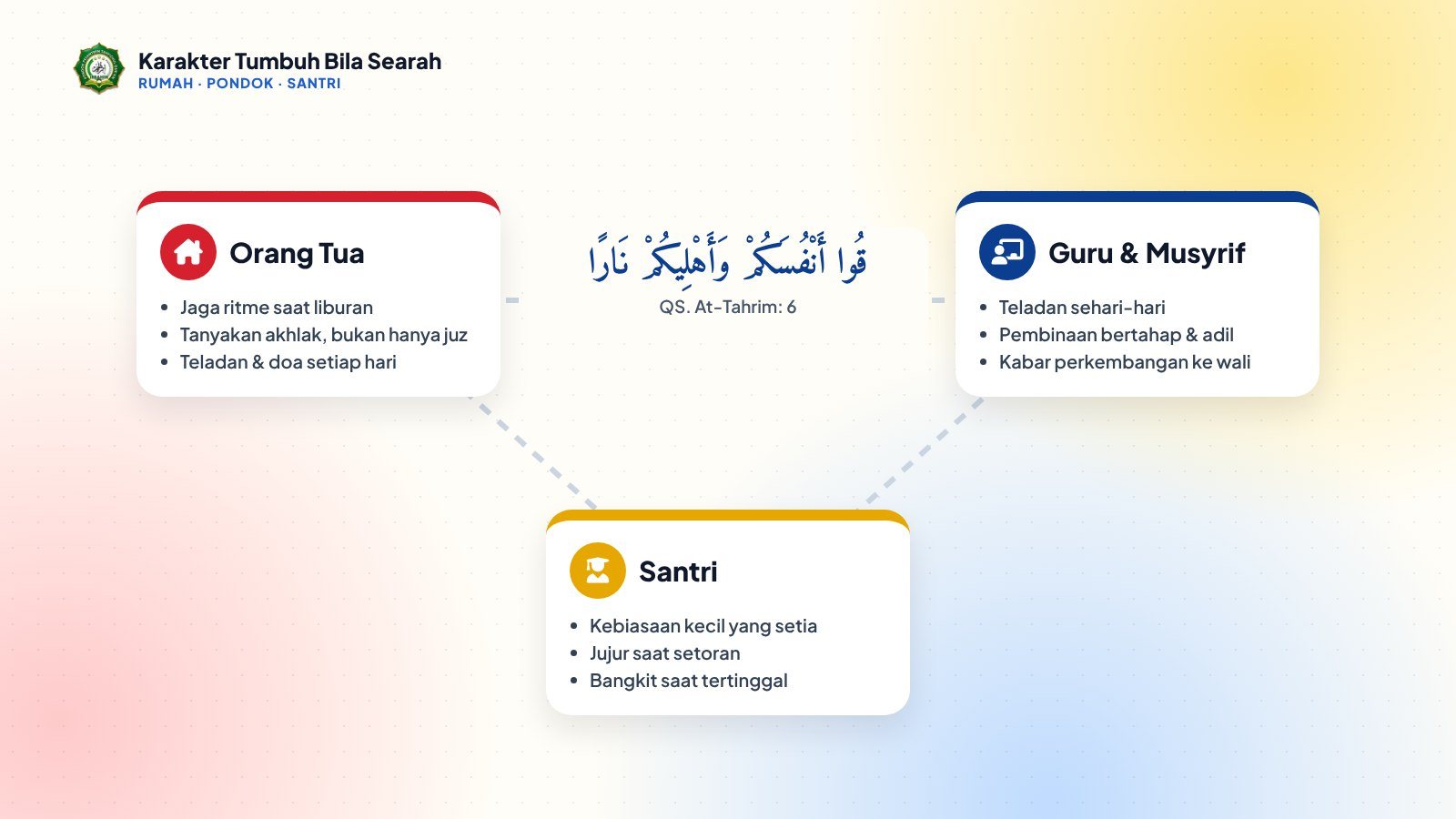
Character grows best when home and pesantren move in the same direction.
Here are a few simple things you can do:
- Keep the rhythm during holidays. Holidays are for rest, but congregational prayer, recitation, and review should continue. Habits built over months can weaken in two weeks if they are abandoned entirely.
- Ask about character, not only memorization. Besides asking "How many juz now?", also ask "Which friend did you help this week?" or "What was hardest for you?" Questions like these show that what you value is your child, not just the numbers.
- Be the example at home. A child who is used to praying on time at the pesantren will be confused if he sees the opposite at home. Consistency between home and pesantren helps a great deal.
- Support disciplinary decisions wisely. If there is a report of a violation, listen to both sides first. Talk calmly with the mentor. Your child needs to see that parents and teachers work together rather than blaming each other.
- Pray for your child every day. A parent's prayer is a strength that is often unseen, yet deeply felt.
A child's education can never be fully handed over. It can only be shared, and that sharing requires trust from both sides.
Bugis Values Meeting Pesantren Values
For the Bugis community in Sidrap and South Sulawesi, many pesantren values actually feel very familiar. Bugis parents have long instilled lempu' (honesty), getteng (steadfastness in principle), ada tongeng (speaking the truth), reso (hard work), and siri', a sense of shame and dignity that keeps a person away from disgraceful acts.
These noble values meet the teachings of Islam and strengthen one another. Honesty in reciting memorization is lempu'. Steadfastness in keeping the study schedule is getteng. Tireless effort to complete 30 juz is reso. The sense of shame at doing wrong, known in Islam as al-haya', is in harmony with the siri' held in high esteem by the ancestors.
That is why a pesantren in South Sulawesi has a special opportunity: to educate children in a language of values they have known since childhood, and then to elevate it with the light of the Qur'an and the Sunnah.
Looking for the Best Tahfidz Pesantren? Look Also at How It Shapes Character
Many parents type "best pesantren" or "best tahfidz pesantren" into a search engine. That is a natural step. However, the measure of "best" is often narrowed down to the number of juz memorized or the grandeur of the buildings. In truth, a good pesantren for your child is one that helps him or her grow into a whole person.
Here are some questions that can help you assess how a pesantren nurtures character:
- How is the students' daily schedule arranged? Is there a balance between memorizing, studying, worship, rest, and exercise?
- Who accompanies students in the dormitory around the clock, and how many students does each mentor look after?
- How does the pesantren handle violations? Are there clear and fair stages of guidance?
- How is the quality of memorization tested? Are competent examiners involved?
- How open is the pesantren to parents? Can a child's progress be followed regularly?
- How does the pesantren care for students' physical and mental health?
- Do the mentors display the character you would like to see in your own child?
A good pesantren does not have to answer all these questions perfectly. But it should be willing to answer them honestly and openly.
A Tahfizh Pesantren in Sidrap, South Sulawesi: Our Efforts at PPTQ Ibrahim
Pondok Pesantren Tahfizhul Qur'an (PPTQ) Ibrahim is run by the Ibrahim La Useng Foundation in Uluale, Watang Pulu District, Sidenreng Rappang Regency (Sidrap), on the Rappang–Parepare road at kilometer 11. For families looking for a pesantren in Sidrap or a pesantren in South Sulawesi not too far from home, it is easily reached from Parepare, Pinrang, Enrekang, Soppeng, Wajo, and the surrounding areas.

We do not wish to call ourselves the best. We would rather you judge for yourself after visiting and asking directly. What we can share are the efforts we are making:
- Tahfizh integrated with madrasah education. Boys and girls follow either the Tahfizh + Madrasah Tsanawiyah (junior high) or the Tahfizh + Madrasah Aliyah (senior high) program, so that memorization goes hand in hand with formal schooling.
- Measurable memorization. New memorization and review are recorded every day in a mutaba'ah log, with targets adjusted to each student's ability. Quality is tested through a tasmi' examination of 10 juz in a single sitting before a Board of Experts.
- Monitored congregational prayer. Students' attendance at the mosque is recorded with QR-coded student cards.
- 24-hour dormitory guidance. Students are accompanied by male and female dormitory mentors, supported by a health clinic (UKS) and a cooperative shop.
- Parents stay connected. Through the SIPANDAI parent portal, parents can follow memorization, discipline, health, leave permissions, and payments from their phones.
- Step-by-step character guidance. Violations are followed up through stages of guidance and communication with parents, not through humiliating punishment.
We also keep learning. Every piece of feedback from parents, whether praise or criticism, we receive as part of our effort to become a better tahfizh pesantren year after year.
Life for Boys and Girls
The boys' and girls' dormitories are separate, each with its own mentors. Students' days are filled with tahfizh circles, madrasah classes, congregational prayer, religious study, sports, and self-development activities. At certain times there are shared activities such as muhadharah (public speaking practice), extracurriculars, and celebrations of Islamic holidays.
We believe students also need to be happy. Laughing with friends, playing on the field, and enjoying meals together are part of a healthy life. A heart at ease receives knowledge more readily than a heart under pressure.
Admission Costs (At the Time of Writing)
Questions about the cost of entering a pesantren come up almost every time. Below is an overview of the costs for the 2027/2028 intake at the time of writing. The latest details can always be found on the new student registration page.
- Registration fee: free.
- Building contribution (infaq): IDR 7,200,000.
- Dormitory fee, mushaf / Qur'anic books (annual): IDR 300,000.
- Three sets of uniforms and attributes: IDR 1,000,000.
- Total initial admission cost: IDR 8,500,000.
- Monthly boarding fee (IBS) for new students: IDR 850,000 per month, including meals.
- Bedding and furniture: bed, mattress, pillow, bolster, sheets, and wardrobe are provided at no extra cost.
- New student bonus: free wash-and-fold laundry up to 150 kg.
The quota for the 2027/2028 intake is 150 students (75 boys and 75 girls). The first registration wave runs from 1 September 2026 to 30 July 2027, and the second wave from 1 to 31 August 2027.
Frequently Asked Questions
My child is quite hard to manage at home. Is a pesantren suitable for him?
Many students known at home as "hard to manage" actually flourish in an orderly environment full of good examples. But a pesantren is not a place to "send problems away." We suggest talking honestly with your child and with the pesantren before registering, so that support can be planned from the start.
How long until changes in a child's character become visible?
Every child is different. Simple habits such as waking early and praying on time usually begin to show within a few months. Deeper changes, such as managing emotions or a sense of responsibility, take longer. Be patient, and notice the small changes.
Will students who memorize slowly feel pressured?
Memorization targets are adjusted to each student's ability. What we emphasize is sincerity and quality, not speed alone. Students who need more time are still accompanied patiently.
How can parents follow their child's character development?
Besides speaking directly with the mentors, parents can follow records of memorization, attendance at congregational prayer, health, and discipline through the SIPANDAI parent portal.
What is the difference between "tahfidz" and "tahfizh"?
Both refer to the same Arabic word, tahfīẓ (تحفيظ), meaning "to have something memorized." The difference lies only in how the letter ẓā' (ظ) is written in Latin script. So "tahfidz pesantren" and "tahfizh pesantren" mean exactly the same thing.
Can students still communicate with their families?
Yes. Communication with family is facilitated according to the pesantren's schedule and rules. In addition, parents can see their child's progress at any time through the parent portal, so they do not have to wait for a phone call to know how their child is doing.
Can prospective students from outside Sidrap apply?
Certainly. The pesantren is open to prospective students from any regency in South Sulawesi, as well as from other provinces. Registration can be done online through the registration page.
Closing: Memorization That Becomes Character
One day, our children may forget the page number on which a certain verse appears. But we hope they never forget how those verses taught them to be patient when tested, honest when no one is watching, and humble when praised.
That is what we truly aspire to: students who have memorized the Qur'an, and at the same time students whose character reflects the Qur'an. The journey is long, and no one can walk it alone. It needs a child who strives, teachers who are sincere, parents who support, and the help of Allah at every step.
If you are looking for a tahfizh pesantren in Sidrap or in South Sulawesi, we would be glad to welcome your visit, questions, or discussion. Please open the registration page or contact the new student admissions committee on WhatsApp at +62 823 4544 9699.
May Allah make our children guardians of the Qur'an, in their hearts and in their character.