

At four in the morning, while most of the village is still asleep, the dormitory lights are already on. A thirteen-year-old student, let us call him Ahmad Fathan, rubs his eyes, performs wudu with cold water, and walks to the mosque holding a small mushaf. Under his breath he repeats the verses he memorized last night, afraid that some might slip away.
Many people admire young memorizers of the Qur'an when they appear at a graduation or recite fluently before guests. Few see the struggle behind the scenes: the sleepiness fought off, the memorization lost and repeated, the longing for mother held back, and the quiet determination. This article invites you to spend one day with a student at a tahfizh (Qur'an memorization) pesantren, and to reflect on the evidence that strengthens their steps.
"Those who strive for Us, We will surely guide them to Our ways." (Qur'an, Al-'Ankabut 29:69)
Striving That Is Promised a Path
The verse we most often read to new students is the word of Allah the Exalted:
وَالَّذِينَ جَاهَدُوا فِينَا لَنَهْدِيَنَّهُمْ سُبُلَنَا وَإِنَّ اللَّهَ لَمَعَ الْمُحْسِنِينَ
"And those who strive for Us, We will surely guide them to Our ways. And indeed, Allah is with the doers of good." (Qur'an, Al-'Ankabut 29:69)
Memorizing the Qur'an is one form of that striving. There is no shortcut, only patient repetition, day after day. And Allah promises guidance to those who strive.
Before Fajr: Beginning the Day With the Qur'an
A tahfizh student's day begins before dawn. On the night before Friday, students rise earlier for tahajjud. Then they pray Fajr in congregation and sit straight down in their halaqah (study circle). The time after Fajr is golden for memorization: the mind is clear and the surroundings are calm.
In the morning halaqah, students recite their new memorization to their ustadz or ustadzah. One by one they come forward and read without looking at the mushaf while the teacher listens carefully. If a vowel is wrong or a verse is skipped, the teacher stops them and asks them to repeat. Sometimes the recitation is accepted. Sometimes the student must return to his place and revise once more.
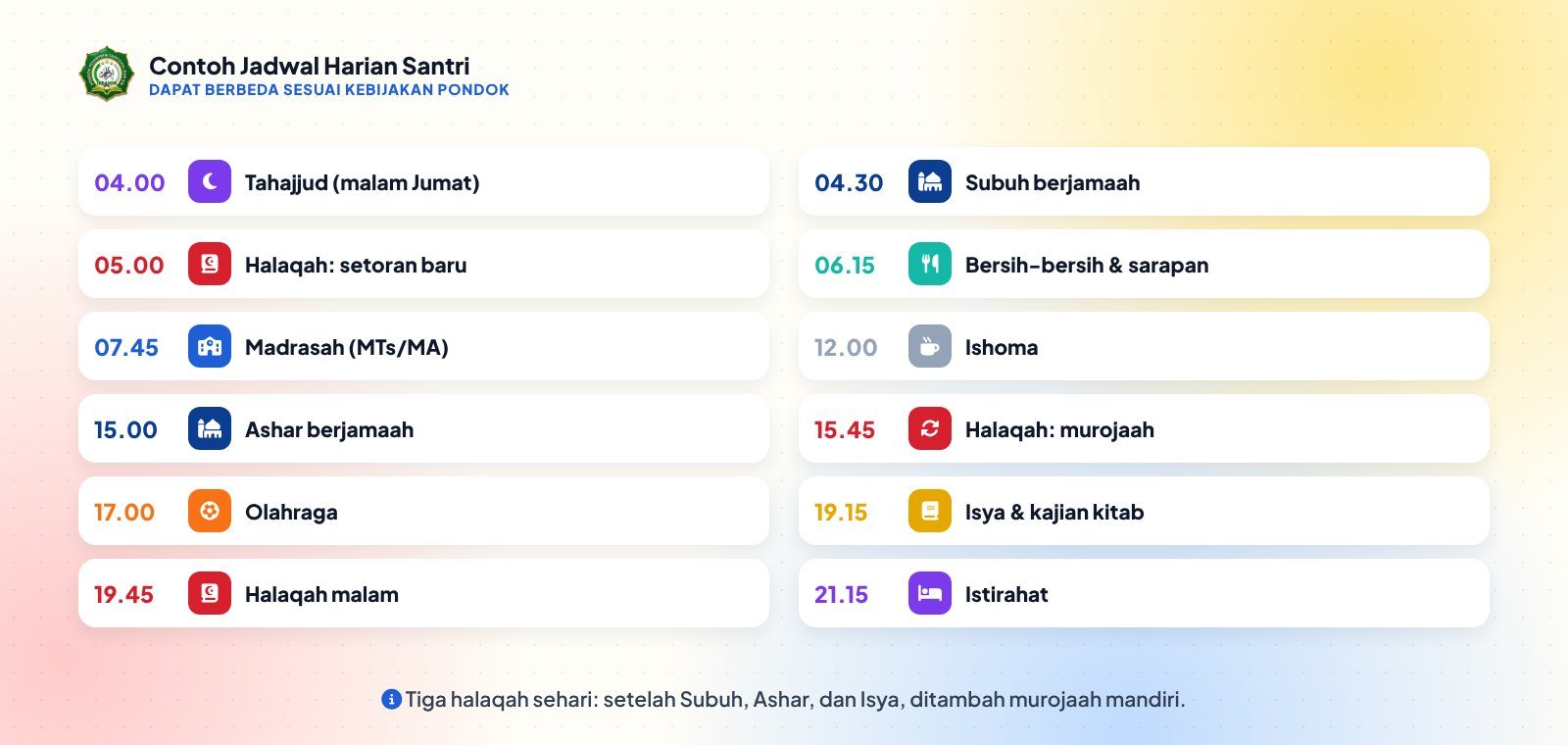
A sample daily schedule (it may differ according to the school's policy).
Morning to Midday: The Madrasah Desk
After tidying their rooms and having breakfast, students get ready for the madrasah. In many tahfizh pesantren that also run formal education, students attend MTs or MA like any other pupils: mathematics, Indonesian, science, English, Arabic, fiqh, and Islamic history.
This is one of the biggest challenges for a tahfizh student: dividing attention between memorization and school lessons. The good news is that many teachers find the habit of memorizing actually trains concentration and memory, so students who are diligent in tahfizh are often diligent in class as well.
Midday to Afternoon: Rest, Prayer, and a Second Halaqah
Midday is for rest, Dhuhr prayer, and lunch. Enough sleep in the afternoon helps the body and mind recover. After praying Asr in congregation, students return to their halaqah. This session is usually for murojaah, revising the past few days' memorization so that it sticks.
Before Maghrib, students exercise and wash. Playing football, running around the field, or simply joking with friends are an important part of pesantren life. Those who memorize the Qur'an are still children who need to move and laugh.
Night: Classical Texts and the Final Halaqah
After Maghrib and Isha in congregation, there is a study of classical texts to instil manners and religious understanding. Then students return to the night halaqah to prepare the new memorization they will recite the next morning. In many pesantren, this is when the hum of Qur'an recitation rises from every corner, like bees busy in their hive.
Shortly after nine at night, the lights go out. Enough sleep is not a luxury. It is part of the effort to preserve memorization, because the brain organizes memories while we sleep.
The Unseen Struggles
Fighting sleepiness
Rising before Fajr every day is not easy, especially for a child used to sleeping late at home. The first weeks are the hardest. Roommates wake one another, the mentor knocks on the door, and slowly the body adjusts.
Memorization that slips away
The Messenger of Allah ﷺ warned that Qur'an memorization easily slips away:
تَعَاهَدُوا هَذَا الْقُرْآنَ، فَوَالَّذِي نَفْسُ مُحَمَّدٍ بِيَدِهِ لَهُوَ أَشَدُّ تَفَلُّتًا مِنَ الْإِبِلِ فِي عُقُلِهَا
"Keep refreshing your knowledge of this Qur'an. By the One in whose hand is the soul of Muhammad, it escapes more readily than camels from their tethers." (Narrated by al-Bukhari and Muslim)
Every memorizer has known the moment when a verse that was fluent yesterday suddenly disappears. That is not failure. It is a sign that memorization must keep being tied down through revision.
Stammering and feeling slow
Some students memorize quickly, others slowly. Some read fluently, others still stumble. To those who feel slow, the Messenger of Allah ﷺ gave glad tidings:
الْمَاهِرُ بِالْقُرْآنِ مَعَ السَّفَرَةِ الْكِرَامِ الْبَرَرَةِ، وَالَّذِي يَقْرَأُ الْقُرْآنَ وَيَتَتَعْتَعُ فِيهِ وَهُوَ عَلَيْهِ شَاقٌّ لَهُ أَجْرَانِ
"The one who is skilled in the Qur'an is with the noble, righteous scribes (the angels). And the one who recites the Qur'an and stumbles over it, finding it difficult, will have two rewards." (Narrated by al-Bukhari and Muslim)
Two rewards: one for the recitation, another for the difficulty and patience. This hadith often brings tears to students' eyes. Not a single drop of sweat in memorizing goes to waste.

Even the difficulty of memorizing is recorded as reward.
Homesickness
On certain nights, especially in the first months, longing for father and mother comes uninvited. Some cry quietly under their blankets. Roommates are usually the first to comfort them, then the mentor who invites them to talk. This longing is natural, and it becomes a lesson in growing up.
Boredom and fatigue
Repeating the same verse dozens of times can feel tedious. Teachers usually encourage students to understand the meaning of what they memorize, listen to their favourite reciter, or recite their memorization in prayer. When a memorized passage is recited while leading the prayer, boredom turns into joy.

Five challenges almost every memorizer faces, and how to get through them.
The Qur'an Kept in the Heart
Allah the Exalted says about the Qur'an:
بَلْ هُوَ آيَاتٌ بَيِّنَاتٌ فِي صُدُورِ الَّذِينَ أُوتُوا الْعِلْمَ
"Rather, it is distinct verses preserved within the breasts of those who have been given knowledge." (Qur'an, Al-'Ankabut 29:49)
This is the honour our students are pursuing: making their hearts a dwelling place for the verses of Allah. An honour that money cannot buy, attainable only through striving and Allah's help.
The Teacher's Role: Listening With the Heart
Behind every successful student is a teacher who listens patiently. A tahfizh teacher may hear dozens of recitations a day, record each student's progress, and notice who is tired or sad. At Pondok Pesantren Tahfizhul Qur'an Ibrahim in Sidrap, these daily notes are entered in the mutaba'ah log, so each student's progress is clear to the mentors and can be followed by parents on their phones.
To test the strength of their memorization, students also sit a tasmi' examination, reciting before an examiner. At a higher level there is an examination of 10 juz in a single sitting heard by the Board of Experts. Such examinations require months of preparation, and passing them becomes an unforgettable memory for the student and the family.
The Parents' Role From Afar
Though they do not meet every day, parents still play a major role:
- Pray every day. Mention your child's name in your prayers after salah. A parent's prayer for a child is answered.
- Use encouraging words. On the phone or during visits, ask how he feels before asking how much he has memorized.
- Do not compare. Each child has his own pace. Compare your child with himself yesterday, not with others.
- Revise together during holidays. When he comes home, set aside time after Fajr or Maghrib for revision together.
- Set an example at home. A child is more motivated when he knows his father and mother read the Qur'an every day too.
Frequently Asked Questions
How many hours a day do tahfizh students memorize?
It depends on the school's schedule. In the sample above there are three halaqah sessions: after Fajr, after Asr, and after Isha, plus independent revision.
Do tahfizh students still attend formal school?
In an integrated tahfizh pesantren, students attend a formal madrasah from morning until midday.
What if my child memorizes slowly?
Speed is not the measure of success. What matters most is consistency, correct recitation, and well-preserved memorization. Discuss realistic targets with the mentor.
Closing
When the dormitory lights go out at night, Ahmad Fathan lies down repeating the last verse he recited. Tomorrow he will wake before Fajr again, repeat again, strive again. There is nothing remarkable about his single day. Yet from thousands of ordinary days like it, guardians of the words of Allah are born.
May Allah strengthen every student who is striving, grant patience to the teachers who listen, and bless the parents who pray from afar. For parents who wish their children to walk the same path, admission information is available on the Admissions page.