

The phone rang one night. On the other end, the voice of a child who had lived at the pesantren for just two weeks trembled: "Mum, I want to come home." The mother fell silent. Her heart wanted to set off at once to fetch him, but her mind reminded her that the decision to send him had been made with prayer and long family discussion.
If you have ever lived through a night like that, know that you are not alone. Almost every new student feels homesick, in boys' and girls' pesantren alike, in Sidrap, across South Sulawesi, and everywhere else. This article will help you understand a new student's adjustment period, what is normal and what needs attention, and how to support your child from afar, equipped with revealed guidance and affection.
"For indeed, with hardship comes ease." (Qur'an, Ash-Sharh 94:5)
Longing Is a Sign of Love, Not of a Wrong Choice
A child who cries to come home does not mean the pesantren is bad or that the child cannot cope. Longing is a sign that he was raised with love. He misses his mother's cooking, joking with his siblings, and his own room. All of this is natural.
What matters is that longing is a feeling one can learn to manage. This is one of the greatest lessons of the pesantren: learning that heavy feelings can be overcome, and that ease always accompanies hardship. Allah the Exalted says:
فَإِنَّ مَعَ الْعُسْرِ يُسْرًا إِنَّ مَعَ الْعُسْرِ يُسْرًا
"For indeed, with hardship comes ease. Indeed, with hardship comes ease." (Qur'an, Ash-Sharh 94:5-6)
Scholars explain that the word al-'usr (hardship) appears in the definite form, so both mentions refer to the same hardship, while yusr (ease) appears in the indefinite form, so it can refer to two different eases. Hence the well-known saying reported from some of the Companions: one hardship will never overcome two eases.
Understanding the Phases of Adjustment
Every child is different, but many dormitory mentors notice a fairly similar pattern among new students. The pattern below is not a fixed rule, only a general picture to keep parents from worrying excessively.
Weeks one to two: the "honeymoon" and the shock
In the first days, many children are actually excited. Everything is new: new friends, a new room, new activities. After a few days, the shock sets in. Waking before Fajr, queuing for the bathroom, different food, and a full schedule leave the body tired.
Weeks two to four: peak homesickness
This is usually the hardest period. Calls full of complaints, requests to come home, or tears are common now. Parents need to be at their strongest precisely at this time.
Months two to three: finding a place
Gradually the child makes close friends, learns the rhythm of activities, and tastes small victories, such as having his first recitation accepted or waking up on his own before Fajr. Complaints fade, replaced by stories about friends and teachers.
After that: growth
Many students who once cried to go home become, a few months later, the senior students comforting the newcomers. They have learned that heavy feelings can be overcome.
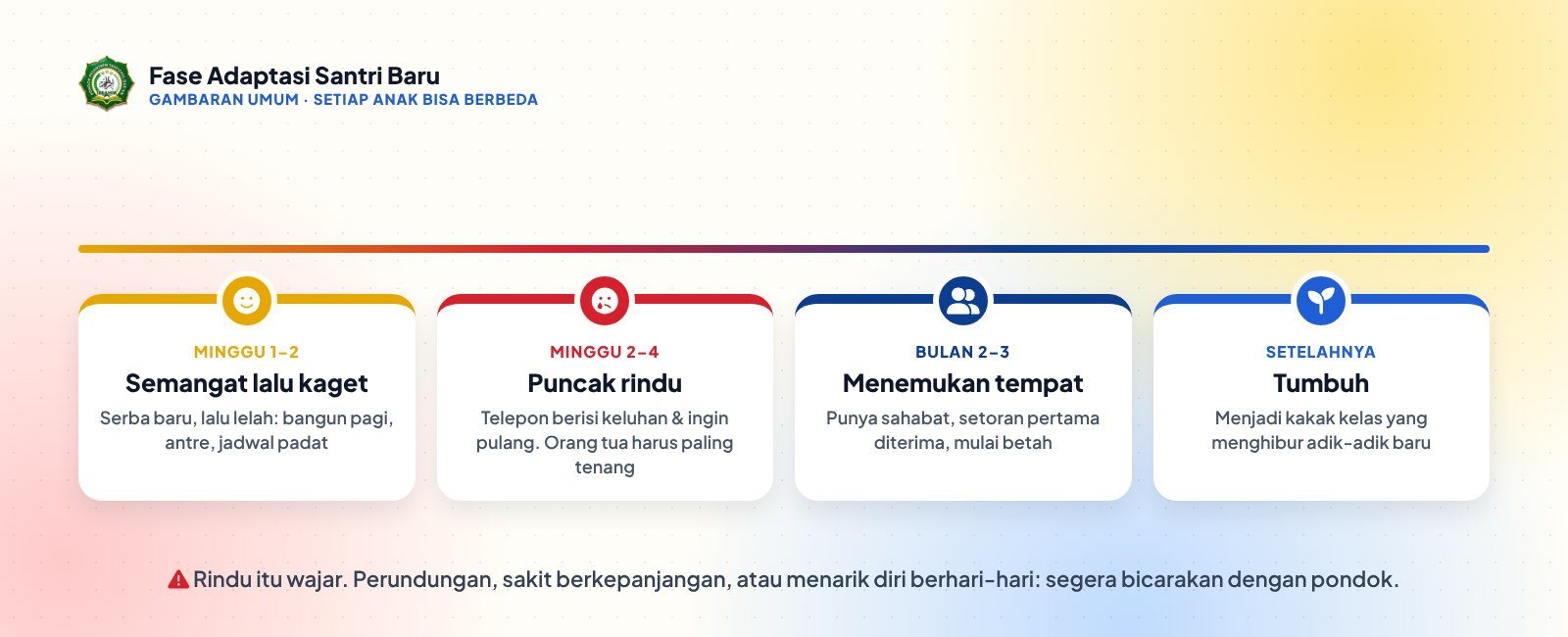
A general picture of a new student's adjustment (each child may differ).
Patience and Prayer: Helpers in Hard Times
Allah the Exalted gives two helpers for every difficulty:
يَا أَيُّهَا الَّذِينَ آمَنُوا اسْتَعِينُوا بِالصَّبْرِ وَالصَّلَاةِ إِنَّ اللَّهَ مَعَ الصَّابِرِينَ
"O you who believe, seek help through patience and prayer. Indeed, Allah is with the patient." (Qur'an, Al-Baqarah 2:153)
Teach your child to pour out his longing to Allah in prostration. Longing expressed in prayer feels lighter, and the child learns that he is never truly alone. Parents can do the same: entrust their longing to Allah in the night prayer.
What Parents Should Do
- Listen first, advise later. When your child complains, let him finish. Say, "I understand, it must be hard." Feelings that are heard settle more quickly.
- Be firm but gentle. Calmly explain that the decision was made out of love, and that you believe he can do it.
- Remind him of his intention. Help him remember why he came: for knowledge, for the Qur'an, to be the pride of his family in this world and the next.
- Build trust with the mentors. Contact the dormitory mentor to ask how your child is really doing. Often a child cries on the phone but is already laughing with friends in the dormitory.
- Send an encouraging letter or voice message. A short message from father or mother can be read again and again when longing strikes.
- Pray for him by name. A parent's prayer for a child is answered.
What Parents Should Avoid
- Promising to pick him up if he keeps crying. Such a promise teaches that tears are a way out of difficulty.
- Crying along on the phone. A child needs calm parents to hold on to.
- Turning up unannounced outside visiting hours. Too many visits in the first month can prolong adjustment.
- Comparing him with other children. "The neighbour's son settled in just fine" does not help. Each child has his own time.
- Ignoring warning signs. Homesickness is normal, but reports of bullying, illness that does not improve, or a child withdrawing for days need to be discussed promptly with the administration.
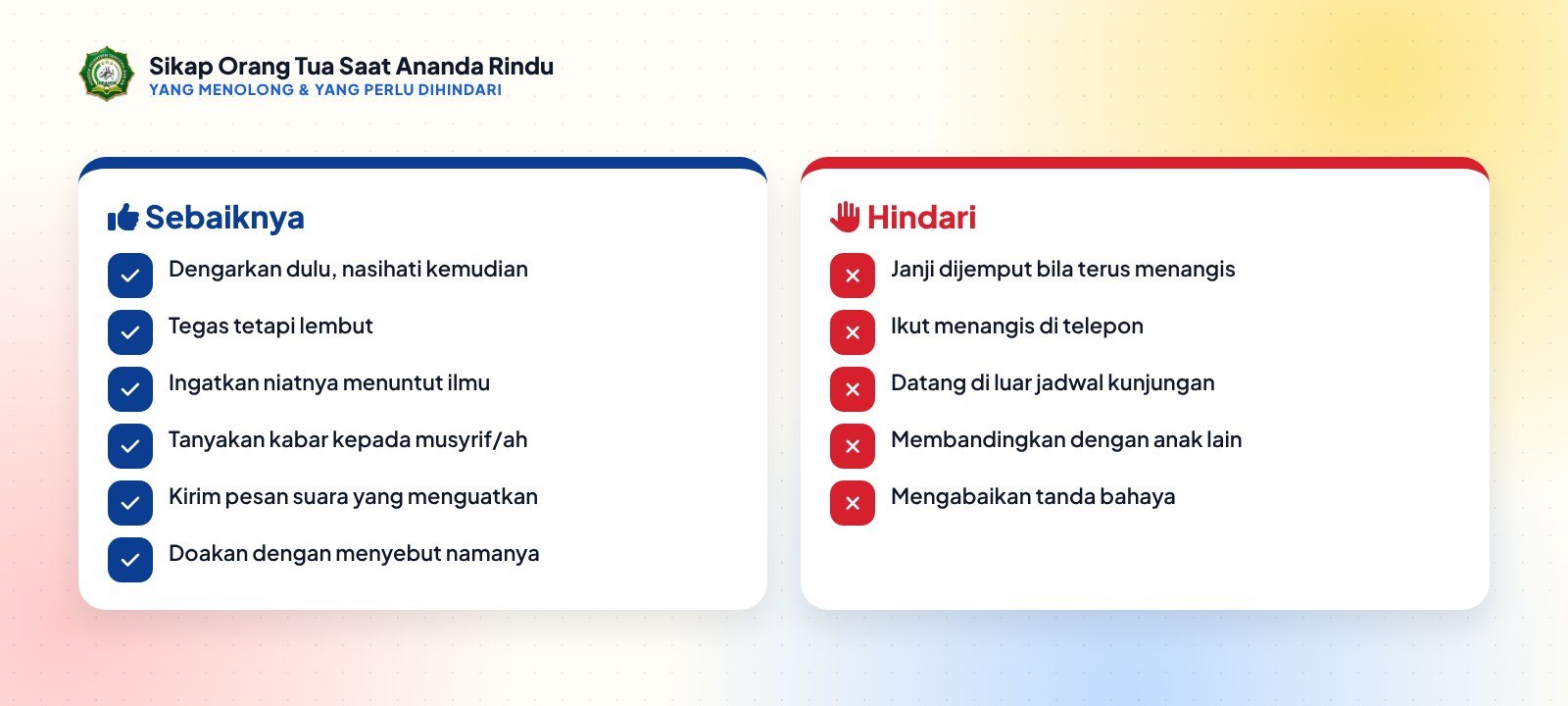
A summary of helpful parental attitudes and those to avoid.
Seeking Knowledge Is a Path to Paradise
When your child feels weighed down, tell him about the honour of the path he is walking. The Messenger of Allah ﷺ said:
وَمَنْ سَلَكَ طَرِيقًا يَلْتَمِسُ فِيهِ عِلْمًا سَهَّلَ اللَّهُ لَهُ بِهِ طَرِيقًا إِلَى الْجَنَّةِ
"Whoever travels a path in search of knowledge, Allah will make easy for him a path to Paradise." (Narrated by Muslim)
Every step he takes to the mosque before Fajr, every verse he recites, every night he holds back his longing, is a step on the path to Paradise. A child who understands the meaning of his struggle becomes stronger in facing it.
Remind him too that Allah does not burden a soul beyond its capacity:
لَا يُكَلِّفُ اللَّهُ نَفْسًا إِلَّا وُسْعَهَا
"Allah does not burden a soul beyond that it can bear." (Qur'an, Al-Baqarah 2:286)
The Parent's Prayer That Is Not Rejected
The Messenger of Allah ﷺ said:
ثَلَاثُ دَعَوَاتٍ مُسْتَجَابَاتٌ لَا شَكَّ فِيهِنَّ: دَعْوَةُ الْمَظْلُومِ، وَدَعْوَةُ الْمُسَافِرِ، وَدَعْوَةُ الْوَالِدِ عَلَى وَلَدِهِ
"Three supplications are answered without doubt: the supplication of the oppressed, the supplication of the traveller, and the supplication of a parent for his child." (Narrated by Abu Dawud, at-Tirmidhi, and Ibn Majah)
Distance does not block prayer. When you cannot hold your child, your prayer is an embrace that reaches him by the help of Allah.
Examples of Encouraging Words
Here are some phrases you might share by phone, letter, or voice message:
- "Son, I am so proud of you. You are doing something not everyone dares to do."
- "Missing home means you love your family. We miss you too, and we entrust that longing to Allah every night."
- "It is fine if you have not memorized much yet. What matters is that you keep trying. Allah sees your effort."
- "Tell me, who is the funniest friend in your room?"
- "Be patient, son. We will see each other soon on visiting day. Dad cannot wait to hear your new memorization."

A simple sentence from a parent can carry a child through difficult nights.
The Pesantren's Role During Adjustment
Parents do not face this period alone. A good pesantren usually has its own way of welcoming new students: mentors who accompany them in the dormitory, senior students who become friends, and gentler guidance in the first weeks. At Pondok Pesantren Tahfizhul Qur'an Ibrahim in Sidrap, for example, boys and girls are cared for by male and female mentors in their respective dormitories, while parents can follow their child's health, prayer attendance, and memorization progress through the SIPANDAI parent portal. That way, parents do not rely only on their child's phone stories to know how he is doing.
Whatever the pesantren, build good communication with the mentors. Close cooperation between home and pondok is the greatest key to a successful adjustment.
Frequently Asked Questions
How long are new students usually homesick?
Every child is different. Many students begin to feel at home after one to three months, especially once they have close friends and are used to the schedule.
Can I call my child every day?
Follow the school's rules on communication. In the early period, very frequent contact can sometimes prolong homesickness. Use information from the mentors and the parent portal to know how your child is doing.
When should parents be concerned?
If your child has an illness that does not improve, reports bullying, refuses to eat, or withdraws for a long time, contact the administration promptly so it can be addressed together.
Closing
That night the mother took a long breath and said softly into the phone, "Son, I miss you too. But I know you are strong. Go and pray first. Tell Allah everything." A few months later, the same child called in a cheerful voice to say that his ustadz had just accepted his new memorization.
May Allah strengthen the hearts of every new student and their parents, and make this longing a witness to their sincerity on the path of knowledge. For parents preparing their children to enter a pesantren, admission information is available on the Admissions page.