One afternoon, a father sat on his porch leafing through several pesantren brochures. His wife brought two glasses of tea and asked quietly, "So, which one is best for our child?" He sighed. Every brochure looked convincing. Every one of them used the words "excellent", "quality", and "the best".
Perhaps you are sitting on that same porch right now: typing "best pesantren" into a search engine, comparing Islamic boarding schools in Sidrap, Parepare, Pinrang, Makassar, and other towns across South Sulawesi, and feeling more confused than when you started. This article will not name any single school as the best. Instead, we would like to help you form the right questions, because the best pesantren for a child is the one that fits his or her needs, character, and aspirations.
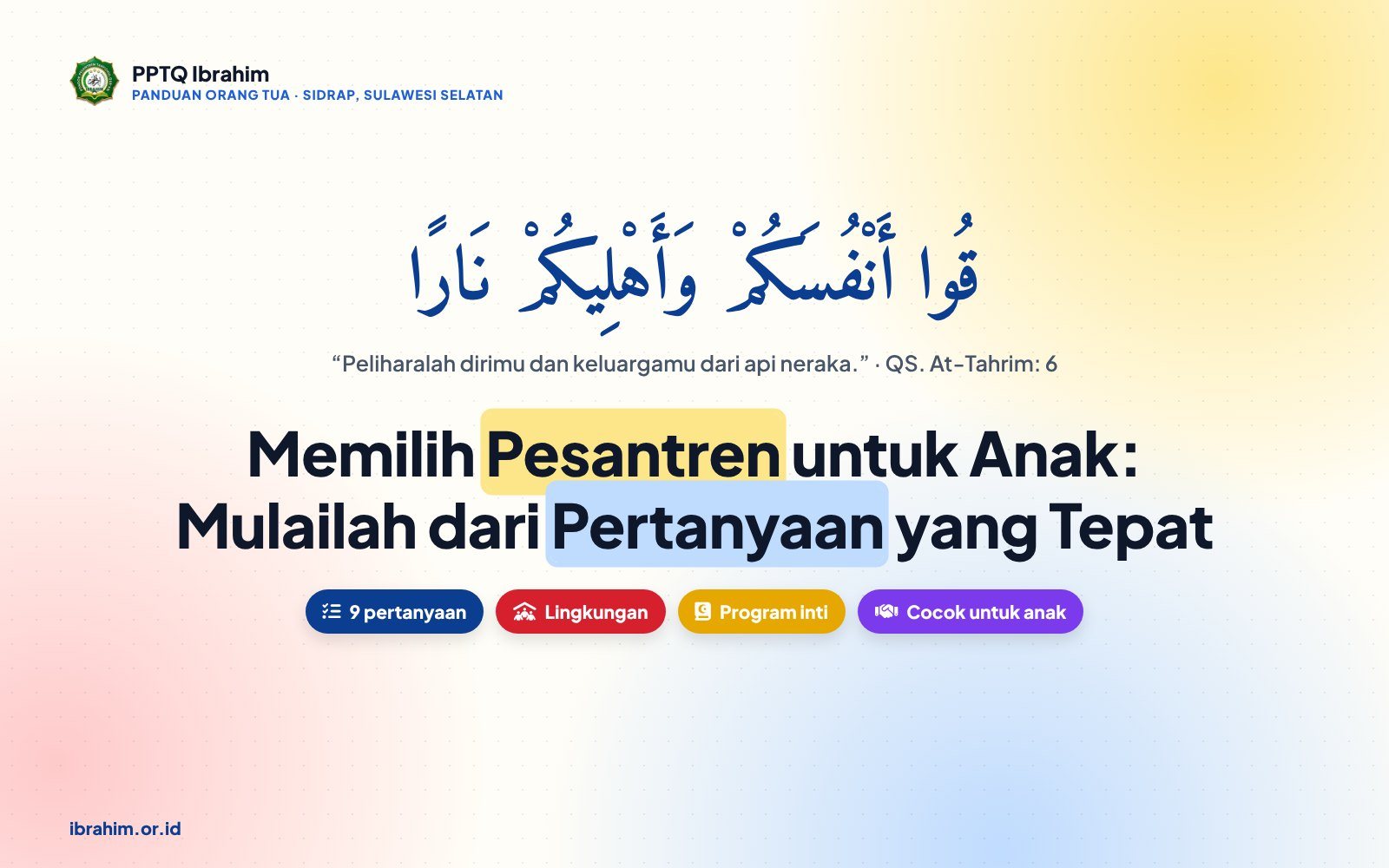
"Protect yourselves and your families from the Fire." (Qur'an, At-Tahrim 66:6)
A Trust That Cannot Simply Be Handed Over
Allah the Exalted says:
يَا أَيُّهَا الَّذِينَ آمَنُوا قُوا أَنْفُسَكُمْ وَأَهْلِيكُمْ نَارًا
"O you who believe, protect yourselves and your families from a Fire." (Qur'an, At-Tahrim 66:6)
The scholars of tafsir explain that protecting one's family from the Fire means teaching them the religion, accustoming them to obedience, and keeping them away from harm. The Messenger of Allah ﷺ also said:
كُلُّكُمْ رَاعٍ وَكُلُّكُمْ مَسْئُولٌ عَنْ رَعِيَّتِهِ
"Each of you is a shepherd, and each of you will be asked about his flock." (Narrated by al-Bukhari and Muslim)
Entrusting a child to a pesantren does not mean giving up responsibility. Parents remain the shepherds of their children. The pesantren is a partner chosen deliberately to help fulfil that trust. That is why choosing a pesantren deserves real care: prayer, istikharah, family discussion, and clear questions.
Environment Shapes a Child More Than Advice Does
A teenager is searching for role models. He imitates the way his friends talk, the way older students dress, and the way his teachers handle problems. The Prophet ﷺ gave a beautiful parable about this:
مَثَلُ الْجَلِيسِ الصَّالِحِ وَالسَّوْءِ كَحَامِلِ الْمِسْكِ وَنَافِخِ الْكِيرِ
"The example of a good companion and a bad companion is like that of a seller of musk and a blacksmith. The seller of musk may give you some, or you may buy from him, or at least you will enjoy a pleasant smell from him. As for the blacksmith, he may burn your clothes, or at least you will smell something unpleasant from him." (Narrated by al-Bukhari and Muslim)
This is the main reason many families choose a pesantren: a 24-hour environment that keeps congregational prayer, Qur'an recitation, respect for teachers, and brotherhood alive. So the first question to ask is not "Which pesantren is the most famous?" but "What kind of environment will accompany my child every single day?"
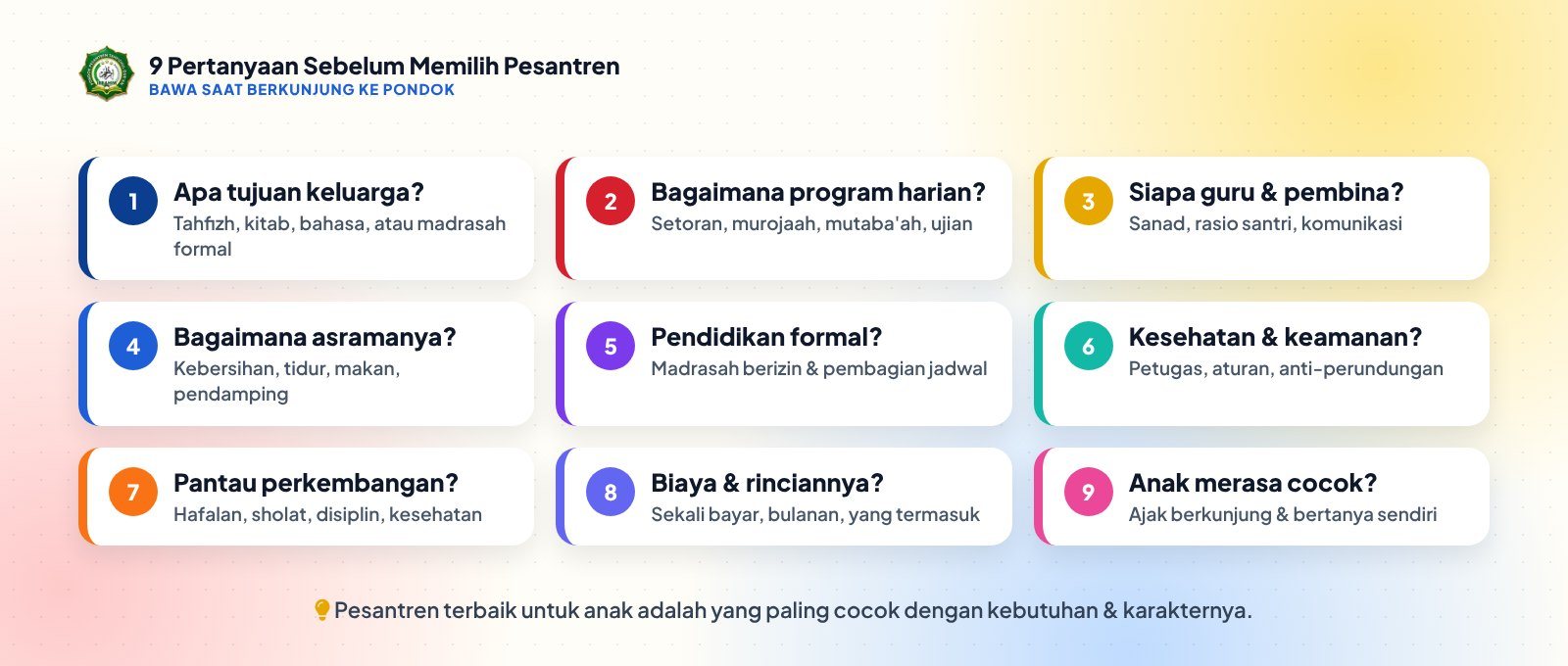
Nine questions you can bring with you when visiting a pesantren.
Looking for the Best Pesantren? Start With These Nine Questions
We compiled the list below from the questions parents ask us most often and from our experience accompanying students year after year. Take it with you when visiting any pesantren, including when you compare boarding schools in Sidrap with those in other regencies of South Sulawesi.
1. What is our main purpose in sending our child to a pesantren?
Some families want their child to memorize the Qur'an. Some want strong Arabic and classical texts. Others want their child to become disciplined and independent while still earning a formal school certificate. All of these goals are good, but each calls for a different kind of pesantren. Write your family's goal in one sentence before you start looking.
2. How is the core program carried out each day?
Brochures list programs, but what matters is how they run. For a tahfizh (Qur'an memorization) pesantren, ask how many times a day students recite new memorization, who listens to them, how revision is organized, and how memorization is tested. A serious tahfidz school usually keeps daily records (mutaba'ah), sets realistic targets, and holds examinations heard by competent examiners.
3. Who are the teachers and mentors?
Ask to meet the teachers, the dormitory mentors, and the head of the school. Ask about their chain of transmission (sanad) or educational background, how many students each teacher supervises, and how mentors communicate with parents. A good teacher is not only skilled at teaching but also patient and a living example.
4. What is dormitory life like?
Look at the bedrooms, bathrooms, kitchen, and laundry area. The cleanliness and order of a dormitory reflect the seriousness of those who run it. Ask about bedtime, the menu, and who stays with the students at night. A child who sleeps enough and eats well learns and memorizes more easily.
5. What about formal education?
Many parents want their children to receive an official certificate. Ask whether the pesantren runs a registered madrasah or school, how the timetable is divided between school and memorization, and whether the two support each other or compete for time.
6. How does the pesantren look after students' health and safety?
Ask about health staff, what happens when a child falls ill, pick-up rules, and how the school deals with bullying. A good pesantren does not hide problems. It has clear rules and is willing to explain them to parents.
7. How can parents follow their child's progress?
Today, communication need not wait for visiting days. Ask whether parents can regularly see memorization progress, prayer attendance, discipline, health records, and payments. Open information helps parents pray for and support their child in the right way.
8. How much will it cost, and what is included?
Admission fees and monthly fees vary widely. Ask for written details: what the monthly fee covers (meals, laundry, bedding), which costs are paid once, and which may arise during the year. Clear costs from the start protect the good relationship between family and school.
9. Does our child feel that it is the right place?
This last question is often forgotten. Bring your child along, let him or her see the atmosphere, meet future friends, and ask questions personally. A child who feels involved in the decision is usually better prepared for the adjustment period.
The Right Fit Matters More Than "the Most Famous"
A large pesantren with thousands of students may be excellent for an independent, active child. A smaller one with close mentoring may suit a child who needs more attention. A modern pesantren with strong foreign-language programs suits a child who dreams of studying abroad. A tahfizh pesantren suits a child who longs to be close to the Qur'an.
The Messenger of Allah ﷺ said:
الْمَرْءُ عَلَى دِينِ خَلِيلِهِ فَلْيَنْظُرْ أَحَدُكُمْ مَنْ يُخَالِلُ
"A person follows the religion of his close friend, so let each of you look carefully at whom he befriends." (Narrated by Abu Dawud and at-Tirmidhi, graded hasan)
This hadith reminds us that the quality of companionship matters more than grand buildings. A simple pesantren whose students pray diligently, help one another, and honour their teachers often leaves a deeper mark on a child's life than luxurious facilities.
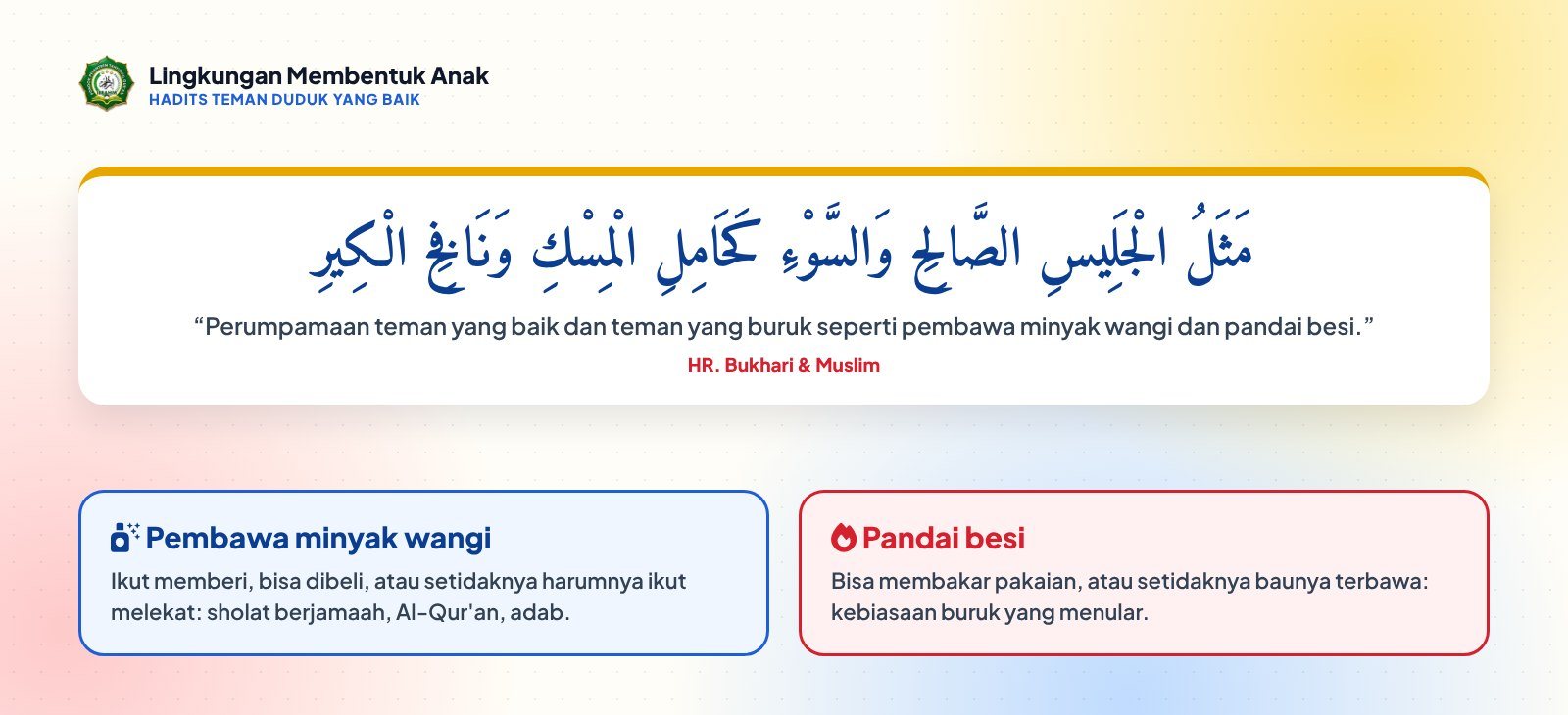
A good environment is like musk: its fragrance stays with you.
When You Visit, Notice the Small Things
A visit answers many questions that brochures never mention. Here are some small things worth noticing:
- Prayer times. Arrive shortly before Dhuhr or Asr. See whether students hurry to the mosque and whether the mentors pray with them.
- How students greet guests. Their salam, smiles, and courtesy show the manners they are trained in.
- The sound of the Qur'an. In a tahfizh pesantren, revision can usually be heard in many corners, not only in the classroom.
- Notice boards. A tidy daily schedule, cleaning rota, and announcements show orderly management.
- The answers you receive. Good administrators answer honestly, including about weaknesses and things they are still improving.
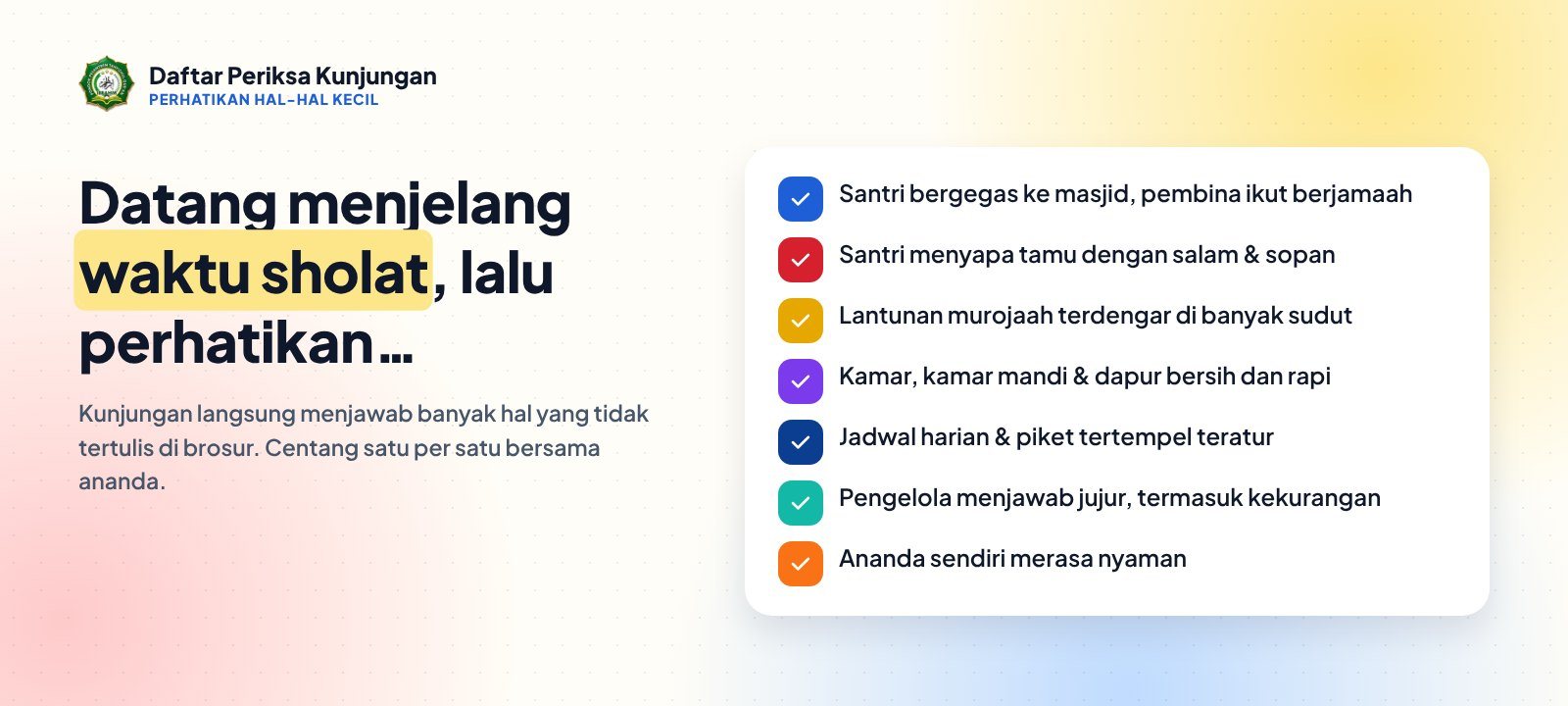
A simple checklist to take with you on your visit.
Pesantren in Sidrap and South Sulawesi: Close to Home, Close to Culture
South Sulawesi has a long tradition of religious education. For generations, Bugis and Makassar families have entrusted their children to the anregurutta, the respected teachers, to study the religion. Today the choice of pesantren in South Sulawesi is very broad: traditional (salaf) schools, modern pesantren, and tahfizh schools that combine Qur'an memorization with a formal madrasah.
For families in Sidrap and the surrounding regencies, choosing a pesantren not too far from home has several advantages. Parents can visit more easily, travel costs are lower, and the child does not have to adjust to an entirely new culture. Yet distance is not the only measure. The questions above still need answers, however near or far the pesantren may be.
An Example: How We Answer Those Questions
So that the list does not feel abstract, here is an example of how one pesantren answers it. At Pondok Pesantren Tahfizhul Qur'an Ibrahim in Uluale, Watang Pulu District, Sidrap:
- Core program: tahfizh with daily mutaba'ah records and memorization targets, plus a tasmi' examination of 10 juz in a single sitting heard by the Board of Experts.
- Formal education: students attend MTs Ibrahim or MA Ibrahim within the same foundation.
- Dormitory life: boys and girls live in separate dormitories under the care of male and female mentors, with bedding provided.
- Congregational prayer: attendance at the mosque is recorded with QR student cards.
- Communication with parents: parents can follow memorization, discipline, health, and payments through the SIPANDAI parent portal on their phones.
This example is not meant to claim that one pesantren is better than another. We simply want to show that every question can, and should, be answered concretely. Whichever pesantren you visit, ask for answers this concrete.
A Parent's Role Does Not End at the School Gate
Once your child is officially a student, your role enters a new chapter. Pray for your child every day, for a parent's prayer for a child is among the prayers that are answered. Stay in touch with the mentors. Respect the school's rules, including those on visits and devices, so your child sees that father and mother stand together with the teachers.
When your child complains, listen first before drawing conclusions. Many complaints in the first months are simply part of growing up. If there is a serious problem, raise it kindly with the administration. A good pesantren welcomes parents' input as part of the partnership.
Frequently Asked Questions
Is there an official list of the best pesantren in South Sulawesi?
The Ministry of Religious Affairs records pesantren holding an operating licence, and this is worth checking. However, "the best" still depends on each child's needs. Make sure the pesantren is licensed, then measure the fit using the nine questions above.
At what age should a child enter a pesantren?
Many families choose the end of primary school to enter MTs (junior secondary), or the end of junior secondary to enter MA (senior secondary). More important than age is readiness: being able to take care of oneself, being willing to live apart from family for a while, and having personal motivation.
What if my child cannot yet read the Qur'an fluently?
Ask whether the pesantren offers a preparatory or tahsin (recitation improvement) class. Many who memorize the Qur'an began with hesitant reading. What matters most is sincerity and patient guidance.
Tahfidz or tahfizh: which spelling is correct?
Both refer to the same thing, memorizing the Qur'an. "Tahfizh" is closer to the Arabic letter ظ, while "tahfidz" is more common in everyday use.
Closing: Ask Clearly, Choose With Prayer
No pesantren is perfect, just as no parent is perfect. There are pesantren that work earnestly and parents who keep learning. May these nine questions help you choose with a calm heart, and may Allah ease every step our sons and daughters take towards beneficial knowledge.
If you would like to see for yourself how these questions are answered in practice, you are welcome to visit or to read our admission information on the Admissions page. We will gladly answer every question, even the hardest ones.