"How can we at home help look after our child while they are memorizing the Qur'an at the pesantren?" Many parents ask us this question. Some ask it on the day they first drop their child off, some send it by WhatsApp late at night, and some say it with tears in their eyes on pick-up day. There is never just one answer. But one of them is simple: keep up acts of worship at home, pray for your child every day, and create the same atmosphere at home that your child lives in at the pesantren.
That is why Pondok Pesantren Tahfizhul Qur'an (PPTQ) Ibrahim, a Qur'an memorization boarding school for boys and girls in Uluale, Watang Pulu, Sidenreng Rappang Regency (Sidrap), South Sulawesi, Indonesia, keeps developing SIPANDAI, its information system for monitoring student data and activities. After introducing Islamic Radio, prayer time reminders, and morning and evening adhkar, SIPANDAI now has four new features: Du'a for Your Child, Hijri Calendar & Sunnah Fasting, Qibla Direction & Nearby Mosques, and the Online Library. The PDF converter and photo editor are now also available to every teacher, supervisor, and staff member.
This article explains each of these features in detail, in plain language and with pictures, so that parents, teachers, and anyone looking for a Qur'an memorization school for their children can easily understand them.
New worship and reading features in SIPANDAI, the information system of PPTQ Ibrahim Sidrap.
Eight Worship and Reading Features in One App
To make them easy to remember, here are all the worship and reading features now available in SIPANDAI. The first four are new, and the other four were introduced earlier and have now been improved.
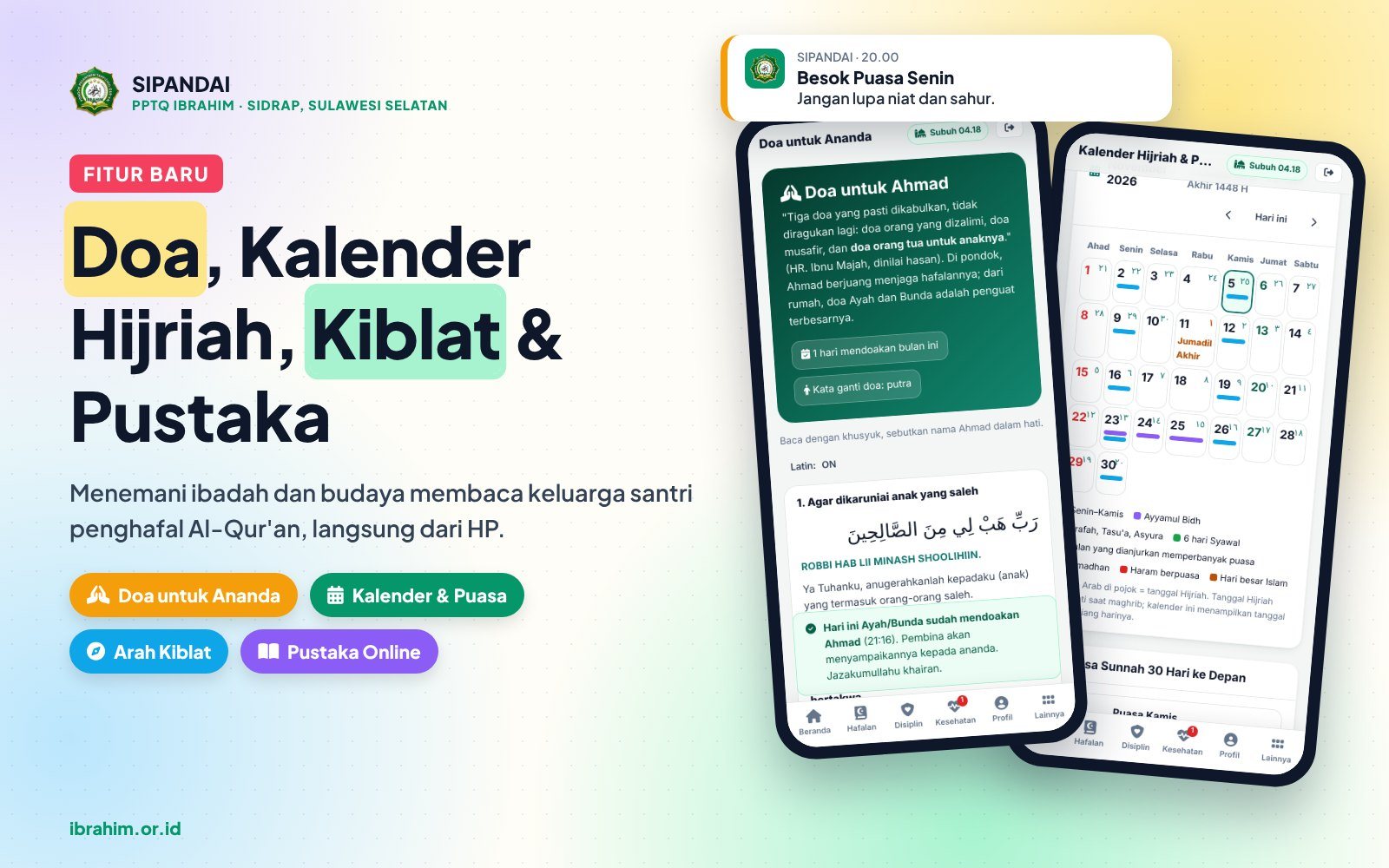
- Du'a for Your Child: a collection of parents' supplications for their children from the Qur'an and authentic hadith, with a daily reminder. When parents finish praying, the news reaches their child through his or her supervisor.
- Hijri Calendar & Sunnah Fasting: Hijri dates calculated using the criteria of Indonesia's Ministry of Religious Affairs, markers for sunnah fasts and Islamic holidays, and fasting reminders on your phone.
- Qibla Direction & Nearby Mosques: a qibla compass, a qibla line on the map, the "rashdul kiblat" schedule, and a list of mosques near you.
- Online Library: free and legal Islamic e-books you can read right on your phone, plus other free reading sources, including self-development books.
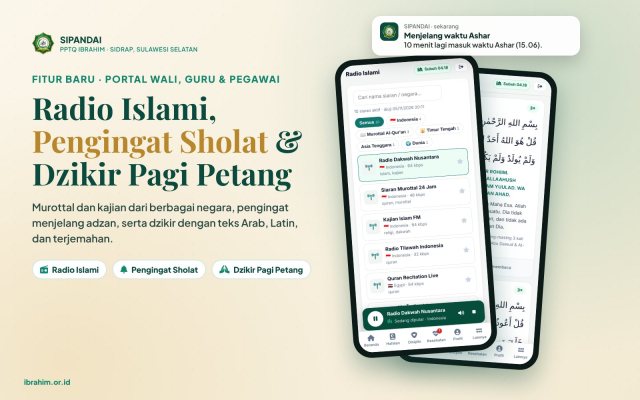
- Islamic Radio: Qur'an recitation, lectures, and da'wah broadcasts from Indonesia and many other countries, showing only stations that actually work.
- Prayer Time Reminders: the next prayer time, a notice before the adhan, a soft chime, and phone notifications.
- Morning & Evening Adhkar: Arabic text, transliteration (which you can hide), translation, and a tap counter.
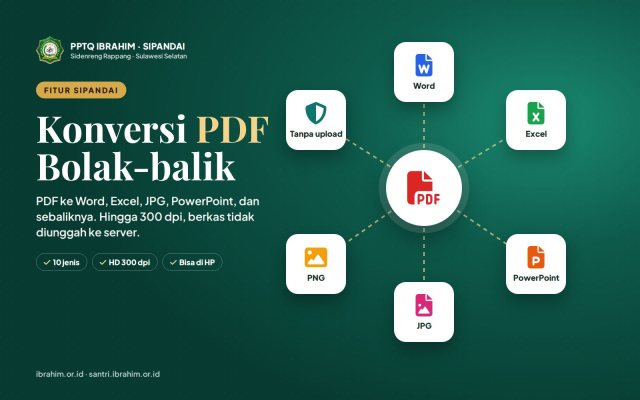
- PDF Converter & Photo Editor: now available to every teacher, supervisor, and staff account, not just some of them.
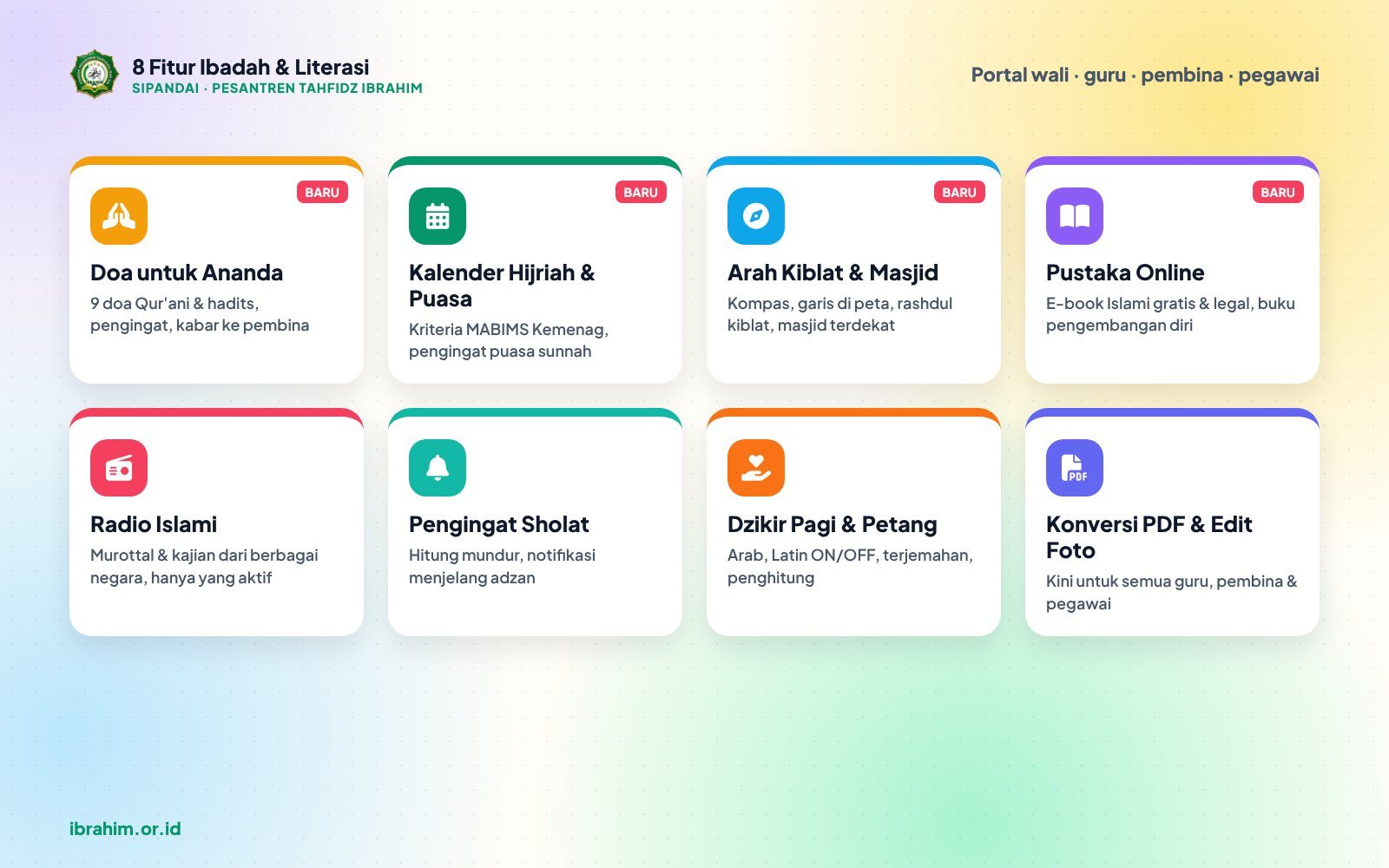
SIPANDAI's eight worship and reading features at a glance.
Why Would a Pesantren Build Worship Features for Parents?
Some may ask why a school information system should concern itself with the worship of parents. Isn't the school's job to educate its students?
Our experience shows that the success of a student memorizing the Qur'an is not decided only by what happens inside the pesantren. Strong memorization grows in an environment that loves the Qur'an. At the pesantren, that environment is maintained by halaqah schedules, congregational prayer, and the example set by the supervisors. But when a child goes home for the holidays, that environment is entirely in the family's hands. If parents at home pray on time, recite their adhkar, pray for their children, and love reading, the holidays stop being a time when memorization slips and become a continuation of what the child learns at the pesantren.
There is also a very human reason. Parents of boarding students miss their children. That longing needs to be turned into something beneficial. Supplication is one of the strongest forms of love, and the Prophet ﷺ described a parent's du'a for their child as one that is answered. We created these features so that longing can become a good deed.
Finally, we know that phones are almost always in our hands. Rather than letting them be a source of distraction, we want parents' and teachers' phones to remind them of good things too. Since parents already open SIPANDAI regularly to see news about their children, placing worship features in the same app felt the most natural.
New Feature 1: Du'a for Your Child
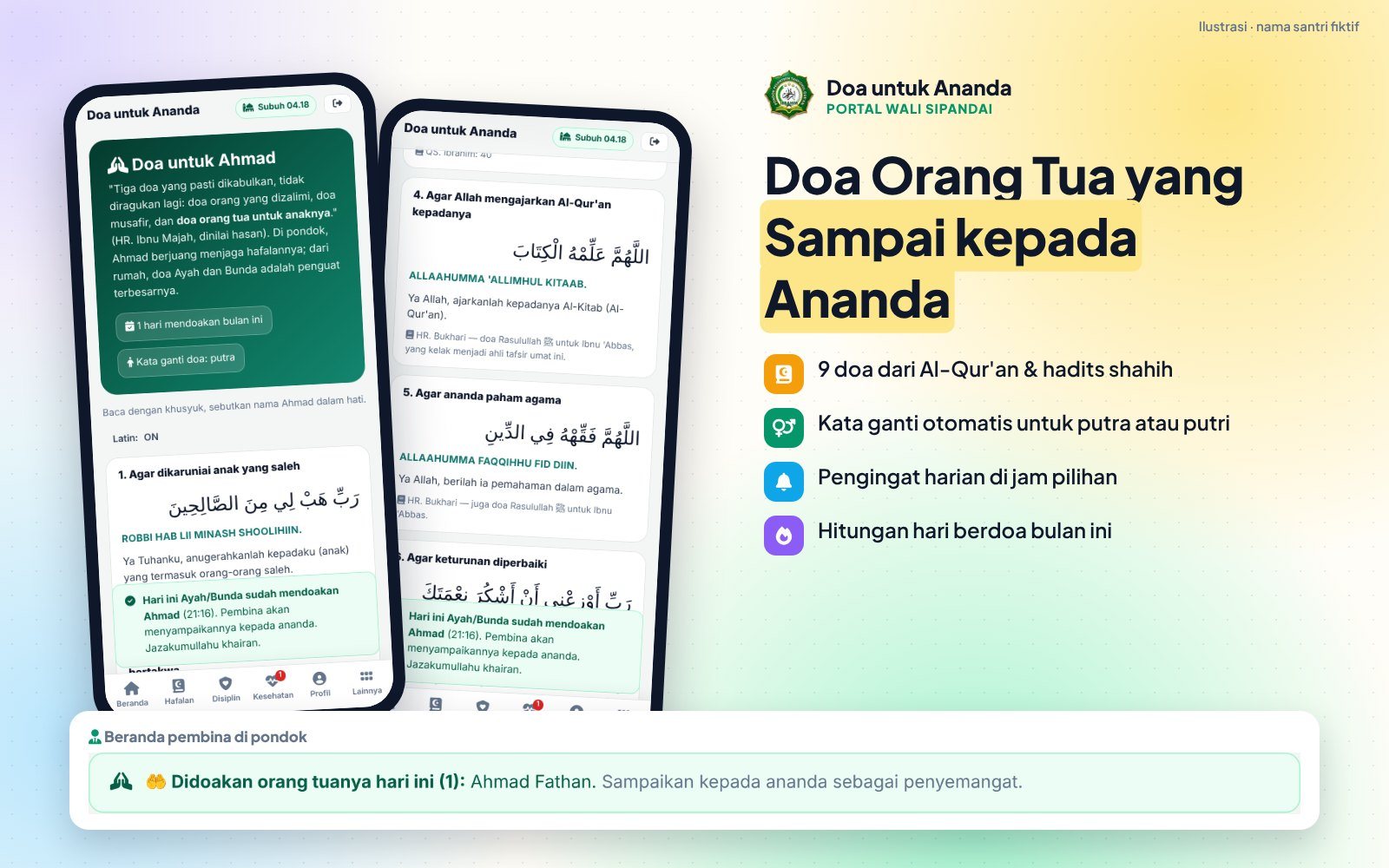
Du'a for Your Child on a parent's phone, and the news that reaches the student's supervisor.
The feature we most hope will touch hearts is Du'a for Your Child. The page opens with a hadith: "Three supplications are answered without doubt: the supplication of the oppressed, the supplication of the traveler, and the supplication of a parent for their child" (Ibn Majah, graded hasan). Below it, your child's name appears, so you feel that these prayers truly are for your own child.
Nine Selected Supplications from the Qur'an and Hadith
The page contains nine supplications of parents for their children, all from the Qur'an or authentic hadith:
- Prophet Ibrahim's du'a for a righteous child: "Rabbi hab lī minaṣ-ṣāliḥīn" (Qur'an, As-Saffat 37:100).
- A du'a that our families be the comfort of our eyes: "Rabbanā hab lanā min azwājinā wa dzurriyyātinā qurrata a'yun…" (Al-Furqan 25:74).
- A du'a that our descendants establish prayer: "Rabbij'alnī muqīmaṣ-ṣalāti wa min dzurriyyatī…" (Ibrahim 14:40).
- A du'a that Allah teach them the Book: "Allāhumma 'allimhul-kitāb", the Prophet's ﷺ du'a for Ibn 'Abbas (Bukhari), the companion who later became known as the great interpreter of the Qur'an.
- A du'a for understanding of the religion: "Allāhumma faqqihhu fid-dīn", also the Prophet's ﷺ du'a for Ibn 'Abbas (Bukhari).
- A du'a for righteous offspring: "Rabbi auzi'nī an asykura ni'matak… wa aṣliḥ lī fī dzurriyyatī…" (Al-Ahqaf 46:15).
- Prophet Zakariya's du'a for good offspring: "Rabbi hab lī min ladunka dzurriyyatan ṭayyibah…" (Al 'Imran 3:38).
- A du'a that we and our descendants submit to Allah: "Rabbanā waj'alnā muslimaini laka wa min dzurriyyatinā ummatan muslimatan lak…" (Al-Baqarah 2:128).
- A du'a of protection for a child: "U'īdzuka bikalimātillāhit-tāmmah…", which the Prophet ﷺ recited over Al-Hasan and Al-Husain (Bukhari).
Each supplication is shown in fully vowelled Arabic, in capitalized transliteration that you can switch off, in an Indonesian translation, and with its source.
The Story Behind a Du'a: Ibn 'Abbas, the Child Who Was Prayed For
Two supplications on this list, "Allāhumma 'allimhul-kitāb" and "Allāhumma faqqihhu fid-dīn", were said by the Prophet ﷺ for a child: 'Abdullah ibn 'Abbas, his cousin. One day, the young Ibn 'Abbas prepared water for the Prophet's ﷺ ablution without being asked. The Prophet asked who had prepared it. When he was told, he prayed that Ibn 'Abbas be given understanding of the religion.
Allah answered that prayer. Ibn 'Abbas grew up to be one of the greatest scholars among the companions. He was called Turjuman al-Qur'an, the interpreter of the Qur'an, and Hibr al-Ummah, the scholar of this nation. Even senior companions asked him about the meaning of Qur'anic verses, although he was much younger than they were.
This story holds two lessons for the parents of our students. First, praying for your child is an investment whose returns can go far beyond what we hope for. Second, a child who shows good manners and earnestness deserves prayers and recognition. When your child at the pesantren works hard to keep his or her memorization and manners, your du'a is the best reward for that effort.
Pronouns That Match a Son or a Daughter
There is one small detail we took very seriously. In Arabic, the pronouns for a boy and a girl are different. "Teach him" is 'allimhu, while "teach her" is 'allimhā. In the same way, "I seek protection for you" is u'īdzuka for a boy and u'īdzuki for a girl.
SIPANDAI adjusts these pronouns automatically based on the student's data. Parents of a daughter see the supplications with feminine pronouns, in both the Arabic text and the transliteration. This way, parents who are not yet fluent in Arabic can still pray with the correct wording.
A Daily Reminder and an "I Have Prayed" Button
Parents can choose a reminder time, for example after Fajr, after Maghrib, or before going to sleep. At that time, SIPANDAI shows a gentle notice: "Have you prayed for your child today?"
After praying, parents can tap the button "I have prayed for [child's name] today". The page then shows how many days this month they have prayed for their child, and for how many days in a row. This is not a competition. It is simply there to help us stay consistent.
A Du'a That Reaches Your Child
This is the most special part. When parents tap the button, the halaqah supervisor of their child at the pesantren sees a notice on his or her SIPANDAI dashboard: "🤲 Prayed for by their parents today: …", followed by the names of the students in their care whose parents prayed for them that day.
The supervisor can then pass this on to the student, for example after the halaqah: "Ahmad, your father and mother prayed for you this morning." For a student far from home who is struggling to keep up their memorization, this simple sentence can be a remarkable source of encouragement. Students do not hold phones in the dormitory, so the news reaches them through the person closest to them at the pesantren: their supervisor.
The Etiquette of Praying for Your Child
Supplication is not just reciting words. Scholars describe several points of etiquette that make a du'a more likely to be answered, and all of them can be practiced by parents at home:
- Begin by praising Allah and sending blessings upon the Prophet ﷺ. The Prophet ﷺ once heard a man supplicate without praising Allah or sending blessings upon him, and said that the man had been hasty (Tirmidhi).
- Be certain that it will be answered. Pray with a present heart, full of hope, not merely out of habit.
- Choose the times when du'a is answered. These include the last third of the night, between the adhan and the iqamah, while in prostration, while fasting, and when breaking the fast. That is why the du'a reminder in SIPANDAI can be set to these times.
- Mention your child's name. Saying your child's name in your du'a helps you focus and feel close to them, even though they are far away at the pesantren.
- Never pray for harm. The Prophet ﷺ forbade parents from praying against their children, because it might coincide with a moment when prayers are answered (Muslim). Even when you are upset, replace angry words with a prayer for good.
- Be consistent. A short du'a made regularly is better than a long one made only once in a while. The day count on the Du'a for Your Child page helps keep this habit.
How to Use Du'a for Your Child
- On the parents' portal home page, tap the Du'a for Your Child icon.
- Scroll through and read the supplications. Turn off the transliteration if you already read Arabic well, for a cleaner view.
- When you have finished, tap "I have prayed for … today". This is recorded once a day.
- In the settings section, choose a reminder time and tap Allow notifications so the reminder appears on your phone.
- If you have more than one child at the pesantren, sign in with each child's parent account, so that every supervisor receives the news for the students in their care.
New Feature 2: Hijri Calendar & Sunnah Fasting
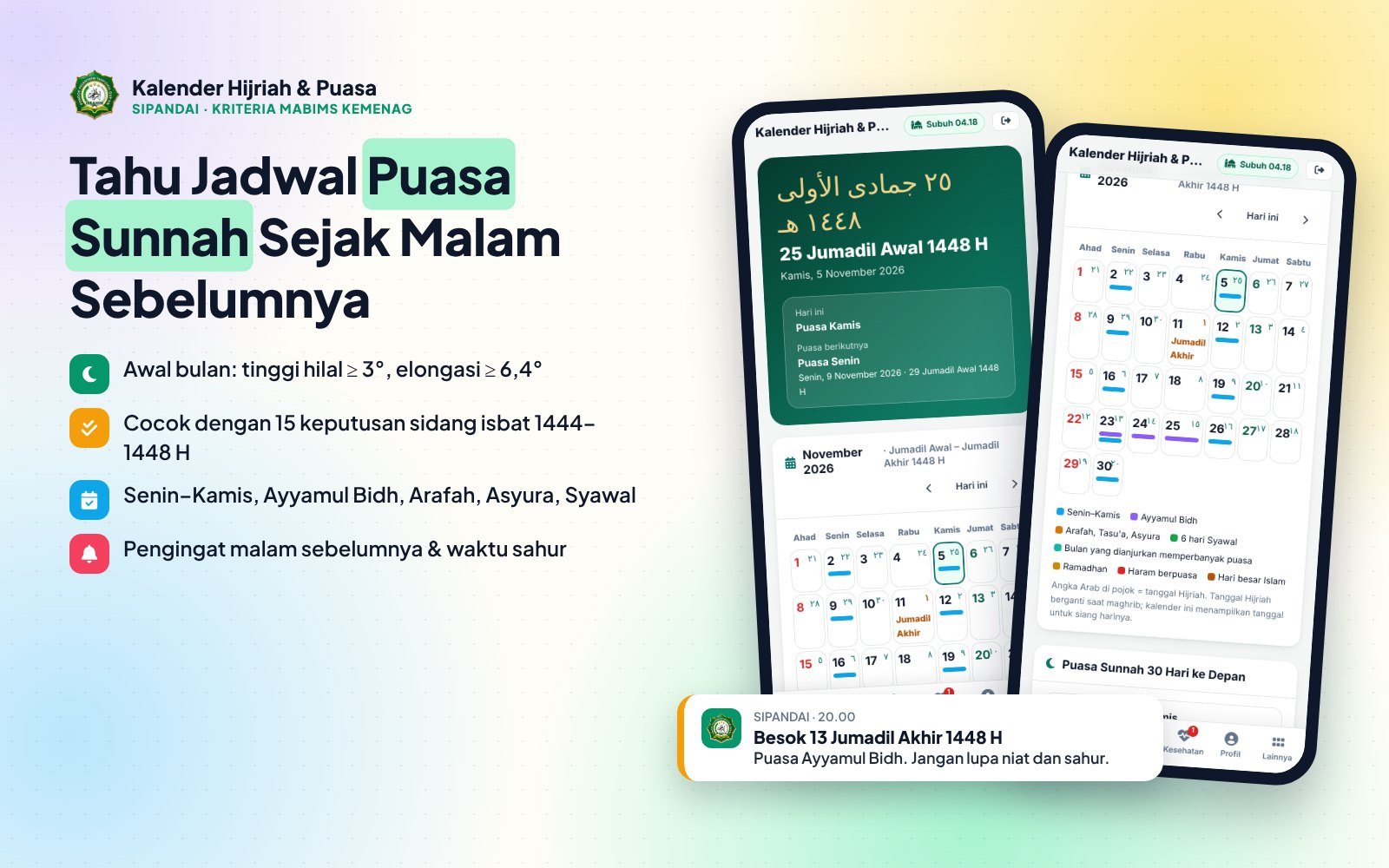
The Hijri calendar, sunnah fasting markers, and fasting reminders on your phone.
The second new feature is the Hijri Calendar & Sunnah Fasting. At the top, today's Hijri date is shown in large Arabic and Latin script, for example "25 Jumada al-Ula 1448 AH", together with today's fast, if any, and the next sunnah fast.
Calculated Using the Ministry of Religious Affairs' Criteria
Many Hijri calendar apps use the calculations of other countries, so their dates often differ by a day from the calendar used in Indonesia. SIPANDAI determines the start of each Hijri month using the MABIMS criteria, which Indonesia's Ministry of Religious Affairs has used since 2022. Put simply:
- Every month, the moon and the sun line up at the same celestial longitude. This is called the ijtima', or conjunction.
- At sunset after the conjunction, the position of the hilal, the young crescent moon, is examined. If it is at least 3° above the horizon and at least 6.4° away from the sun (elongation), the next day is the first day of the new month.
- If not, the current month is completed to 30 days (istikmal).
The positions of the moon and the sun are calculated with Jean Meeus's astronomical algorithms, which many Muslim astronomers also use as a reference. As a test, we compared SIPANDAI's results with 15 decisions of the official isbat sessions from 1444 to 1448 AH, covering the start of Ramadan, Eid al-Fitr, Eid al-Adha, and the Islamic New Year. The results matched on every date we tested.
Still Following the Isbat Session
However careful the calculation, the official start of Ramadan, Shawwal, and Dhu al-Hijjah is still decided by the government through the isbat session. That is why SIPANDAI adds a "check isbat" label to months in which the position of the crescent is very close to the threshold. The pesantren's administrator can also enter the official date announced after the isbat session, and the calendar adjusts immediately for every user.
This page also shows a calculation table: the first day of each upcoming month, the height of the crescent, and its elongation. For teachers, senior high school students, or anyone interested in Islamic astronomy, this table can be an interesting learning resource.
Marking Sunnah Fasts and Islamic Holidays
The monthly calendar shows both the Gregorian and the Hijri dates. Special days are marked in easily recognizable colors:
- Monday and Thursday fasts, which the Prophet ﷺ loved because on those days deeds are presented to Allah (Tirmidhi).
- Ayyam al-Bid fasts on the 13th, 14th, and 15th of every Hijri month, whose reward is like fasting the whole year.
- The fast of 'Arafah on 9 Dhu al-Hijjah, which expiates the sins of the previous year and the coming year (Muslim).
- The fasts of Tasu'a and 'Ashura on 9 and 10 Muharram.
- Six days of fasting in Shawwal, which together with Ramadan are like fasting the whole year (Muslim).
- Months in which fasting is encouraged: Muharram, Sha'ban, and the first ten days of Dhu al-Hijjah.
- The obligatory fast of Ramadan.
- Days on which fasting is forbidden: Eid al-Fitr, Eid al-Adha, and the days of Tashriq (11 to 13 Dhu al-Hijjah). These days are marked in red to avoid mistakes.
- Islamic holidays: the Islamic New Year, the Prophet's Birthday, Isra' and Mi'raj, Nuzul al-Qur'an, Eid al-Fitr, and Eid al-Adha.
Below the calendar is a list of sunnah fasts for the next thirty days, with their Hijri dates. The virtue of each fast is also briefly explained, with its evidence.
Fasting Reminders on Your Phone
Who hasn't forgotten that tomorrow is Monday, only to remember after breakfast? SIPANDAI's fasting reminders help with that:
- A reminder the night before, at a time you choose between 6:30 p.m. and 10:00 p.m., for example: "Tomorrow, 13 Jumada al-Akhirah 1448 AH: Ayyam al-Bid fast, Monday fast. Don't forget your intention and suhoor."
- A suhoor reminder (optional), 15 to 60 minutes before imsak.
- A choice of fasts: Monday, Thursday, Ayyam al-Bid, 'Arafah/Tasu'a/'Ashura, and Shawwal can each be switched on or off. Ramadan is always included.
These settings are saved on each phone, so a father and a mother can use different settings to suit their own routines.
Starting Sunnah Fasts as a Family
Sunnah fasting often feels hard when you start alone. Here are some ways to help a family begin:
- Start with three days a month. The Ayyam al-Bid fast is only three days each month, on the 13th, 14th, and 15th of the Hijri month. The Prophet ﷺ advised Abu Hurairah to keep it (Bukhari and Muslim).
- Have suhoor together. Eating suhoor with your spouse or older children makes fasting feel lighter and becomes a moment of togetherness.
- Don't force young children. Invite young children to fast for half a day as practice, then praise their effort.
- Tell your child at the pesantren. At the pesantren, students are also encouraged to keep sunnah fasts. Knowing that their family at home is fasting on the same day can be a special encouragement.
- Look after your health. Anyone with health concerns should consult a doctor first. Islam does not burden anyone beyond what they can bear.
A Note on When the Day Changes
In the Hijri calendar, the day changes at Maghrib, not at midnight. SIPANDAI's calendar shows the Hijri date for the daytime. So if tonight is the eve of the 13th, the calendar still shows the 12th until the following day. This small detail is worth understanding so that you don't make a mistake when deciding to fast.
Islamic Astronomy Made Simple
Ilmu falak, Islamic astronomy, is the study of the positions of the heavenly bodies, which in Islam is used to determine prayer times, the start of Hijri months, eclipses, and the qibla direction. The calendar in SIPANDAI is a small application of this science. Three terms are often heard before Ramadan and Eid:
- Hisab means calculation. The positions of the moon and the sun are calculated with astronomical formulas, so they can be known well in advance.
- Ru'yah means sighting. Observers at various locations try to see the crescent directly, with the naked eye or a telescope, at sunset.
- Imkan al-ru'yah means the possibility of sighting. The MABIMS criteria (a height of 3° and an elongation of 6.4°) are the threshold agreed by Indonesia, Malaysia, Brunei Darussalam, and Singapore for declaring that the crescent may be visible.
The Indonesian government combines hisab and ru'yah in the isbat session. SIPANDAI uses hisab with the same imkan al-ru'yah criteria, so its results are almost always the same as the isbat decision. When they differ, the government's official decision is followed, and the pesantren's administrator enters it into SIPANDAI.
How to Use the Hijri Calendar & Fasting
- Tap the Calendar & Fasting icon on the home page or in the Worship & Library menu.
- See today's Hijri date and the next sunnah fast at the top.
- Use the arrow buttons to move to the following months. Tap "Today" to return.
- In the Fasting Reminders section, choose the evening reminder time, turn on the suhoor reminder if you need it, and select the fasts you want to be reminded about. Your choices are saved immediately.
- Tap Allow notifications, then Test to make sure the reminder appears.
New Feature 3: Qibla Direction & Nearby Mosques
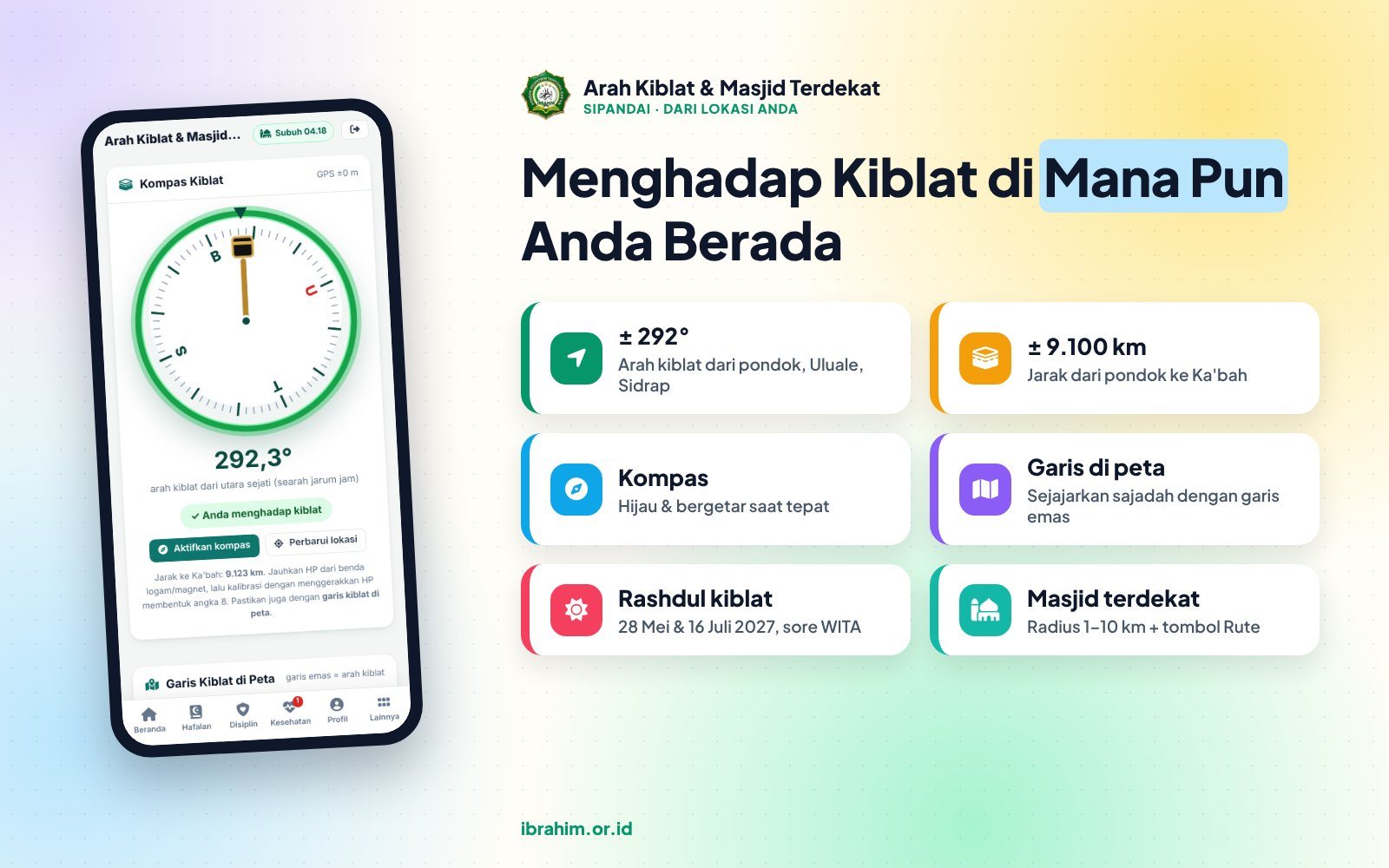
The qibla compass, the qibla line on the map, and the rashdul kiblat schedule.
The third feature is especially useful when traveling: Qibla Direction & Nearby Mosques. When parents drop off or pick up their child from far away, stay with relatives, or stop along the road, this feature helps them find the direction of prayer and the nearest mosque.
The Qibla Is Calculated from Your Location
SIPANDAI takes your location from your phone's GPS and calculates the direction to the Ka'bah using spherical trigonometry, the same method used to determine the official qibla direction. The result is given in degrees from true north. For the pesantren's location in Uluale, Sidrap, the qibla is about 292°, slightly to the right of due west, and the Ka'bah is about 9,100 km away.
If location permission is not granted, SIPANDAI uses the pesantren's location as a reference and says so on the screen.
Three Ways to Find the Qibla
- The qibla compass. Tap "Enable compass", then turn your body slowly. When the gold needle with the Ka'bah icon points straight up, the compass ring turns green, the phone vibrates, and the words "You are facing the qibla" appear. Phone compasses rely on a magnetic sensor, so they can be off by a few degrees near metal objects. Move your phone in a figure-eight to calibrate it.
- The qibla line on the map. The map shows a gold line from your location to the Ka'bah. You can line it up with a building, a road, or your prayer mat. This method is often more reliable than the compass because it is not affected by magnetic fields.
- Rashdul kiblat. Twice a year, the sun is directly above the Ka'bah. At that moment, the shadow of any upright object anywhere on the daylit half of the earth points directly away from the qibla. In 2027, this happens on 28 May at 5:18 p.m. Central Indonesia Time (WITA) and on 16 July at 5:27 p.m. WITA. SIPANDAI shows the next date and time in your phone's time zone. This is the most accurate way to check the qibla of a mosque or a prayer room at home.
Mosques and Prayer Rooms Around You
Further down, SIPANDAI lists the mosques and prayer rooms nearest to you within 1, 3, 5, or 10 kilometers, sorted from the closest. Each mosque has a Route button that opens directions in Google Maps.
The mosque data comes from OpenStreetMap, an open map built by volunteers around the world. Because it is built by volunteers, not every village mosque has been added yet. That is why there is also a "Search Google Maps too" button.
Why Isn't Our Qibla Due West?
Many people assume that the qibla from Indonesia is due west. It isn't. Because the earth is round, the shortest path from Sulawesi to Makkah curves toward the northwest. From Sidrap, the qibla is about 292°, roughly 22° to the right of due west. The difference looks small, but carried over 9,100 km, a direction that is 22° off ends up thousands of kilometers away from the Ka'bah.
That is why Indonesia's Ministry of Religious Affairs has encouraged the public to re-check the qibla of mosques and prayer rooms, especially those built simply "facing west". Scholars explain that for those far from the Ka'bah, the obligation is to face its direction as best they can determine it. When we have the means to know the direction more precisely, it is better to use them.
How to Use the Qibla Direction
- Tap the Qibla Direction icon, then allow location access when asked.
- Hold your phone flat in your palm, away from metal objects, and tap Enable compass. On an iPhone, allow access to the motion sensors.
- Turn slowly until the ring turns green and the words "You are facing the qibla" appear.
- To double-check, scroll to the map and compare the qibla line with the buildings or roads around you.
- Scroll down to see the nearest mosques, then tap Route to get there.
New Feature 4: Online Library
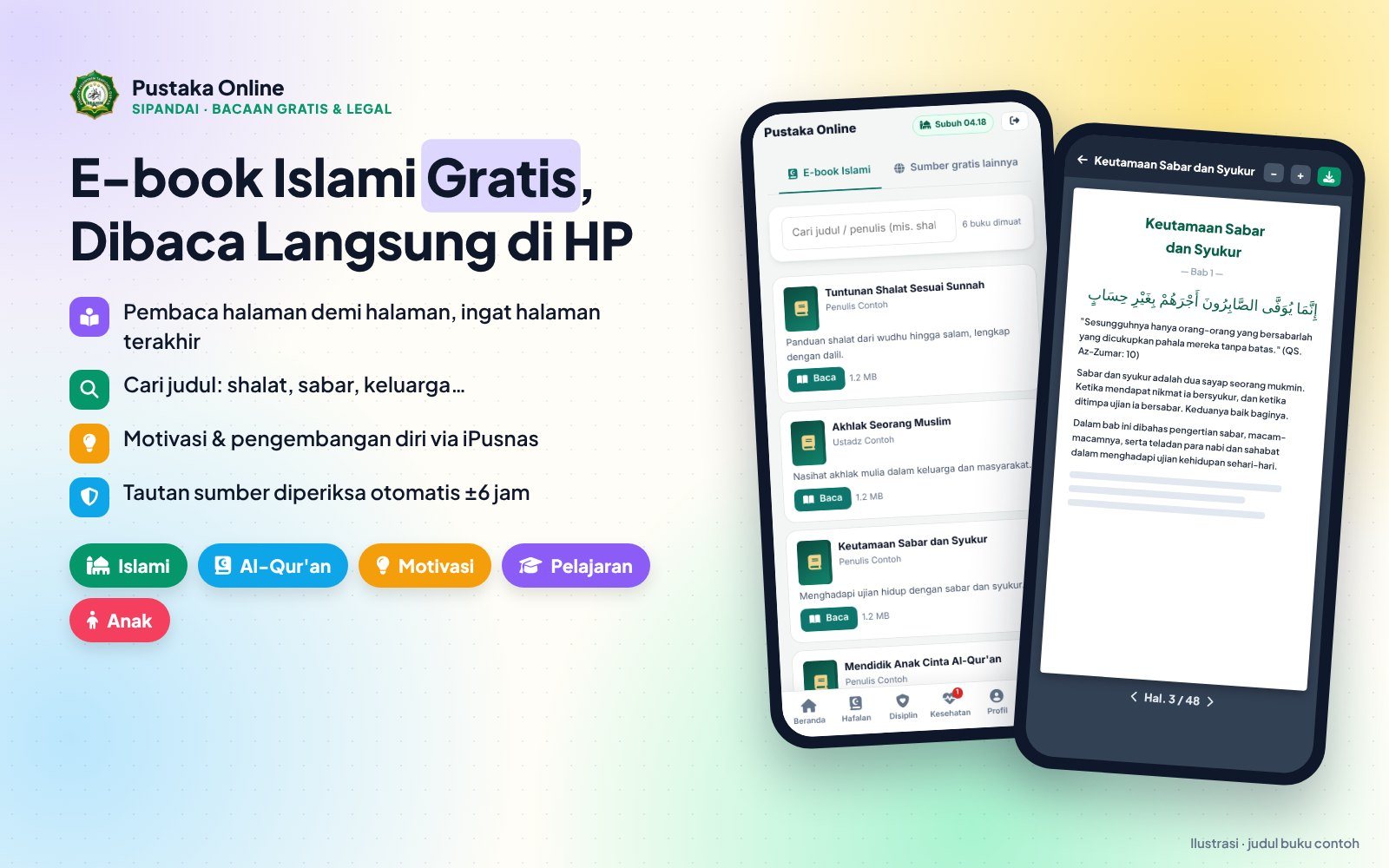
The Online Library: free Islamic e-books you can read right on your phone.
Reading is the door to knowledge. At the pesantren, students are used to reading the Qur'an, classical texts, and books. We want this reading habit to grow at home and in the staff room as well. And so the Online Library was born.
Free Islamic E-books You Read Right on Your Phone
The first tab contains Indonesian-language Islamic e-books from IslamHouse.com, an international da'wah library that allows its books to be shared freely, on condition that the content is not changed and the source is credited. The topics are varied: creed, the jurisprudence of worship, character, family, the stories of the prophets, and more.
Books are read inside SIPANDAI with a page-by-page reader that is comfortable on a phone, can be zoomed, and remembers the last page you read. There are no ads. Books can also be downloaded to read offline. A search box lets you look for a title or author, for example "shalat" (prayer), "sabar" (patience), or "keluarga" (family).
The pesantren's librarian can also copy selected books to the Pesantren E-Catalog with one click, so the book is stored on the pesantren's server and can be read at any time.
Other Free Reading Sources, Checked Automatically
The second tab lists other free and legal reading sources, grouped by theme:
- Islamic: IslamHouse.com in Indonesian.
- Qur'an: the Qur'an, its translation, and the official commentary of Indonesia's Ministry of Religious Affairs.
- Motivation & Self-Development: iPusnas from the National Library of Indonesia, which holds thousands of Indonesian-language books on self-development, motivation, parenting, religion, history, and fiction that can be borrowed for free. There are also Open Library and Project Gutenberg for classic self-development books in English.
- Textbooks: SIBI from the Ministry of Primary and Secondary Education, with official school textbooks, including Islamic Religious Education.
- Children's Books: the Language Agency's Digital Books, Let's Read, and Literacy Cloud, with illustrated storybooks for younger brothers and sisters at home.
The addresses of government and institutional websites sometimes change. So that parents and teachers don't run into dead links, the SIPANDAI server checks every link automatically about every six hours and shows only the sources that can actually be opened.
Why Only Legal Sources?
Many PDFs of well-known motivational books circulate online without the permission of their authors and publishers. As an Islamic educational institution, we want to set an example of trustworthiness: respecting the rights of others, including copyright. That is why the Online Library only points to legal sources. Recent motivational books are usually still under copyright, and the legal and free way to read them is to borrow them through iPusnas.
Building a Reading Culture at Home
The first revelation to the Prophet ﷺ was the command iqra': read. Reading is the beginning of knowledge, and knowledge is a path to Paradise. The Prophet ﷺ said, "Whoever takes a path in search of knowledge, Allah will make easy for him a path to Paradise" (Muslim).
Children learn more from what they see than from what they hear. A child who sees their father and mother reading grows up thinking that reading is normal and enjoyable. Here are some simple habits you can start at home:
- Ten minutes a day. It doesn't have to be long. Ten minutes after Maghrib or before bed, done every day, can add up to many finished books in a year.
- Read together. Choose one book to read as a family, then talk about it over dinner.
- Read stories to the little ones. The illustrated storybooks in the Children's Books section are perfect for bedtime.
- Tell your child at the pesantren. During your scheduled phone calls, talk about the book you are reading. Your child will feel that their parents share their love of learning.
How to Use the Online Library
- Tap the Online Library icon on the home page or in the Worship & Library menu.
- On the Islamic E-books tab, type a keyword in the search box or scroll through the list.
- Tap Read. The book opens inside SIPANDAI. Use the plus and minus buttons to zoom, and scroll to move between pages.
- For other sources, open the Other free sources tab, choose a theme (Islamic, Qur'an, Motivation, Textbooks, Children), and tap the source you want.
- For iPusnas, you need to create a free account in the iPusnas app or website before borrowing books.
Improved Features: Islamic Radio, Prayer Reminders, and Adhkar
The three features introduced earlier continue to be improved:
Islamic Radio
Qur'an recitation, lectures, and da'wah broadcasts from Indonesia, the Middle East, Southeast Asia, and other countries. The SIPANDAI server tests every station regularly and shows only those that are actually broadcasting sound. Stations that fail to play on a user's phone are hidden automatically. Stations are also filtered so that only Islamic ones are shown.
Islamic Radio is good company on the road when dropping off or picking up your child, while cooking, or while working. For parents who would like to memorize more of the Qur'an themselves, the recitation stations can help with revision: listen to one surah again and again until it feels familiar, then try reciting it yourself. Who knows, when your child comes home, you may be able to listen to each other's recitation.
Prayer Time Reminders
The next prayer time appears in the top bar of every page, with a countdown. A notice appears a few minutes before the adhan (adjustable from 5 to 30 minutes) and again when the prayer time begins, with a soft chime and a phone notification. The schedule is calculated using the Ministry of Religious Affairs' criteria for the pesantren's location and aligned with Al-Ikhlas Panretanete Mosque in Uluale, where the students pray in congregation every day.
Morning and Evening Adhkar
Morning and evening remembrances from the Qur'an and hadith, with Hisn al-Muslim as a reference. Each one has fully vowelled Arabic text, capitalized transliteration that can be turned on or off, a translation, and a tap counter with a gentle vibration. Your count is saved for each day, so it isn't lost if you are interrupted.
PDF Converter and Photo Editor for Every Teacher, Supervisor, and Staff Member
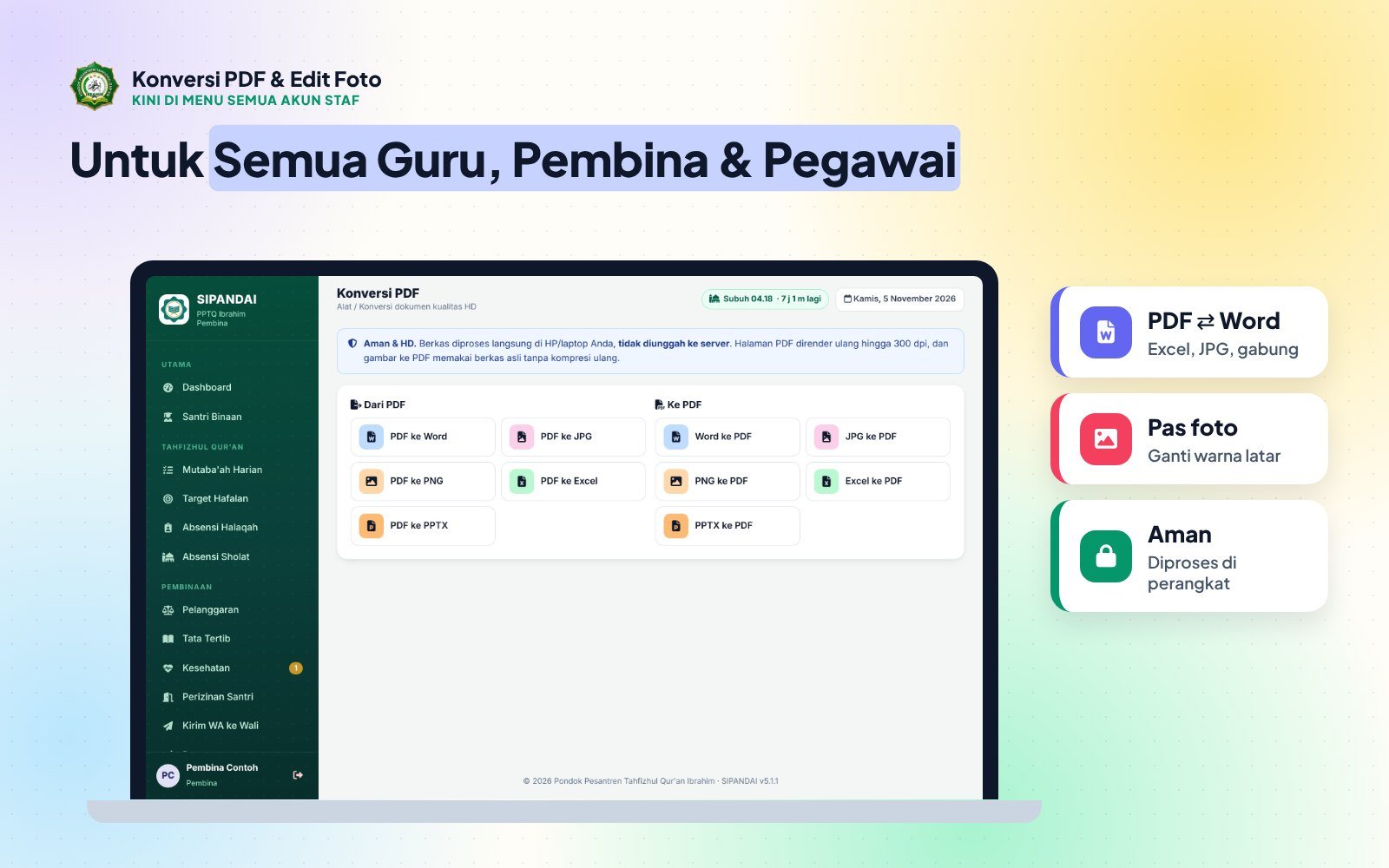
The PDF Converter and Photo Editor are now in the menu of every staff account.
The PDF Converter (PDF to Word, Excel, JPG, and back) and Photo & Design Editor (changing the background of ID photos, a layer studio) used to appear in the menus of only some accounts. Both tools are now available in the menu of every staff account: junior and senior high school teachers, dormitory supervisors, administration, health unit staff, canteen staff, the treasurer, and the leadership.
Processing happens directly on the user's phone or laptop. Files are not uploaded to the server, so personal documents and family photos stay safe. Supervisors can now make students' ID photos, merge reports, or turn a PDF into a Word document without installing another app.
Who Can Use These Features?
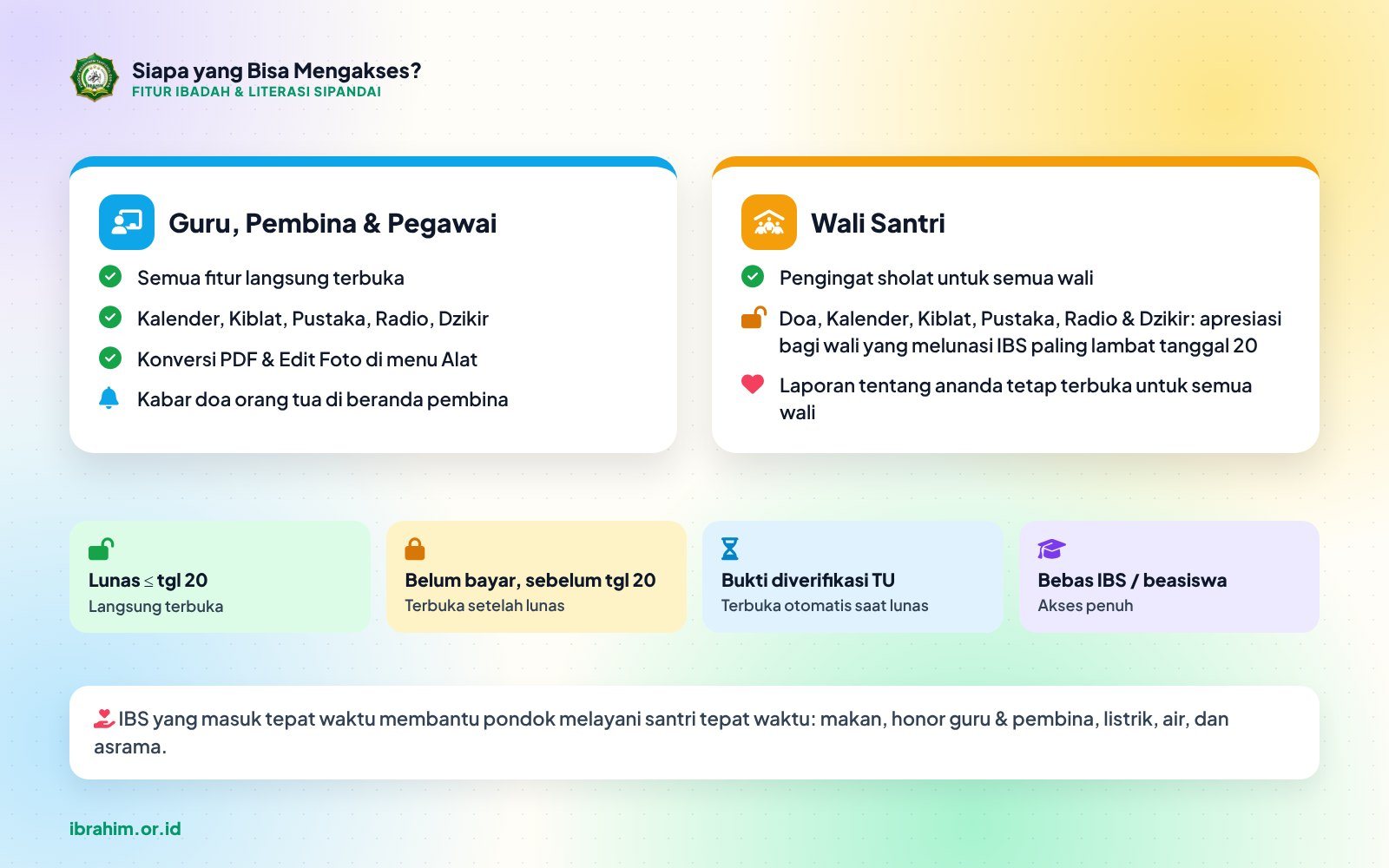
An overview of who can access SIPANDAI's worship and reading features.
Teachers, Supervisors, and Staff
All staff accounts can use Islamic Radio, prayer reminders, adhkar, the Hijri Calendar & Fasting, Qibla & Mosques, the Online Library, and the PDF Converter and Photo Editor right away. Everything is in the Worship & Library and Tools menus.
Parents
- Prayer time reminders and the prayer schedule are open to all parents.
- Du'a for Your Child, the Hijri Calendar & Fasting, Qibla Direction, the Online Library, Islamic Radio, and Adhkar are open as a token of appreciation for parents who pay the IBS (monthly student contribution) on time, meaning paid in full no later than the 20th of each month, with no arrears.
We want to explain this rule openly. The IBS is the main source of the pesantren's operating funds: students' meals, teachers' and supervisors' pay, electricity, water, and dormitory upkeep. When the IBS comes in on time, the pesantren can meet its own obligations on time too. These features are a small thank-you to the parents who help make that possible.
This rule does not affect your child's rights. Reports on memorization, health, discipline, and all news about your child remain open to every parent, without exception. Parents who have not yet met the requirement will see a lock icon, the reason, and a button to the payment page. If payment is made before the 20th, the features open automatically once the administration office confirms the payment.
Students exempted from the IBS, such as scholarship recipients, still get full access.
Getting Started: Five Easy Steps
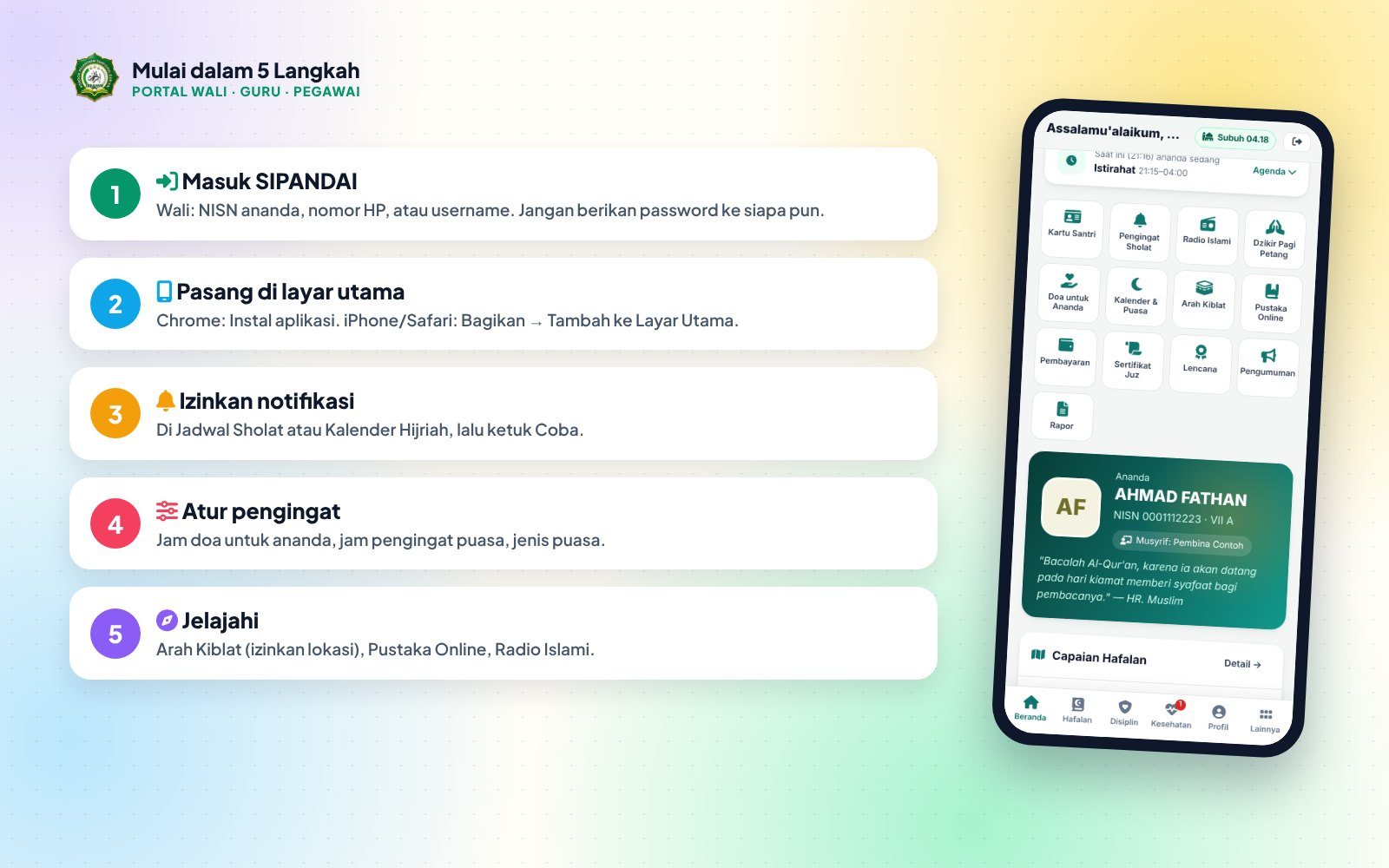
Five steps to start using SIPANDAI's worship and reading features.
- Sign in to SIPANDAI. Parents sign in with their child's NISN (national student number), the parent's phone number, or their own username. Teachers and staff use their own accounts. Never give your password to anyone, including someone claiming to be from the pesantren.
- Add SIPANDAI to your phone's home screen. In Chrome on Android, open the three-dot menu and choose Install app or Add to Home screen. On an iPhone, open it in Safari, tap the Share button, then Add to Home Screen. This makes the reminders more reliable.
- Allow notifications on the Prayer Schedule or Hijri Calendar page, then tap Test to make sure.
- Set your reminders: the time to pray for your child, the fasting reminder time, and the fasts you want to be reminded about.
- Explore the Qibla Direction (allow location access), the Online Library, and Islamic Radio. All the icons are on the parents' portal home page and in the Worship & Library menu.
A Day with SIPANDAI: An Illustration
To make it easier to picture, here is an illustration of one day in a family's life. The names and circumstances are fictional.
Mr. Hasan and Mrs. Aisyah are the parents of Ahmad Fathan, a seventh-grade student at PPTQ Ibrahim. They live in Parepare. On Sunday at 8:00 p.m., Mrs. Aisyah's phone shows a reminder: "Tomorrow is the Monday fast. Don't forget your intention and suhoor." She invites her husband to fast with her. At 3:40 a.m., the suhoor reminder goes off, thirty minutes before imsak.
After Fajr, Mr. Hasan opens the Du'a for Your Child page. He slowly recites "Allāhumma 'allimhul-kitāb" with the help of the transliteration, then taps "I have prayed for Ahmad today". Later that day, after the halaqah, Ahmad's supervisor tells him, "Your father prayed for you this morning." Ahmad smiles and goes back to revising his memorization with new energy.
The following Thursday, the family visits Ahmad and stays at a relative's house in Sidrap. When it is time for Isha, Mrs. Aisyah opens the Qibla Direction, lines up the prayer mat with the gold line on the map, and the family prays together. Before going to sleep, she reads a chapter of a book on raising children from the Online Library.
The illustration is simple, but that is exactly our aim: home and pesantren moving in step, and parents' prayers reaching a child who is working hard to memorize the Qur'an.
Benefits for Teachers and Supervisors
These worship features are not only for parents. Teachers and supervisors benefit from them too:
- News of parents' prayers becomes a warm source of motivation to pass on to students.
- The Hijri Calendar helps plan activities, such as group sunnah fasts or preparations for Ramadan.
- Prayer and adhkar reminders keep teaching and administrative work from crowding out worship.
- The Online Library provides legal teaching materials and self-development reading.
- The PDF Converter and Photo Editor make daily administrative work easier.
- The Qibla Direction is useful when accompanying students on activities outside the pesantren.
Suggestions for Teachers and Supervisors
- Pass on the news of prayers warmly. A good time is after the halaqah or before bed. One sentence is enough: "Your father and mother prayed for you today." Avoid comparing students who were prayed for with those who weren't, because not every parent is used to tapping the button, and they may well be praying anyway.
- Encourage students to pray for their parents. Supplication goes both ways. Students can respond to the news from their parents by getting into the habit of saying "Rabbighfir lī wa liwālidayya" after each prayer.
- Use the calendar to plan activities. The Ayyam al-Bid and Monday–Thursday fasts can be the basis for group iftars in the dormitory.
- Use the Online Library for short talks. IslamHouse books contain clear evidence and simple language, which makes them good material for short sermons or brief advice.
Benefits for Students
Students don't open SIPANDAI themselves, but they benefit the most. First, they hear that their parents prayed for them that day. Second, when they go home for the holidays, they find a home atmosphere not very different from the pesantren: parents who pray on time, recite their adhkar, keep sunnah fasts, and read books. An environment like this helps them keep their memorization during the holidays. Third, students learn that worship is not just a pesantren rule but the way of life of the whole family.
Benefits for the Leadership and the Foundation
For the pesantren's leadership and the Ibrahim La Useng Foundation, these features are part of an effort to build a partnership with parents. Educating students who memorize the Qur'an is a shared task, not the pesantren's alone. Through SIPANDAI, the pesantren not only reports students' progress to their parents but also invites parents to take part in nurturing them from home.
The appreciation rule for parents who pay the IBS on time also helps keep the pesantren's finances healthy, so that teachers and supervisors are paid on time, students' meals stay nutritious, and the dormitories can be well maintained. In the end, all of this comes back to the students.
Privacy and Security
We take user privacy seriously:
- Reminder settings, favorite radio stations, adhkar counts, and the last page read in a book are stored on each phone, not sent to the server.
- Your GPS location is used only on your phone to calculate the qibla and find mosques. The pesantren does not store your location.
- The only thing recorded on the server is the "I have prayed" mark (date and time), so that the supervisor can pass it on to the student.
- PDF conversion and photo editing are processed on the user's device. Files are not uploaded.
- There are no ads in any of these features.
Behind the Scenes: Developed from Within the Pesantren
Like SIPANDAI's other features, these were not bought off the shelf. SIPANDAI was designed and developed by Muh. Ikhsan, Chairman of the Ibrahim La Useng Foundation, who is also active in education and technology. Because it is developed in-house, suggestions from parents, teachers, and supervisors can be acted on quickly.
Du'a for Your Child, for example, grew out of a simple question from parents: "What can we do from home?" The Hijri Calendar came from the need to know sunnah fasting days with dates that match the Ministry of Religious Affairs' decisions. Qibla Direction and Nearby Mosques came from the experience of parents traveling long distances to drop off and pick up their children. And the Online Library came from the wish that the reading culture should not stop at the pesantren gate.
We also know that no app is perfect. If you find a mistake, especially in the Arabic text of the supplications and adhkar, please let the SIPANDAI administrator know so it can be corrected promptly.
Looking for the Best Tahfidz Pesantren in Sidrap or South Sulawesi? Start with the Right Questions
For parents who are putting together a list of pesantren for their son or daughter, we would like to share some questions we think are important to ask, whichever pesantren you are considering. "The best" can mean many things, and the best pesantren for one child is not necessarily the best for another. So start with the right questions:
- How is the memorization program measured? Are there memorization targets, daily records of recitation, and exams that test the quality of memorization, not just the amount?
- How is daily worship nurtured? Is students' congregational prayer monitored? How are adhkar, manners, and character built into daily habits?
- How are parents involved? Can parents follow their child's progress regularly and play a part from home?
- Is there recognized formal education? Do students receive valid madrasah certificates so they can continue their studies?
- How are students' health and safety looked after? Are there health services, clear leave rules, and dormitory supervisors?
- How is discipline enforced? Are the rules written, fair, and known to parents?
- How much does it cost, and what is included? Are the details transparent from the start?
We ask ourselves these same questions. At PPTQ Ibrahim, you can see the answers directly, not just in a brochure but in the parents' portal that our students' families use every day.
Why Parents Choose Ibrahim Tahfidz Pesantren
- A measurable memorization program: daily follow-up, memorization targets, and a 10-juz tasmi' exam in a single sitting before the Board of Experts.
- Monitored congregational prayer: students' attendance at congregational prayer is recorded with QR-coded student cards at the mosque door.
- Parents always connected: the SIPANDAI parents' portal for following memorization, discipline, health, and payments from a phone, now with worship and reading features.
- Integrated formal education: Ibrahim kindergarten (RA), junior high (MTs), and senior high (MA) under one foundation, running alongside the memorization program.
- 24-hour dormitory care: students are guided by male and female supervisors, supported by a health unit (UKS) and a cooperative store.
- Verifiable certificates: memorization certificates for each juz and mutqin certificates with QR codes that can be checked for authenticity.
A Tahfidz Boarding School for Boys and Girls in Sidrap, South Sulawesi
PPTQ Ibrahim accepts boys and girls in separate dormitories, in two educational tracks:
- Tahfidz + Madrasah Tsanawiyah (MTs), equivalent to junior high school.
- Tahfidz + Madrasah Aliyah (MA), equivalent to senior high school.
Students who complete the three-year program receive certificates from both the pesantren and the madrasah. The pesantren is located on Jl. Jend. A. Yani (the Rappang–Parepare road, km 11), Uluale, Watang Pulu District, Sidenreng Rappang Regency, South Sulawesi. It is easy to reach from Rappang, Pangkajene Sidenreng, and Parepare, which makes it close enough for families from Sidrap, Parepare, Pinrang, Enrekang, Wajo, Soppeng, Barru, and other regencies in South Sulawesi.
What Is Life Like for Qur'an Memorizers at PPTQ Ibrahim?
A student's day begins before Fajr. After congregational Fajr prayer and the morning adhkar, students recite their memorization in tahfidz circles with their supervisors. From morning until midday, they study at the madrasah at their level. Afternoons and evenings are filled with revision, study circles, extracurricular activities, and enough rest.
Every memorization session is recorded in SIPANDAI. Attendance at congregational prayer is recorded by scanning student cards at the mosque door. Students' health is looked after by the health unit staff, and discipline is guided by written rules known to parents. Now all of this is complemented by parents' prayers, news of which reaches the students every day.
Registering at Ibrahim Pesantren: How to Apply and Admission Fees
If you would like to enroll your son or daughter at PPTQ Ibrahim, here are the steps:
- Open the Registration page on this website.
- Fill in the registration form with the details of the prospective student and parents.
- Prepare the documents: family card, birth certificate, report cards, and the most recent school certificate.
- The admissions committee will contact you about the next steps.
- If you have any questions, contact the committee by phone or WhatsApp at +62 823 4544 9699.
The following fees apply at the time of writing. The latest details are always available on the Registration page.
- No registration fee.
- Quota for the 2027/2028 academic year: 150 students (75 boys and 75 girls).
- First intake: 1 September 2026 – 30 July 2027. Second intake: 1–31 August 2027.
- Initial fees: a building contribution of Rp 7,500,000 and three sets of uniforms plus accessories for Rp 1,000,000 (total Rp 8,500,000).
- Monthly fee (IBS): Rp 850,000 for new students and Rp 800,000 for transfer students, including meals.
- Free bedding and furniture: bed, mattress, pillow, bolster, sheets, and wardrobe.
- Bonus for new students: 150 kg of free wash-and-fold laundry.
- Graduates of MTs Ibrahim who continue to MA Ibrahim do not pay the building contribution again.
Every accepted student receives a SIPANDAI parents' portal account from their very first day at the pesantren.
Tips for Parents
- Make du'a a routine. Choose a fixed time each day, for example after Fajr, to pray for your child.
- Start sunnah fasting with something light. Three days of Ayyam al-Bid each month is a good start.
- Tell your child. When you call, let them know that you are also keeping up your worship at home. Your child will feel supported.
- Read to the little ones. Use the children's books in the Online Library so that the reading habit grows throughout the family.
- Check the qibla of your local mosque or home prayer room on a rashdul kiblat day, together with your children, and learn a little astronomy at the same time.
- Pay the IBS before the 20th. Besides unlocking the appreciation features, paying on time greatly helps the pesantren serve your child.
- Keep your account safe. Never give your password to anyone. Pesantren staff will never ask for a parent's password.
Frequently Asked Questions
Do these features cost anything?
No. All the features are part of SIPANDAI at no extra cost. For parents, some features are open as a token of appreciation for those who pay the IBS by the 20th with no arrears.
Can students use these features?
The features are intended for parents, teachers, and staff. Under pesantren rules, students do not keep phones in the dormitory. Students benefit through the news of their parents' prayers, passed on by their supervisors.
Why does the Hijri date in SIPANDAI sometimes differ from other calendars?
Many calendars use other countries' calculations. SIPANDAI uses the MABIMS criteria adopted by Indonesia's Ministry of Religious Affairs, so its dates follow the decisions made in Indonesia. For the start of Ramadan, Shawwal, and Dhu al-Hijjah, always follow the official announcement of the isbat session.
Is the qibla direction in SIPANDAI accurate?
The calculated direction is accurate because it uses GPS coordinates and spherical trigonometry. What can be off is the phone's compass, because of magnetic interference. So also use the qibla line on the map or the rashdul kiblat method to be sure.
Why doesn't the mosque near my house appear?
The mosque data comes from OpenStreetMap, which is built by volunteers, so not every mosque has been added yet. Use the "Search Google Maps too" button. You can also add mosques to OpenStreetMap yourself as a good deed.
Can books in the Online Library be read offline?
IslamHouse books can be downloaded with the download button in the reader and then opened offline. Books on iPusnas follow iPusnas's lending rules.
I don't read Arabic well. How can I pray?
Use the transliteration provided, while understanding the translation. The transliteration is only an aid, because some Arabic sounds can't be written exactly in Latin letters. Ask your child to teach you when they come home for the holidays. It may turn out to be a beautiful moment.
Reminders don't appear on my phone. What should I do?
Make sure SIPANDAI has been added to your home screen, notifications are allowed, and SIPANDAI has not been force-closed. On some phones, battery saver features can stop reminders, so check the battery settings for the browser you use.
Does my phone always need to be online?
You need the internet to open SIPANDAI, play the radio, read books, and find mosques. The qibla compass keeps working once your location has been found, and IslamHouse books you have downloaded can be read offline.
I have two children at the pesantren. How do I pray for both?
Each student has their own parent account. Sign in to each child's parent account and tap "I have prayed" in each one. The pronouns in the supplications adjust, and the news reaches each child's supervisor.
What if my IBS payment is late this month?
The appreciation features will open again the following month if the IBS is paid in full by the 20th, with no arrears. Prayer reminders and all reports about your child remain open as usual. If you are having difficulty with payments, please talk to the pesantren's administration office.
Who can see that I have prayed for my child?
Only that student's supervisor sees the notice on their SIPANDAI dashboard. It is not shown to other parents and is not published.
What about when the student is home for the holidays?
During the holidays, you can still use all these features. That is the perfect time to invite your child to recite supplications, keep sunnah fasts, and read books together, and to see how they practice the habits of the pesantren at home.
Do Islamic Radio and the Online Library use a lot of data?
Radio broadcasts generally use about 30 to 60 MB per hour, depending on the station's quality. PDF books are a few megabytes and are downloaded only once when opened, after which they can be read again and again. To save data, use Wi-Fi when listening to the radio for long periods or when downloading large books.
Can I use these features on a laptop?
Yes. SIPANDAI can be opened in a browser on a laptop or computer. Only the qibla compass needs a phone's sensors. On a laptop, use the qibla line on the map instead.
Tahfidz or tahfizh: which spelling is correct?
Both refer to the same Arabic word, tahfīzh, meaning "memorization". The letter ظ (zha) is more accurately written "zh", so "tahfizh" follows transliteration guidelines more closely. But "tahfidz" is more common in Indonesia. Searches for "pesantren tahfidz", "pondok tahfidz", or "pesantren tahfizh" all refer to the same kind of school: a boarding school for memorizing the Qur'an.
How do I enroll my child at Ibrahim Tahfidz Pesantren?
Visit the Registration page or contact the committee on WhatsApp at +62 823 4544 9699. Registration is free.
Closing: A Du'a That Connects Home and Pesantren
A student memorizing the Qur'an is on a long journey. There are days when their memorization flows, and days when they are tired, homesick, and close to giving up. At times like these, their parents' prayers are a strength that cannot be seen but is deeply felt.
Through Du'a for Your Child, the Hijri Calendar & Sunnah Fasting, Qibla Direction & Nearby Mosques, the Online Library, and the other features, we hope SIPANDAI becomes a bridge that connects prayer, worship, and knowledge between home and pesantren. May Allah accept our deeds, protect your child's memorization and character, and make our families families of the Qur'an.
For parents who would like to join the big family of Ibrahim Tahfidz Pesantren, registration for new students for the 2027/2028 academic year is now open, with no registration fee. Visit the Registration page or contact us on WhatsApp at +62 823 4544 9699.