
"Our child recites the Qur'an and prays in congregation at the pesantren every day. What about us at home?" We hear this question often from parents, at pick-up time, at parents' meetings, and in WhatsApp messages. There is a longing to share in the atmosphere of the pesantren: to hear the Qur'an recited at home, to not miss the prayer in the middle of a busy day, and to keep up the morning and evening remembrances (adhkar) that our students practise in their dormitories.
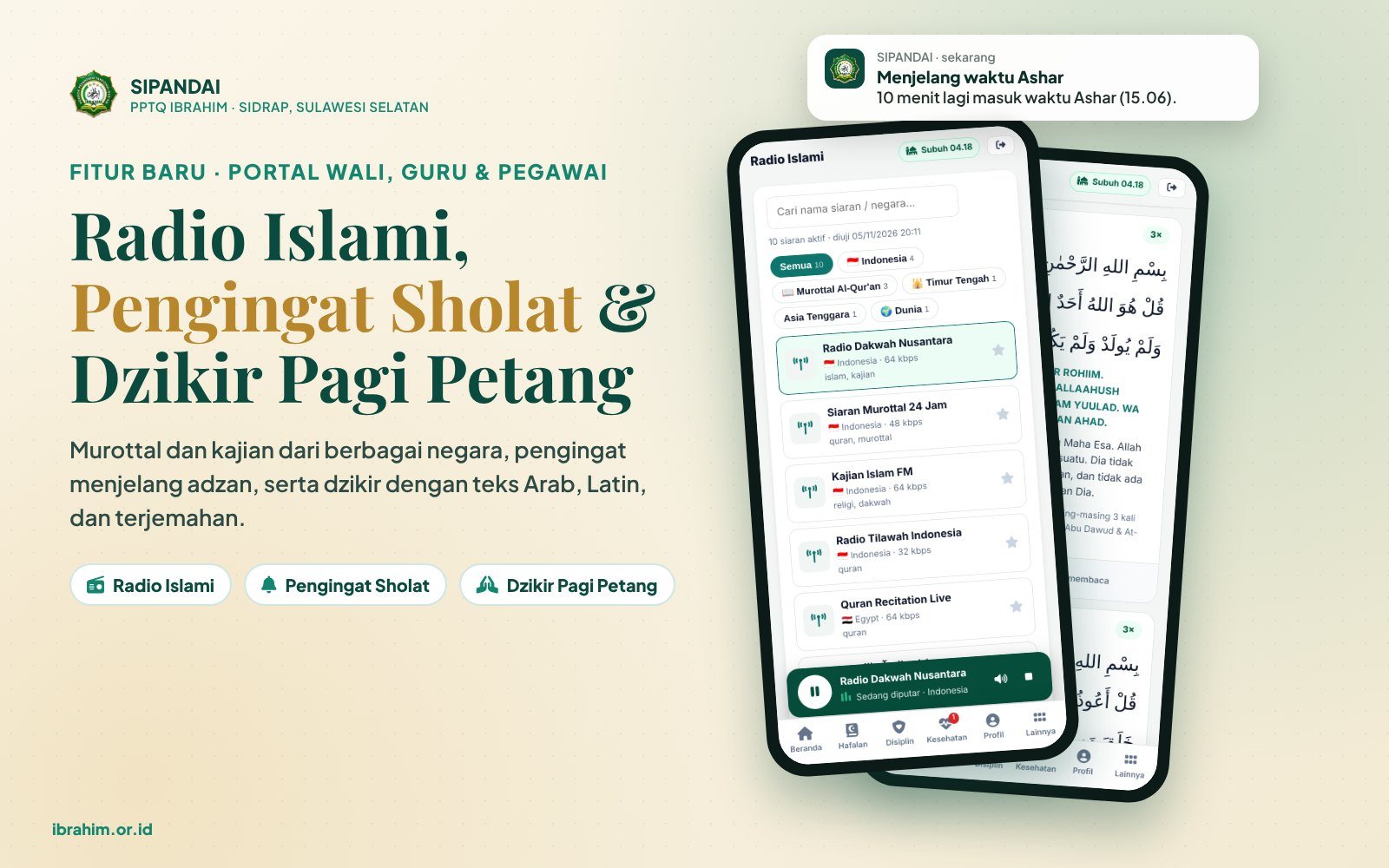
That simple question gave birth to three new features in SIPANDAI, the Ibrahim Student Data and Activity Monitoring System. From now on, the parents' portal as well as the teachers' and staff accounts at Pondok Pesantren Tahfizhul Qur'an (PPTQ) Ibrahim, a Qur'an memorization boarding school for boys and girls in Uluale, Sidenreng Rappang (Sidrap), South Sulawesi, Indonesia, come with:
- Islamic Radio, with Islamic broadcasts, lectures, and Qur'an recitation (murottal) stations from Indonesia and many other countries.
- Prayer time reminders that appear on screen and can show up as phone notifications before and at the start of each prayer time.
- Morning and evening adhkar with vowelled Arabic text, Latin transliteration, translation, and a tap counter.
This article explains all three features in detail: what they contain, how to use them, who can access them, and why we built them. We also share a little about student life at PPTQ Ibrahim, for parents who are currently looking for a Qur'an memorization school for their son or daughter.
Three new worship features in SIPANDAI for parents, teachers, and staff of PPTQ Ibrahim.
What Is New in SIPANDAI This Month?
Until now, SIPANDAI has been known as the place where parents follow their child's Qur'an memorization, congregational prayers, health, discipline, and payments from their phones. Teachers and staff use it to record memorization sessions, attendance, teaching journals, and many other administrative tasks. All of these concern the student and the work.
This month's features point in a slightly different direction. The focus is no longer only on student data, but on the worship of SIPANDAI users themselves: parents at home, teachers in the classroom, and staff in the office. We want SIPANDAI to be more than an app you open to read reports. We want it to be a companion that reminds you of prayer times, keeps you company with Qur'an recitation, and guides your daily remembrance of Allah.
All three features sit in the Worship & Library menu, together with the Prayer Schedule and the E-Catalogue of books. On the home screen of the parents' portal there are now also icons for Prayer Reminder, Islamic Radio, and Morning & Evening Adhkar, so each one is a single tap away.
Islamic Radio from Many Countries on One Page
The first feature is Islamic Radio. On this page you can listen live to Islamic broadcasts from Indonesia and abroad: da'wah and lecture stations, round-the-clock Qur'an recitation channels, and Islamic radio from the Middle East, Southeast Asia, and other parts of the world.
We deliberately do not give an exact number of stations in this article, because the number changes. The station list is tested regularly, and only stations that are currently live are shown. Some days a station is under maintenance; other days a new station begins broadcasting. What is certain is that there are plenty of choices to accompany your daily activities.
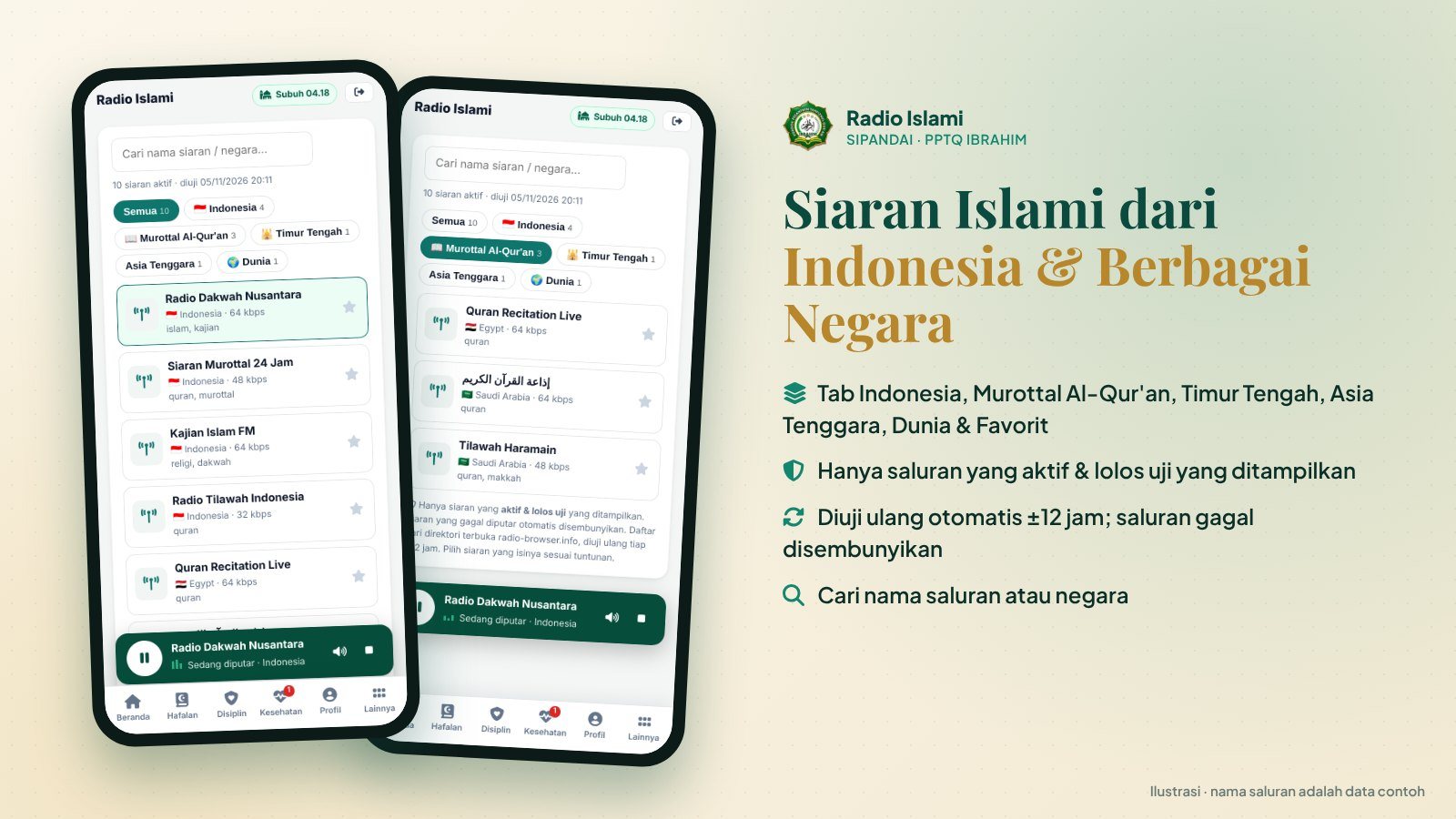
The Islamic Radio page on a phone. Station names in the picture are sample data.
Stations Grouped for Easy Choice
To keep things simple among so many options, stations are grouped into several tabs:
- Indonesia: da'wah, lecture, and religious stations in Indonesian.
- Qur'an Recitation: stations dedicated to Qur'an recitation, ideal while working, cooking, or before sleep.
- Middle East: broadcasts from Arab countries and the surrounding region, including Arabic Qur'an stations.
- Southeast Asia: Islamic broadcasts from neighbouring countries such as Malaysia and Brunei.
- World: Islamic radio from other countries, including English-language stations.
- Favourites: stations you have marked with a star, so you can find them again quickly.
At the top there is also a search box. Type a station name or a country, and the list filters instantly.
Only Stations That Actually Work Are Shown
Anyone who has searched for online radio knows the problem: many links are dead, some play for a moment and stop, and others show error messages. We did not want parents and teachers to waste their time on that.
So before a station is shown, it is first tested by the SIPANDAI server. The server checks whether the station really connects and sends audio, not just whether its address still exists. Stations that fail are left out of the list. This test is repeated regularly, roughly every twelve hours.
A second safeguard runs on the user's phone. If a station still fails to play, for example because it suddenly stopped broadcasting, SIPANDAI automatically hides it and lets you know that it could not be played. The station is also hidden for other users for a day. This keeps the radio list clean and ready to listen to.
Filtered to Match the Values of the Pesantren
The station list is drawn from an open internet radio directory (radio-browser.info) that lists tens of thousands of stations worldwide. From that directory, SIPANDAI only takes stations related to Islam, the Qur'an, and da'wah. Stations focused on other religions and general entertainment stations are filtered out.
Even so, we want to be honest: automatic filtering will never be perfect. The content of each broadcast is the responsibility of the station itself. Please choose stations whose content is in line with sound guidance, and if you find a station that seems inappropriate, let the SIPANDAI admin know so we can review it.
How to Listen to Islamic Radio
- Open SIPANDAI and sign in with your account.
- Tap the Islamic Radio icon on the home screen, or open Worship & Library → Islamic Radio.
- Choose a tab, for example Qur'an Recitation.
- Tap a station name. A small player appears at the bottom of the screen with play/pause, volume, and stop buttons.
- Tap the star icon to save the station to your Favourites.
On many phones, while a station is playing, its name also appears on the lock screen with pause and play controls. The radio keeps playing as long as the Islamic Radio page is not closed.
Tips for Saving Mobile Data
Online radio uses mobile data, though far less than video. As a rough guide, a medium-quality audio stream usually uses a few tens of megabytes per hour. Each station shows a kbps figure: the smaller the number, the less data it uses. If you are on a limited data plan, choose stations with a lower kbps, or listen while connected to Wi-Fi.
Prayer Time Reminders: Not Missed in the Middle of a Busy Day
The second feature is prayer time reminders. We have all experienced it: absorbed in work, on the road, or finishing chores at home, and suddenly the prayer time is already well under way. These reminders are designed to make that happen less often.
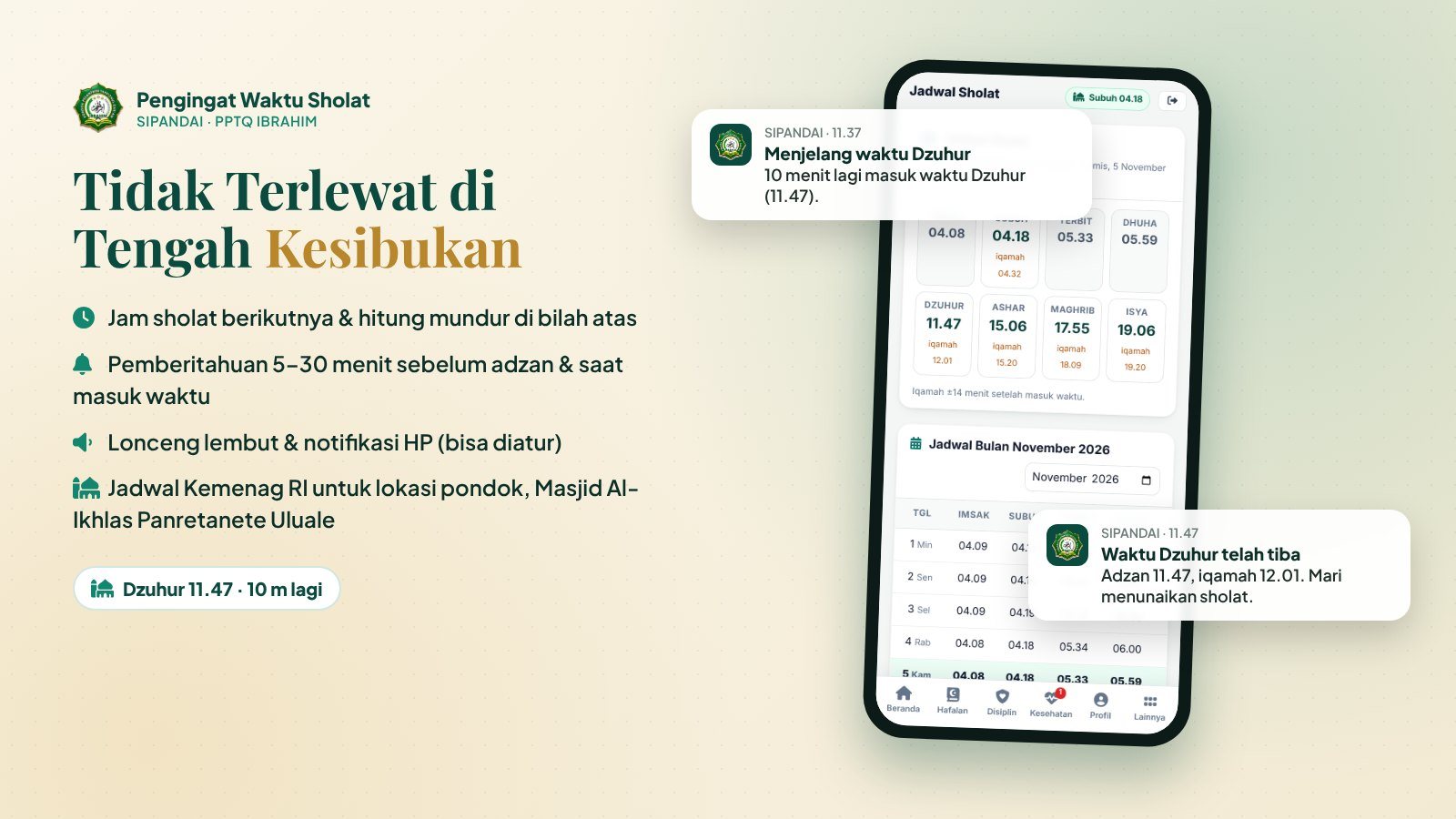
The next prayer time in the top bar, a notice before the call to prayer, and the daily schedule.
What the Reminders Look Like
- The next prayer time in the top bar. Every SIPANDAI page shows a small badge with the name and time of the next prayer, for example "Asr 15.06". As the time approaches, the badge shows a countdown, such as "1 h 30 m left".
- A notice before the call to prayer. A few minutes before the prayer time begins, a notice appears on screen. The default is 10 minutes beforehand, and you can change it to 5, 15, or 30 minutes, or turn it off.
- A notice when the time begins. Exactly at the call to prayer, a notice tells you that the prayer time has arrived, together with the estimated time of the iqamah at the pesantren mosque.
- A soft chime. The notice comes with a short, gentle chime that will not startle you. The sound can be turned off.
- Phone notifications. If you allow it, the notice also appears in your phone's notification bar like an ordinary message.
The Schedule Is Calculated for the Pesantren's Location
Prayer times in SIPANDAI are calculated using the criteria of Indonesia's Ministry of Religious Affairs (Fajr angle 20° and Isha angle 18°, with a small precautionary margin, ihtiyat) for the pesantren's location in Uluale, Watang Pulu, Sidrap. The schedule is also aligned with that of Masjid Al-Ikhlas Panretanete Uluale, the mosque where our students pray in congregation every day. The gap between the call to prayer and the iqamah at the pesantren mosque is about 14 minutes, and on Fridays the schedule adjusts for the length of the sermon.
There is one thing we must say honestly. Because the schedule is calculated for the pesantren's location, parents who live in other regencies or provinces may find a difference of a few minutes from the schedule of their local mosque. For nearby areas, such as other regencies in central South Sulawesi, the difference is usually small. For distant areas it can be larger. Treat these reminders as a general prompt, and always follow the call to prayer at your local mosque for the actual start of the prayer time where you live.
On the other hand, a schedule that follows the pesantren has a special value of its own. When the reminder sounds, you know that at the very same moment your child is getting ready to walk to the pesantren mosque. Many parents feel a closeness in that: in different places, yet heading to prayer at almost the same time.
Setting the Reminders to Suit You
Reminder settings are on the Prayer Schedule page, in the Reminders on This Phone box. The options are:
- Show or hide the reminder when the prayer time begins.
- Turn the chime on or off.
- Choose a reminder before the call to prayer: none, 5, 10, 15, or 30 minutes.
- Turn on phone notifications, then tap Allow notifications.
- Tap Test to make sure the chime and notifications work.
These settings are stored on each phone. So a father's phone and a mother's phone can use different settings: the father might prefer a reminder 15 minutes before the call to prayer, while the mother only needs one exactly at the call.
The same page also shows the full monthly prayer schedule for the pesantren's location, with today highlighted. This is useful for parents who want to know their child's daily rhythm, for example to choose a good time to call or visit.
Making the Reminders More Reliable
The reminders work while SIPANDAI is open, either on screen or running in the background. For better reliability, we recommend:
- Add SIPANDAI to your home screen. In Chrome on Android, open the three-dot menu and choose Install app or Add to Home screen. On iPhone, open it in Safari, tap the Share button, then choose Add to Home Screen. SIPANDAI can then be opened like a regular app.
- Allow notifications when asked, so reminders are still visible while you are using other apps.
- Do not force-close SIPANDAI from your recent apps if you want the reminders to keep running.
- On some phones, battery-saving features can stop apps in the background. If reminders often fail to appear, check the battery settings for the browser you use.
These reminders are not meant to replace the call to prayer. They simply help those of us who tend to lose track of time when busy.
Morning and Evening Adhkar in the Palm of Your Hand
The third feature is morning and evening adhkar. At the pesantren, students are trained to recite their remembrances after Fajr and after Asr. Many parents want to keep the same practice at home, but they do not always carry a book of adhkar, or they lose count of where they are. The adhkar page in SIPANDAI was built for exactly this.
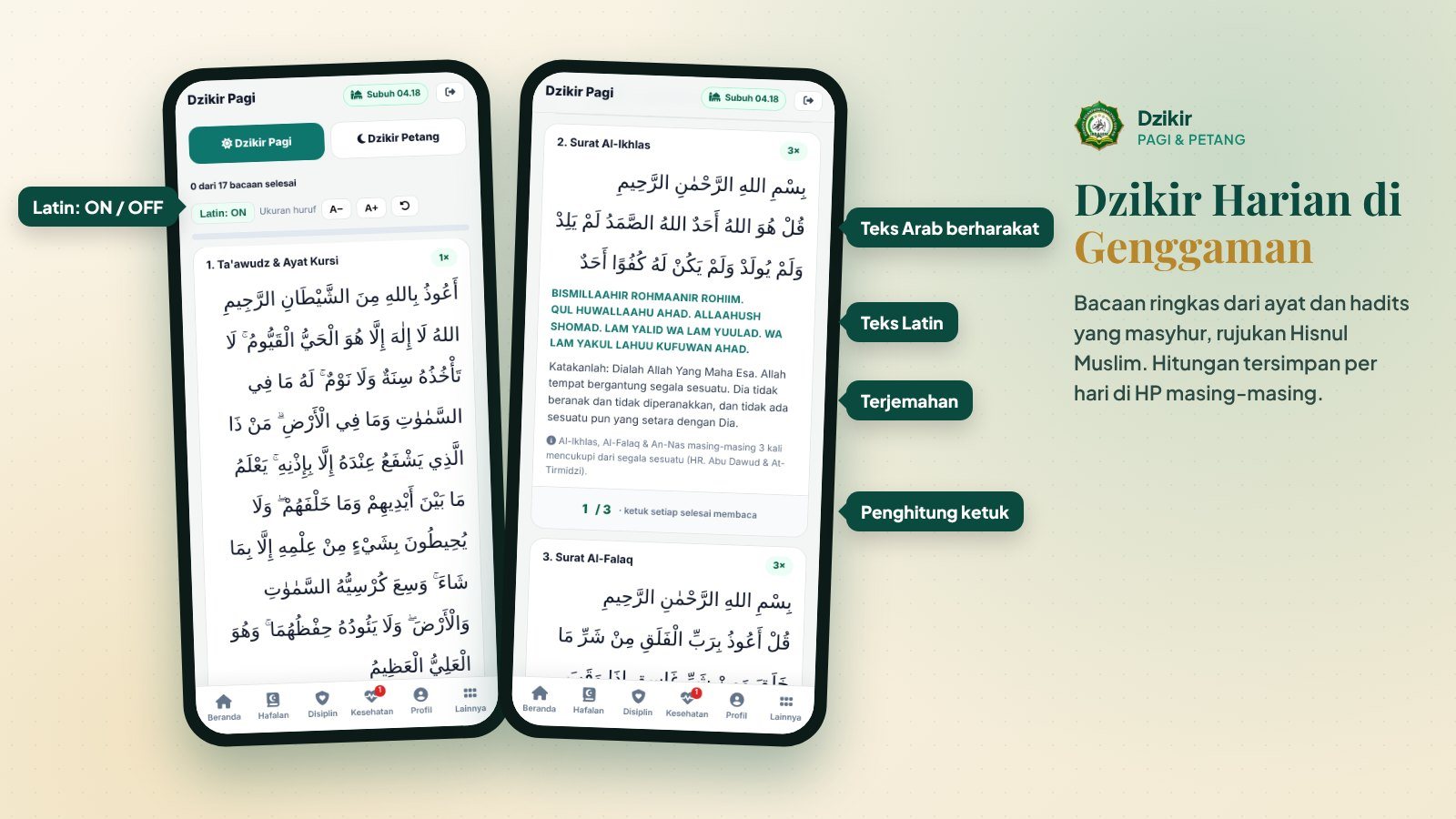
Vowelled Arabic text, Latin transliteration, translation, and a tap counter on one page.
The Recitations Included
The page contains a concise set of morning and evening adhkar taken from well-known Qur'anic verses and hadiths, with Hisn al-Muslim by Sa'id ibn Ali al-Qahtani as the reference. Among them:
- Seeking refuge (ta'awwudh) and Ayat al-Kursi.
- Surat al-Ikhlas, al-Falaq, and an-Nas, three times each.
- The supplication for entering the morning and the evening ("Asbahna wa asbahal mulku lillah" in the morning and "Amsayna wa amsal mulku lillah" in the evening).
- Sayyid al-Istighfar, the master supplication for forgiveness.
- The supplication of being pleased with Allah as Lord, Islam as religion, and Muhammad ﷺ as Prophet.
- The supplication for well-being in body, hearing, and sight.
- The supplication for pardon and 'afiyah in this world and the Hereafter.
- "Bismillahil ladhi la yadurru…", "Hasbiyallahu la ilaha illa huw…", and "Ya Hayyu ya Qayyum…".
- Seeking refuge in the perfect words of Allah (evening only).
- Tasbih, tahlil, istighfar (morning only), and sending blessings upon the Prophet ﷺ.
The page adjusts to the time of day automatically. Opened in the morning, it shows the morning adhkar; opened in the afternoon or evening, it shows the evening adhkar. You can of course switch at any time with the Morning and Evening buttons at the top.
Arabic, Transliteration, and Translation
Each recitation is shown in three layers:
- Fully vowelled Arabic text in a clear typeface, which can be enlarged or reduced with the A− and A+ buttons.
- Latin transliteration in capital letters, to help those who do not yet read Arabic fluently.
- A translation, so that we understand what we are saying. (In SIPANDAI the translation is in Indonesian.)
The transliteration can be hidden with the Latin: ON/OFF button. For those who already read Arabic well, hiding it makes the page more compact and helps them focus on the original words. This choice is also saved on each phone.
We want to be honest about transliteration: it is only an aid. Some Arabic sounds cannot be written precisely in Latin letters. We therefore encourage you to keep learning to read directly from the Arabic, little by little, and to use the transliteration as a bridge. Perhaps your child who is studying at the pesantren can be your best teacher when they come home for the holidays.
A Tap Counter: No More Losing Count
Some adhkar are repeated: three times, seven times, ten times, even a hundred times. Under each recitation there is a large button to tap each time you finish one repetition. The number goes up, the phone vibrates gently, and when the count is complete the page scrolls on to the next recitation by itself.
At the top you can see your progress, for example "8 of 17 recitations completed", with a green progress bar. The count is saved for that day on each phone. If you are interrupted halfway, the count is still there when you open the page again. The next day, the count starts fresh.
Checked Texts, Open to Correction
The adhkar texts in SIPANDAI were compiled carefully from well-known references. Even so, we welcome corrections wholeheartedly. If parents, teachers, or our Board of Experts (Dewan Pakar) find any error in the vowel marks, the transliteration, or the translation, please inform the SIPANDAI admin. We will correct it as soon as possible, and the correction will apply to all users immediately.
Why Adhkar, Qur'an Recitation, and Timely Prayer Matter for Families of Qur'an Memorizers
Some may ask why a pesantren information system should go to the trouble of providing radio, prayer reminders, and adhkar. Can't all of these be found in other apps? The answer lies in how we see Qur'an memorization education.
Memorizing the Qur'an is not a journey a child makes alone. Strong memorization grows in an environment that loves the Qur'an. At the pesantren, that environment is protected by the timetable, the memorization circles (halaqah), and the example of the mentors. When the child goes home, that environment lies entirely in the hands of the parents. If the home is used to hearing the Qur'an, if parents keep their prayers on time, and if the morning and evening adhkar are a family habit, then the holidays are no longer a time of "slipping back" but a continuation of the training at the pesantren.
The virtues of these deeds are also very great. Prayer offered on time is among the deeds most beloved to Allah, as the Prophet ﷺ answered when asked which deed is most beloved to Allah (Bukhari and Muslim). About Sayyid al-Istighfar, the Prophet ﷺ said that whoever says it during the day with firm faith and dies before the evening will be among the people of Paradise, and likewise if said at night (Bukhari). Ayat al-Kursi recited in the morning is a protection until the evening, and recited in the evening a protection until the morning (al-Hakim). Listening attentively to the Qur'an is hoped to bring mercy, as Allah says in Surat al-A'raf, verse 204.
We are also aware of the realities of modern life. Many parents work from morning until evening; some trade, farm, or work far from home. The phone is almost always in hand. Rather than the phone being only a source of distraction, we want it to be a reminder of good as well. Since parents already open SIPANDAI to see news of their child, placing worship features in the same place feels the most natural: one app to know how your child is doing and, at the same time, to look after your own worship.
There is also a reason of caution. Many radio and adhkar apps out there show advertisements that are not always appropriate, or request excessive permissions on your phone. The features in SIPANDAI carry no advertisements, ask for no permission other than notifications (and even that is optional), and are managed by the pesantren itself. For parents who are careful about what is installed on the family phone, this is a more reassuring option.
Who Can Use These Features?
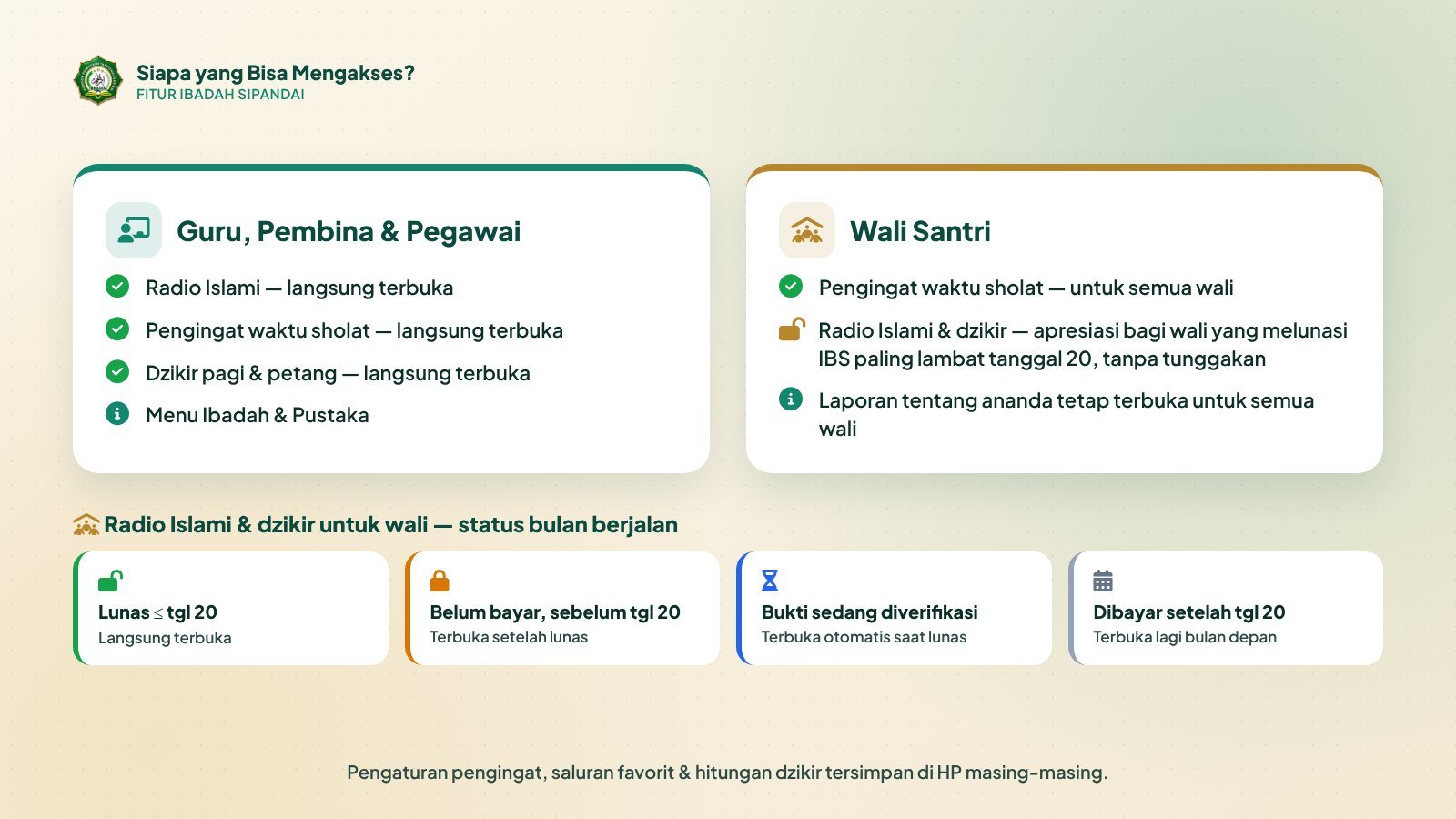
Summary of access to the SIPANDAI worship features.
These three features are for the whole PPTQ Ibrahim family. The details are as follows.
Teachers, Mentors, and Staff
All teacher, mentor, and staff accounts, including teachers at the MTs, MA, and RA, the administration office, the treasurers, the health unit (UKS), and the leadership, can use Islamic Radio, prayer time reminders, and morning and evening adhkar straight away. They are in the Worship & Library menu.
For teachers, the prayer reminder is especially helpful between lessons and administrative work. Qur'an recitation can keep them company while preparing lesson plans or marking assignments, and the morning adhkar can be recited before the first lesson begins.
Parents
For parents, the arrangement is as follows:
- Prayer time reminders and the prayer schedule are open to all parents, with no conditions at all.
- Islamic Radio and morning and evening adhkar are opened as a token of appreciation for parents who pay the monthly student contribution (IBS) on time, that is, in full no later than the 20th of each month, with no arrears from previous months.
We understand this arrangement may raise questions, so we explain our reasons openly. The IBS is the main source of the pesantren's operating budget: the students' meals, the honoraria of teachers and mentors, electricity, water, and dormitory upkeep. When the IBS comes in on time, the pesantren can meet its obligations on time too, and services for the students run smoothly. Islamic Radio and the adhkar page are a small thank-you to parents who help make that possible.
This arrangement has nothing to do with the services provided to your child. Memorization, health, mentoring, and every report about your child remain available to all parents as usual.
How Does It Work for Parents?
- If this month's IBS is paid in full by the 20th and there are no arrears, Islamic Radio and the adhkar open immediately.
- If it has not been paid yet and it is not yet the 20th, the page shows a padlock and a message that the feature will open once this month's IBS is paid by the 20th.
- If a transfer receipt is being verified by the administration office, the feature opens automatically once the payment is confirmed.
- If payment is made after the 20th, the feature opens again from the following month, provided that month's IBS is paid on time.
- Students exempted from the IBS (for example, scholarship recipients) receive full access.
On the parents' home screen, the Islamic Radio and Adhkar icons show a padlock while locked and change to the normal icon once opened. Every locked page has a View / pay IBS button that leads to the payment page.
Benefits for Parents, Students, Teachers, and the Pesantren
For Parents
- Sharing the pesantren atmosphere at home. Qur'an recitation playing at home is a reminder of the memorization your child is striving for.
- Praying more punctually. Gentle but consistent reminders help build the habit.
- Making adhkar a routine. The tap counter and daily progress make the morning and evening adhkar easier to keep.
- Being an example for your child. When your child comes home and sees that their parents also keep the adhkar and pray on time, the advice of the pesantren becomes all the stronger.
For Students
Students do not use phones in the dormitory, in line with pesantren rules. Yet they benefit indirectly. The habits instilled at the pesantren are not broken during the holidays, because the atmosphere at home is similar: parents also keep their prayer times, recite adhkar, and listen to the Qur'an. Consistency between the pesantren and the home is one of the keys to successful character education.
For Teachers, Mentors, and Staff
- Prayer reminders ensure that teaching and administration do not push prayer away from its proper time.
- Qur'an recitation and lectures can be a calming companion at work.
- Morning adhkar before teaching provides a sense of calm for the day ahead.
- Teachers who look after their own worship find it easier to be role models for students.
For the Pesantren and the Foundation
For the pesantren, these features are part of the effort to build a complete educational ecosystem, in which students, parents, teachers, and staff move with the same values. The appreciation for parents who pay the IBS punctually is also expected to support smooth operations, so that services for students can keep improving.
Getting Started in Four Steps
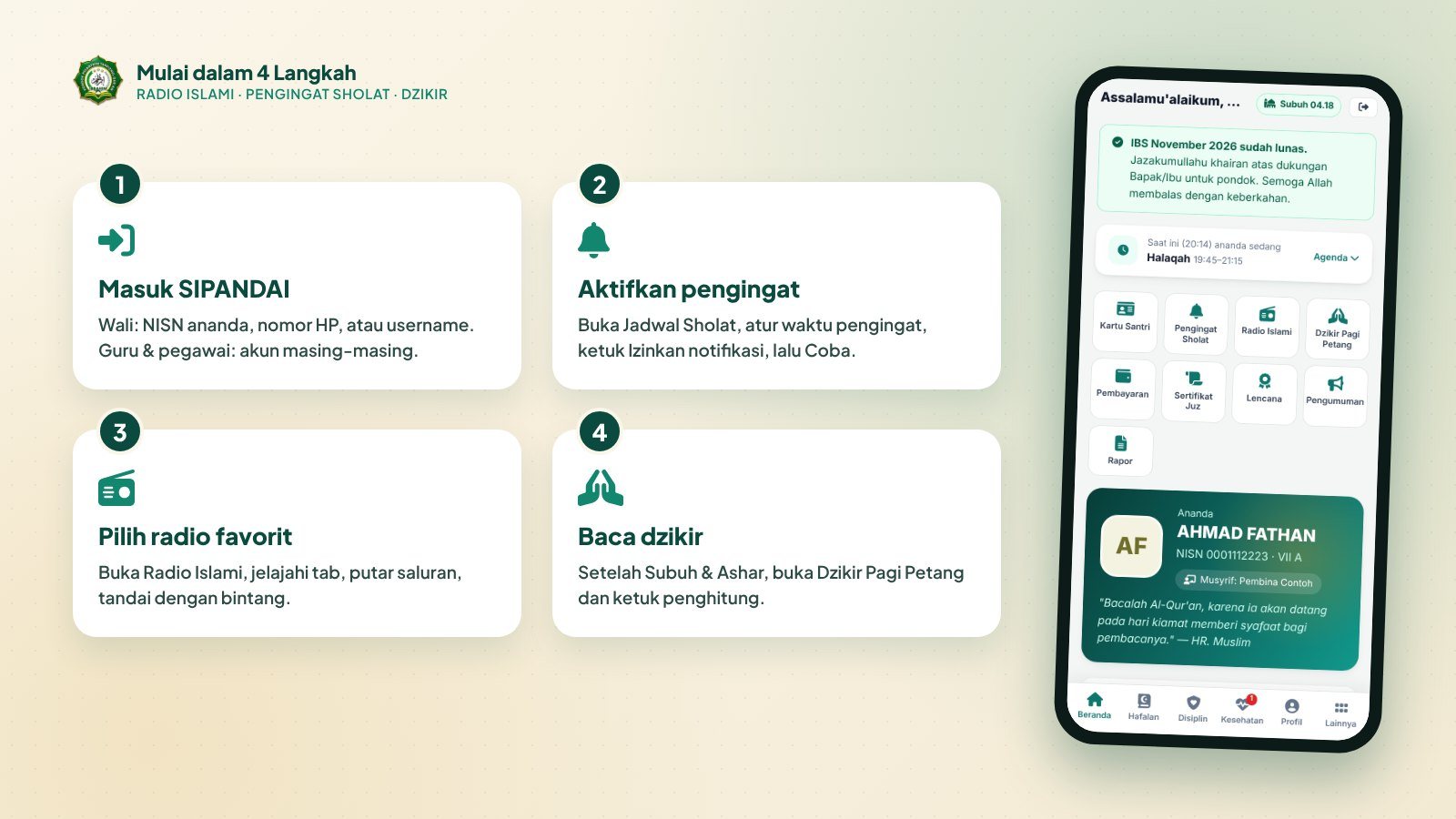
Four steps to start using the worship features in SIPANDAI.
- Sign in to SIPANDAI. Parents sign in with their child's student number (NISN), the parent's phone number, or a username of their own. Teachers and staff sign in with their own accounts. Forgot your password? Contact the pesantren admin, and remember: never give your password to anyone.
- Turn on prayer reminders. Open the Prayer Schedule, set the reminders as you like, tap Allow notifications, then tap Test.
- Choose your favourite stations. Open Islamic Radio, browse the tabs, play a few stations, and star the ones you like.
- Schedule your adhkar. After Fajr and Asr, open Morning & Evening Adhkar and recite one by one while tapping the counter.
A Day with SIPANDAI: An Illustration
To make it easier to picture, here is an illustration of one parent's day. The names and circumstances are fictional, but the flow shows how these features are used.
Mrs Fatimah is the mother of Ahmad Fathan, a Grade 7 student at PPTQ Ibrahim. She works in an office in town. At 4:20 a.m., her phone shows a notice that Fajr begins in ten minutes. She gets up, performs ablution, and prays. At that moment in Uluale, her son is lining up to walk to the pesantren mosque.
After Fajr, Mrs Fatimah opens the morning adhkar. She keeps the transliteration switched on, because she is still learning to read Arabic more fluently. She taps the counter after each recitation. Halfway through, her youngest child calls her. She puts the phone down, and when she comes back, her count is exactly where she left it.
At the office, she plays a Qur'an recitation station quietly through earphones while working on a report. Shortly before Dhuhr, the soft chime sounds. She finishes the last sentence of her report and heads to the office prayer room.
In the afternoon, on her way home, she opens the parents' portal to see Fathan's memorization for the day and smiles at the note "fluent" from his mentor. After Asr, she recites the evening adhkar. That night she calls Fathan at a time she knows from the pesantren schedule, and tells him that she too has started reciting Ayat al-Kursi every morning and evening, just as he does at the pesantren.
The illustration is simple, but that is exactly our aim: SIPANDAI is not only a window for seeing how your child is doing, but also a bridge that helps home and pesantren move in step.
Etiquette for Listening to Radio and Reciting Adhkar
A good feature is all the more blessed when used with good manners. A few reminders for all of us:
- Listen to the Qur'an attentively. Allah commands us to listen and pay attention when the Qur'an is recited (al-A'raf: 204). When you are very busy, it may be better to choose a lecture station or lower the volume, rather than treating Qur'an recitation as mere background sound.
- Mind the volume. Respect neighbours, colleagues, and those who are resting. Use earphones in public places.
- Listen to trustworthy sources. For lectures, prefer speakers whose knowledge is clear and whose message brings calm.
- Adhkar is not a counting contest. The counter is only an aid. What matters most is a present heart and an understanding of the meaning.
- A reminder is not a substitute for intention. The chime only reminds. What moves our feet towards prayer is still our intention and sincerity.
Behind the Scenes: Developed from Within the Pesantren
Like SIPANDAI's other features, Islamic Radio, prayer time reminders, and the morning and evening adhkar were not bought ready-made from an outside vendor. SIPANDAI is designed and developed by Muh. Ikhsan, Chairman of the Ibrahim La Useng Foundation, who is also active in education and technology. Because it is developed within the foundation itself, suggestions from parents, teachers, and mentors can be acted upon quickly.
This month's features also came from conversations with parents and teachers. Some parents wanted to listen to Qur'an recitation without searching for yet another app. Some teachers wanted to be reminded of prayer times between lessons. Others wanted the morning and evening adhkar complete with transliteration and translation. We brought all of that feedback together into the three features you are reading about now.
We have also paid attention to privacy. Reminder settings, favourite stations, adhkar font size, and adhkar counts are stored on each phone, not sent to the server. The pesantren does not record which stations you listen to or how many times you recite your adhkar. The only thing the server records is the list of stations that failed to play, so they can be hidden for all users.
Looking for the Best Qur'an Memorization School in Sidrap or South Sulawesi? Start with the Right Questions
For parents reading this because they are looking for a pesantren for their son or daughter, we would like to share a few questions we believe are worth asking, wherever you enquire. "The best" can mean many things. The best pesantren for one child is not necessarily the best for another. So start with the right questions:
- How is the memorization programme measured? Are there clear memorization targets, daily session records, and exams that test the quality of memorization, not just the quantity?
- How is daily worship nurtured? Is students' congregational prayer monitored, and how are adhkar and good manners instilled?
- How are parents kept informed? Can parents follow their child's progress regularly, or only at report time?
- Is there recognised formal education? Do students receive a valid madrasah certificate to continue to the next level?
- How are students' health and safety protected? Is there a health service, clear leave rules, and dormitory mentors who accompany the students?
- How is discipline upheld? Are the rules written down, fair, and known to parents?
- What are the fees, and what do they include? Are the details transparent from the start?
We ask these questions of ourselves too. At PPTQ Ibrahim, you can see the answers for yourself, not only in brochures, but in the parents' portal that our families use every day.
Why Parents Choose PPTQ Ibrahim
- A measured memorization programme: daily mutaba'ah, memorization targets, and a 10-juz tasmi' exam in a single sitting before the Board of Experts.
- Monitored congregational prayer: students' attendance at congregational prayer is recorded with QR student cards at the mosque door.
- Parents always connected: the SIPANDAI parents' portal for following memorization, discipline, health, and payments from a phone, now with Islamic Radio, prayer reminders, and morning and evening adhkar.
- Integrated formal education: RA, MTs, and MA Ibrahim under one foundation, running alongside the memorization programme.
- 24-hour dormitory mentoring: students are mentored by male and female dormitory mentors (musyrif and musyrifah), supported by a health unit (UKS) and a cooperative.
- Verifiable certificates: memorization certificates for each juz and mutqin certificates with a QR code that can be checked for authenticity.
A Qur'an Memorization School for Boys and Girls with Formal Madrasah Education
PPTQ Ibrahim accepts boys and girls in separate dormitories, in two educational tracks:
- Tahfizh + Madrasah Tsanawiyah (MTs), equivalent to junior high school.
- Tahfizh + Madrasah Aliyah (MA), equivalent to senior high school.
Students who complete three years of study receive certificates from both the pesantren and the madrasah. The pesantren is located on Jl. Jend. A. Yani (Rappang–Parepare main road, km 11), Uluale, Watang Pulu District, Sidenreng Rappang Regency, South Sulawesi. It is easy to reach from Rappang, Pangkajene Sidenreng, and Parepare, making it convenient for families from Sidrap, Parepare, Pinrang, Enrekang, Wajo, Soppeng, Barru, and other regencies in South Sulawesi.
What Is Student Life Like at PPTQ Ibrahim?
A student's day begins before Fajr. After Fajr in congregation and the morning adhkar, students recite their new memorization in tahfizh circles with their mentor. From morning until midday, they study at the madrasah according to their level. Afternoons and evenings are filled with revision (muraja'ah), lessons, extracurricular activities, and sufficient rest.
Every memorization session is recorded in SIPANDAI. Attendance at congregational prayer is recorded by scanning student cards at the mosque door. Students' health is looked after by the health unit staff, and discipline is nurtured through written rules that parents know. All these records can be read by parents from their phones, now accompanied by worship features that bring home and pesantren even closer.
Admission Fees at PPTQ Ibrahim
The following information applies at the time of writing. The latest details are always available on the Admissions page.
- No registration fee.
- Quota for the 2027/2028 academic year: 150 students (75 boys and 75 girls).
- Wave 1: 1 September 2026 – 30 July 2027. Wave 2: 1–31 August 2027.
- Initial admission costs: building contribution IDR 7,500,000 and three sets of uniforms with accessories IDR 1,000,000 (total IDR 8,500,000).
- Monthly fee (IBS): IDR 850,000 for new students and IDR 800,000 for transfer students, including students' meals.
- Free bedding and furniture: bed, mattress, pillow, bolster, sheets, and wardrobe.
- New student bonus: free wash-and-fold laundry up to 150 kg.
- MTs Ibrahim graduates continuing to MA Ibrahim do not pay the building contribution again, only uniforms and the IBS.
Every accepted student's family receives a parents' portal account from the first day, including prayer time reminders. Islamic Radio and the morning and evening adhkar are open to parents who pay the IBS by the 20th of each month.
Tips for Parents: Using the Worship Features Wisely
- Start small. There is no need to recite all the adhkar at once. Begin with Ayat al-Kursi and the last three surahs, then add more little by little.
- Involve the whole family. Play Qur'an recitation at home during family time, and invite your child's younger siblings to join the adhkar.
- Tell your child about it. When you call, tell them that you too are keeping the adhkar and praying on time. Children feel supported, not just watched.
- Use reminders, but do not depend on them. Let the reminder be a help while you build the habit of getting ready before the call to prayer.
- Pay the IBS before the 20th. Besides opening Islamic Radio and the adhkar, punctual payment greatly helps the pesantren serve your child well.
- Keep your account secure. Never give your password to anyone, including people who claim to be from the pesantren. Pesantren staff will never ask for a parent's password.
Frequently Asked Questions
Do these features cost anything?
No. Islamic Radio, prayer time reminders, and the morning and evening adhkar are part of SIPANDAI at no extra cost. For parents, Islamic Radio and the adhkar open as a token of appreciation for those who pay the IBS by the 20th with no arrears.
Why does my Islamic Radio show a padlock?
Most likely this month's IBS has not been paid in full, was paid after the 20th, is still awaiting verification by the administration office, or there are arrears from a previous month. The exact reason is written on the Islamic Radio page. Tap View / pay IBS to check your payment status.
I transferred the payment before the 20th, but the feature is still locked. Why?
Transfer receipts must first be verified by the administration office or treasurer. Once the payment is confirmed with a payment date no later than the 20th, the feature opens automatically. If it is still locked after one or two working days, please contact the pesantren administration office.
Will the prayer reminder still sound when my phone is locked?
If notifications are allowed and SIPANDAI has not been force-closed, notifications can appear in your phone's notification bar. Each phone behaves differently, especially because of battery-saving settings. For better reliability, add SIPANDAI to your home screen and allow notifications.
I live outside Sidrap. Does the schedule match my area?
The schedule is calculated for the pesantren's location in Uluale, Sidrap. In other areas there may be a difference of a few minutes, depending on the distance. Follow the call to prayer at your local mosque for the start of prayer times where you live.
How much data does the radio use?
It depends on the stream quality. Look at the kbps figure for each station: the smaller the number, the less data it uses. For long listening sessions, it is best to listen on Wi-Fi.
Can students listen to Islamic Radio in the dormitory?
These features are intended for parents, teachers, and staff. In line with pesantren rules, students do not keep phones in the dormitory. At the pesantren, students hear and recite the Qur'an directly with their mentors and friends.
What if I find an error in the adhkar text?
Please report it to the SIPANDAI admin through the Feedback & Suggestions menu in the parents' portal, or through the mentors and teachers. We will check and correct it as soon as possible.
Tahfidz or tahfizh: which spelling is correct?
Both refer to the same Arabic word, tahfīẓ, meaning memorization. The letter ظ (ẓa) is closer to "zh", so "tahfizh" follows Arabic–Latin transliteration guidelines more closely. However, "tahfidz" is also very common in Indonesia. That is why searches for "pesantren tahfidz", "tahfidz Quran school", or "pesantren tahfizh" all refer to the same kind of boarding school.
How do I enrol my child at PPTQ Ibrahim?
Visit the Admissions page to fill in the form and see the latest details, or contact the new student admissions committee by phone/WhatsApp at +62 823 4544 9699.
Closing: Home and Pesantren Moving in Step
A student's education does not only take place within the walls of the pesantren. It also takes place at home, in telephone conversations, and in the example a child sees in their parents. With Islamic Radio, prayer time reminders, and the morning and evening adhkar, we hope SIPANDAI can be a small bridge that brings the atmosphere of the pesantren into your home, and onto the desks of our teachers and staff.
We know these features can still be improved. Your feedback is very welcome, so that SIPANDAI keeps growing according to the real needs of the PPTQ Ibrahim family. May Allah accept the worship of all of us, keep our children firm in their memorization and character, and make both home and pesantren places filled with the Qur'an.
For families who would like to join the PPTQ Ibrahim family, admissions for the 2027/2028 academic year are now open with no registration fee. Visit the Admissions page or contact us on WhatsApp at +62 823 4544 9699.