

"Can my child really memorize the Qur'an? He isn't the smartest in his class." We often hear this from parents who visit the pesantren. Others ask the opposite: "Why go to all the trouble of memorizing when the mushaf and Qur'an apps are everywhere?"
Both questions are natural, and both have beautiful answers. The Qur'an itself declares that it has been made easy to remember. The Prophet ﷺ also explained that those who carry the Qur'an in their hearts hold a special place, in this world and the next. This article invites you to learn about the virtues of those who memorize the Qur'an, based on verses and hadith, the etiquette they should keep, how to preserve memorization, and the role of parents at home.
"And We have certainly made the Qur'an easy to remember." (Qur'an, Al-Qamar 54:17)
The Qur'an Has Been Made Easy to Remember
In Surah Al-Qamar, Allah repeats one sentence four times: "Wa laqad yassarnal-Qur'āna lidz-dzikri fahal min muddakir", "And We have certainly made the Qur'an easy to remember, so is there anyone who will take heed?" (Al-Qamar 54:17, 22, 32, 40). Commentators explain that this ease covers reciting, understanding, and memorizing it.
That is why we find ten-year-old children who have memorized all 30 juz, retirees who begin memorizing after they stop working, and even memorizers who do not speak Arabic. No other book in the world is memorized by so many people, of so many nations and ages, letter by letter.
Allah also says, "Rather, it is clear verses in the hearts of those who have been given knowledge" (Al-'Ankabut 29:49). The Qur'an is preserved not only on pages but also in human hearts. And Allah Himself guarantees its preservation: "Indeed, it is We who sent down the Reminder, and indeed, We will be its guardian" (Al-Hijr 15:9). Those who memorize it are one of the ways Allah preserves His Book from generation to generation.
Ten Virtues of Those Who Memorize the Qur'an
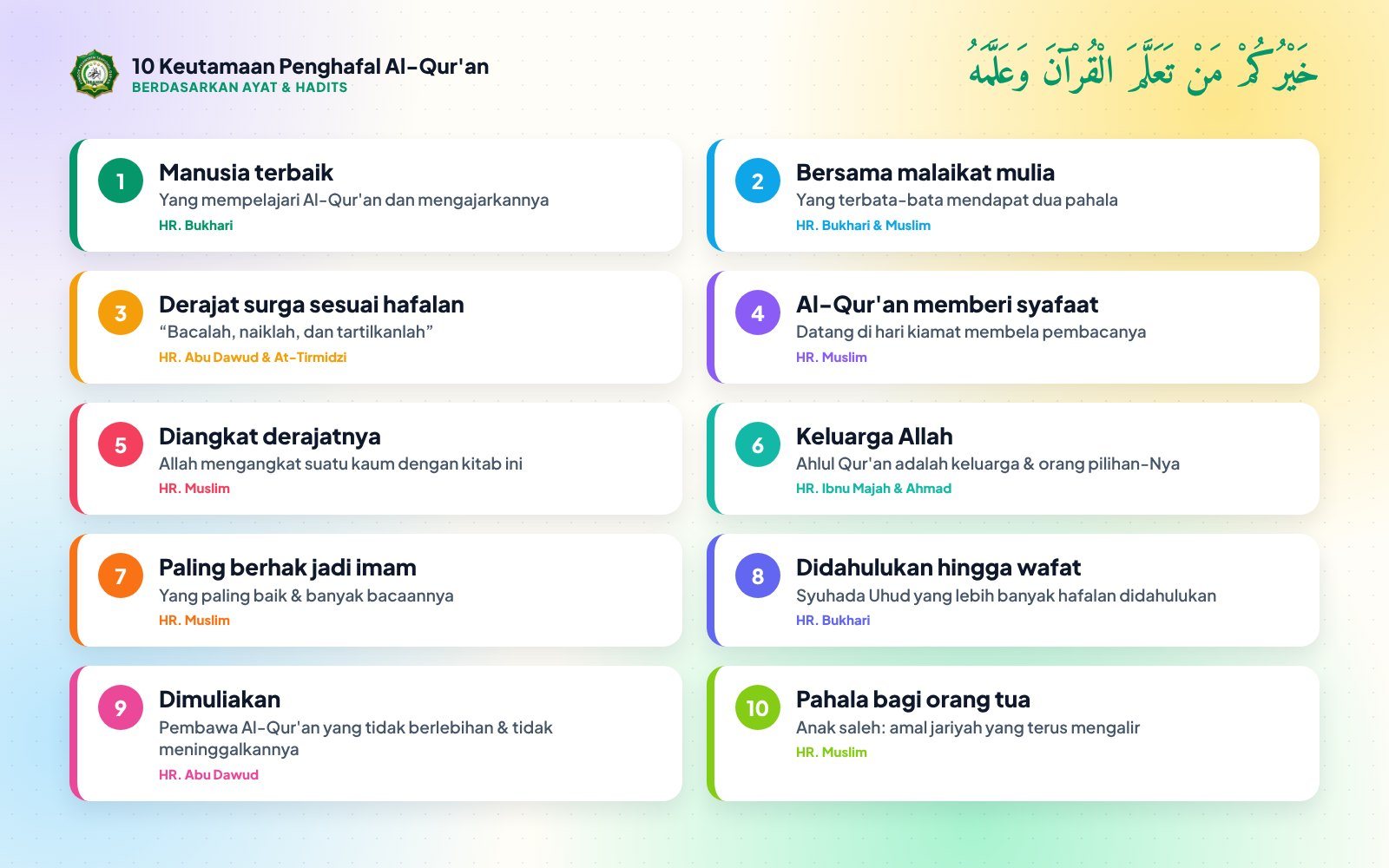
Ten virtues of those who memorize the Qur'an, with their sources.
Here are the virtues of those who memorize and recite the Qur'an mentioned in the verses and hadith. We include the sources so you can refer to them directly.
1. Among the best of people
The Prophet ﷺ said, "The best of you are those who learn the Qur'an and teach it" (Bukhari). "Best" here is not measured by wealth or position, but by closeness to the Qur'an: learning it and then teaching it to others.
2. In the company of noble angels
"The one who is skilled in reciting the Qur'an will be with the noble and obedient scribes (angels). And the one who recites the Qur'an and stumbles over it, finding it difficult, will have a double reward" (Bukhari and Muslim). This hadith is a great comfort for children who are just beginning. Their struggle is not wasted; it earns a double reward.
3. A rank in Paradise according to what is memorized
"It will be said to the companion of the Qur'an: Recite, rise, and recite slowly as you used to recite slowly in the world, for your rank will be at the last verse you recite" (Abu Dawud and Tirmidhi; Tirmidhi graded it hasan sahih). Scholars explain that the "companion of the Qur'an" is one who accompanies it by reciting, memorizing, and acting upon it.
4. The Qur'an will intercede
"Recite the Qur'an, for it will come on the Day of Resurrection as an intercessor for its companions" (Muslim). The Book we preserve in this world will speak for us on a day when no one can intercede except by Allah's permission.
5. Raised in rank by Allah
"Allah raises some people by this Book and lowers others by it" (Muslim). 'Umar ibn al-Khattab said this when he learned that a freed slave had been appointed governor over the people of Makkah because he knew the Qur'an well and was learned in the laws of inheritance.
6. The people of Allah and His chosen ones
"Allah has His own people among mankind." The companions asked, "Who are they, O Messenger of Allah?" He said, "The people of the Qur'an, they are the people of Allah and His chosen ones" (Ibn Majah and Ahmad; graded sahih by some hadith scholars).
7. Most entitled to lead the prayer
"The one who should lead a people in prayer is the one who is most versed in the Book of Allah" (Muslim). That is why, in many mosques, young memorizers are often asked to lead the prayer, especially during Ramadan.
8. Given precedence even in death
When the martyrs of Uhud were buried, two men were placed in one grave. The Prophet ﷺ asked, "Which of them knew more of the Qur'an?" and he placed that man first in the grave (Bukhari). The honor of the Qur'an's bearer was observed even at burial.
9. Honored as a way of glorifying Allah
"Part of glorifying Allah is honoring the gray-haired Muslim, and the bearer of the Qur'an who neither goes to extremes in it nor neglects it…" (Abu Dawud, graded hasan). Note the conditions: neither going to extremes nor neglecting it. This is the balance a memorizer must keep.
10. An honor shared by parents
There are narrations stating that the parents of one who recites the Qur'an and acts upon it will be adorned with a crown or garments of honor on the Day of Resurrection (Abu Dawud, Ahmad, and al-Hakim). Hadith scholars differ on the strength of these chains; some consider them weak, while others strengthen them through other routes. Even without them, we know from an authentic hadith that a righteous child is an ongoing charity whose reward continues to reach the parents (Muslim). Raising a child to love and memorize the Qur'an is one of the finest forms of that ongoing charity.
Memorizing Is Not Only for the Brightest Children
Back to the question at the start: can only gifted children memorize the Qur'an? The experience of tahfidz teachers shows that what matters most is not intelligence but three things: a sincere intention, a consistent habit, and a supportive environment.
Some children add new memorization quickly but also forget quickly. Others are slow, yet their memorization is strong because they review diligently. Both can reach the finish line. The hadith about a double reward for those who stumble is both a comfort and an encouragement: Allah does not judge speed, but sincerity and effort.
What should be avoided is comparing one child with another. Every child has their own pace. The task of parents and teachers is to make sure the child keeps moving forward, little by little, without losing their love for the Qur'an.
How Long Does It Take to Memorize 30 Juz?

Estimated time to memorize 30 juz by pages per day (effective days, not counting review days and holidays).
The standard Madinah mushaf widely used in Indonesia has 604 pages, about 20 pages per juz. From this we can make a simple estimate:
- Half a page a day: about 1,208 effective days, a little over 3 years.
- One page a day: about 604 effective days, roughly 1 year and 8 months.
- Two pages a day: about 302 effective days, roughly 10 months.
These figures are only a picture. In practice there are days for full review, exams, holidays, and illness. Some juz are easier and some harder. The real lesson of the calculation is this: a little done regularly beats a lot done rarely. Half a page a day, kept up for years, can take a child to the completion of all 30 juz during their school years.
Keeping Memorization: Harder Than Adding to It
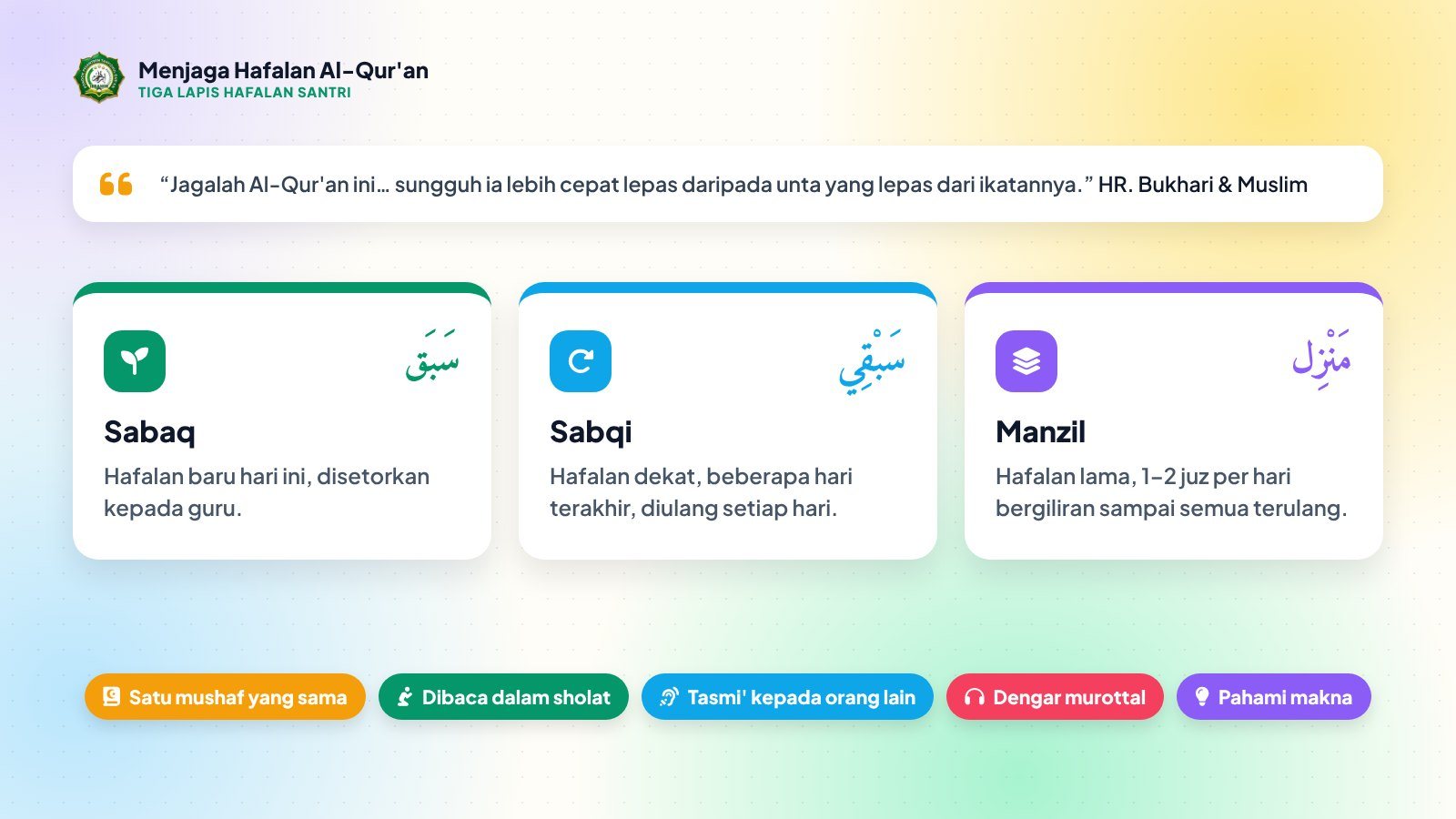
Three layers of memorization: new, recent, and old.
The Prophet ﷺ warned, "Keep up with this Qur'an. By the One in whose hand is Muhammad's soul, it escapes more quickly than a camel from its tether" (Bukhari and Muslim). Memorizers know exactly what this means: adding new memorization is hard, but keeping it requires even more patience.
That is why many tahfidz schools divide a student's memorization into three layers, often called sabaq, sabqi, and manzil:
- Sabaq (new lesson): the verses memorized today, recited to the teacher.
- Sabqi (recent lessons): what was memorized over the last few days or weeks and is not yet firm, reviewed every day.
- Manzil (old memorization): juz memorized long ago, reviewed in rotation, for example one or two juz a day, so that everything is revisited within a few weeks.
Other methods that help:
- Use the same mushaf. Visual memory of where a verse sits on the page is a great help.
- Recite your memorization in prayer. Voluntary prayers, especially night prayer, are the most blessed place for review.
- Tasmi', reciting to someone else. Mistakes we don't notice will be heard by the listener.
- Listen to recitations. Listening repeatedly to a good reciter strengthens both recitation and memory.
- Understand the meaning. Verses whose meaning is understood are easier to remember and easier to practice.
The Etiquette of Those Who Memorize the Qur'an
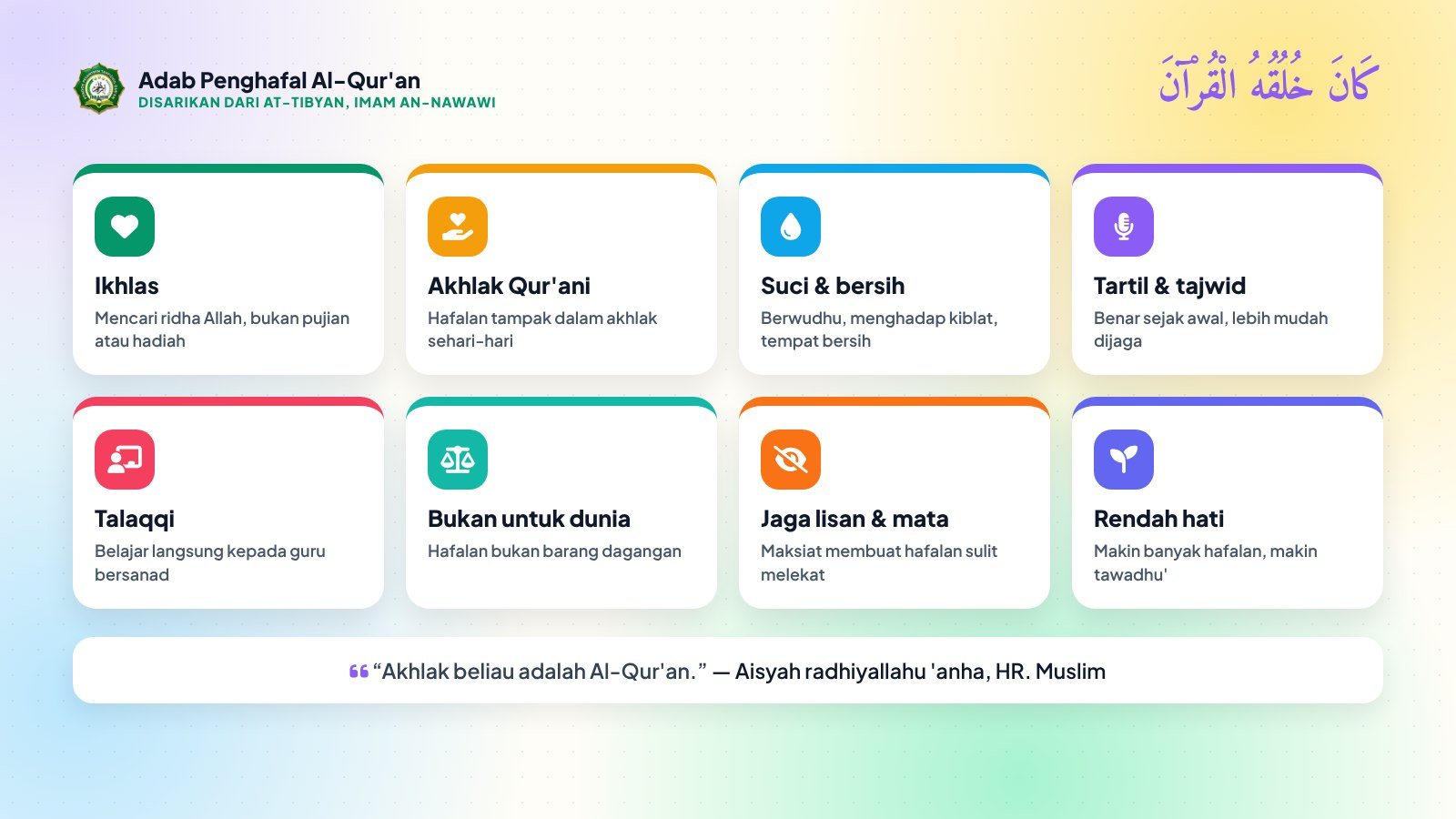
Etiquette for memorizers, drawn from Imam an-Nawawi's At-Tibyan.
Imam an-Nawawi wrote a book devoted to etiquette with the Qur'an, At-Tibyan fi Adab Hamalat al-Qur'an. From this book and the advice of other scholars, here are the main points of etiquette for memorizers:
- Sincerity. Memorize to seek Allah's pleasure, not praise, titles, or prizes. The intention needs constant renewal, because it easily shifts.
- Taking on the character of the Qur'an. 'Aishah described the Prophet's ﷺ character in one sentence: "His character was the Qur'an" (Muslim). Memorization that does not show in one's character is not yet complete.
- Purity and cleanliness. Be in a state of wudu when holding the mushaf, face the qibla, and recite in a clean place.
- Reciting with tartil and tajwid. Memorizing with correct recitation from the start is far easier than correcting mistakes later.
- Learning directly from a teacher (talaqqi). The Qur'an has been passed on from mouth to mouth since the Prophet ﷺ received it from Jibril. An unbroken chain of recitation is a distinction of this ummah.
- Not using the Qur'an merely to gain worldly things. Memorization is not a commodity, nor something to boast about.
- Guarding the tongue and the eyes. Scholars remind us that sins cloud the heart and make memorization hard to retain.
- Humility. The more one memorizes, the greater the responsibility. A good memorizer becomes ever more humble.
The Role of Parents: Memorizers Grow from Home

Eight ways parents can support a child who is memorizing the Qur'an.
A tahfidz boarding school provides teachers, schedules, and an environment. But parents still play a role no one else can fill. Here are some things you can do:
- Pray every day. A parent's supplication for their child is among those that are answered (Ibn Majah). The Prophet's ﷺ du'a for Ibn 'Abbas, "Allāhumma 'allimhul-kitāb" (O Allah, teach him the Book), can be a daily du'a for your child.
- Be a role model. Children love the Qur'an more easily when they see their parents reading it every day, even just a few verses.
- Guard your child's intention. Avoid promising big prizes that make a child memorize for the reward. Appreciation is fine, but the goal remains Allah.
- Be patient with the process. There will be times when progress feels slow or slips back. What your child needs then is support, not comparison with others.
- Keep up review during the holidays. Holidays are the real test of memorization. Set aside time each day, for example after Fajr and after Maghrib, for review. You can listen along while following in the mushaf.
- Be wise about devices. Screen entertainment easily crowds out review time. Agree clearly on screen time and content during the holidays.
- Provide halal food and enough sleep. A healthy body and good rest have a great effect on memory.
- Stay in touch with the supervisor. Ask about your child's progress, their difficulties, and how you can help from home. Parents and teachers working together are a great strength for a child.
Five Common Mistakes
- Chasing quantity and forgetting quality. Memorizing a lot but without proper recitation and with frequent lapses. Better a little that is mutqin, firm and correct.
- Adding without reviewing. New memorization keeps growing while the old slowly disappears.
- Studying alone without a teacher. Uncorrected recitation errors can persist for years.
- Memorizing under pressure. A child who memorizes out of fear rather than love easily stops when no one is watching.
- Feeling that completion is the end. Completing the memorization is not the finish line but the start of the responsibility to preserve it and live by it.
Memorizing and Practicing
The companions of the Prophet ﷺ were known to learn the Qur'an ten verses at a time. They did not move on to the next verses until they had learned the knowledge and practice contained in them. Some early scholars said that in this way they learned knowledge and action together.
This is the ultimate goal of memorizing the Qur'an: not merely storing verses in memory, but bringing the Qur'an into life. A memorizer who is honest, kind to their parents, steadfast in prayer, and beneficial to others is a living picture of the verses they carry.
Choosing a Qur'an Memorization Pesantren: What to Look For
For parents looking for a tahfidz pesantren, whether in Sidrap, in South Sulawesi, or elsewhere, the following points may help as you put together your list:
- A clear system of recitation and review. Is there a schedule for sabaq, sabqi, and manzil, with progress records for every student?
- Teachers with a chain of recitation or proper training. Who listens to the students' memorization, and how good is their recitation?
- Exams that test the strength of memorization. For example, reciting several juz in one sitting, not just counting pages recited.
- Nurturing of manners and worship. How are congregational prayer, adhkar, and character built day to day?
- Parental involvement. Can parents follow their child's memorization progress regularly?
- Balance with formal education. Do students still receive recognized madrasah education?
The right pesantren is the one that fits your child's needs and character. "The best" is better measured by these points than by a big name alone.
Ibrahim Tahfidz Pesantren in Sidrap
Pondok Pesantren Tahfizhul Qur'an (PPTQ) Ibrahim in Uluale, Watang Pulu, Sidenreng Rappang Regency, South Sulawesi, is a Qur'an memorization boarding school for boys and girls. Its tahfidz program runs alongside formal education at MTs and MA Ibrahim. Every memorization session is recorded daily and can be followed by parents through the SIPANDAI parents' portal. A 10-juz tasmi' exam in one sitting is held before the Board of Experts, and memorization certificates carry a QR code that can be checked for authenticity.
Registration for new students for the 2027/2028 academic year is open, with no registration fee. The latest fees and schedule are on the Registration page, or contact the committee on WhatsApp at +62 823 4544 9699.
Frequently Asked Questions
At what age should a child start memorizing the Qur'an?
The earlier the better, as long as it is enjoyable. Young children can start with short surahs by listening and repeating. But it is never too late; many people begin as teenagers or even adults.
Does memorizing the Qur'an interfere with school?
Not with a well-organized schedule. The habit of memorizing actually trains focus, discipline, and time management. What matters is balance and enough rest.
What if my child keeps forgetting?
Forgetting is part of the process. Reduce new memorization for a while and increase review. Make sure your child recites in prayer and regularly recites to someone else.
Do parents need to have memorized the Qur'an too?
No. What matters most is support, prayer, and setting an example in reading the Qur'an. Parents can listen to their child's recitation while following in the mushaf. Many parents actually start memorizing after their child enters a pesantren.
Tahfidz or tahfizh: which is correct?
Both refer to the same Arabic word, tahfīzh, meaning memorization. "Tahfizh" follows transliteration guidelines more closely, while "tahfidz" is more common in Indonesia. A pesantren tahfidz, a pondok tahfizh, and a Qur'an memorization pesantren all refer to the same kind of school.
How do I register at Ibrahim Tahfidz Pesantren?
Visit the Registration page on this website or contact the committee on WhatsApp at +62 823 4544 9699.
Closing
Memorizing the Qur'an is a long journey made with patience, prayer, and togetherness. The child memorizes, the teacher guides, and the parents pray and set an example. May Allah make our children people of the Qur'an, His own people and His chosen ones, and make the Qur'an a light for our families in this world and an intercessor in the next.