

Many parents dream that their child will one day memorize the Qur'an. It is a beautiful dream, but often the effort only begins when the child is already a teenager and ready to enter a pesantren. In truth, the seed of love for the Qur'an can be planted much earlier: on a mother's lap, in conversations over dinner, and in the sound of a father reciting the Qur'an after Maghrib.
This article invites you to understand why childhood matters so much, which habits can be built at home, which mistakes are best avoided, and how to connect all of this with education at kindergarten, madrasah, and later a tahfizh pesantren.
Before a child memorizes the Qur'an, he first needs to love it.
Every Child Is Born Upon the Fitrah
The Messenger of Allah ﷺ said:
كُلُّ مَوْلُودٍ يُولَدُ عَلَى الْفِطْرَةِ، فَأَبَوَاهُ يُهَوِّدَانِهِ أَوْ يُنَصِّرَانِهِ أَوْ يُمَجِّسَانِهِ
"Every child is born upon the fitrah (natural disposition). It is his parents who make him a Jew, a Christian, or a Magian." (Narrated by al-Bukhari, no. 1385, and Muslim)
This hadith carries two messages. First, every child carries a natural inclination toward goodness and toward his Lord. Second, parents play a very large role in nurturing that fitrah or clouding it. Home is the first place where a child learns what his family loves and honors.
When the Qur'an is warmly present at home, a child comes to know it as part of the family's happiness, not merely a lesson to be finished.
Why Childhood Matters So Much
Child development researchers agree that the early years of life are a time of very rapid brain development. During this period, children absorb language, sounds, and the habits around them with remarkable ability. Young children can imitate songs, advertisements, or the accents of people around them without being specially taught. The same ability can be directed toward getting to know the recitation of the Qur'an.
But one thing is often forgotten: children learn not mainly from commands, but from example and atmosphere. A child who hears his father reciting the Qur'an every day, sees his mother smile when listening to murattal, and feels a warm hug when he manages to memorize a verse, is learning something far deeper than memorization: he is learning that the Qur'an is joyful and beloved.
Perhaps this is the simple secret: children will love what they see their parents love.
Eight Habits You Can Build at Home
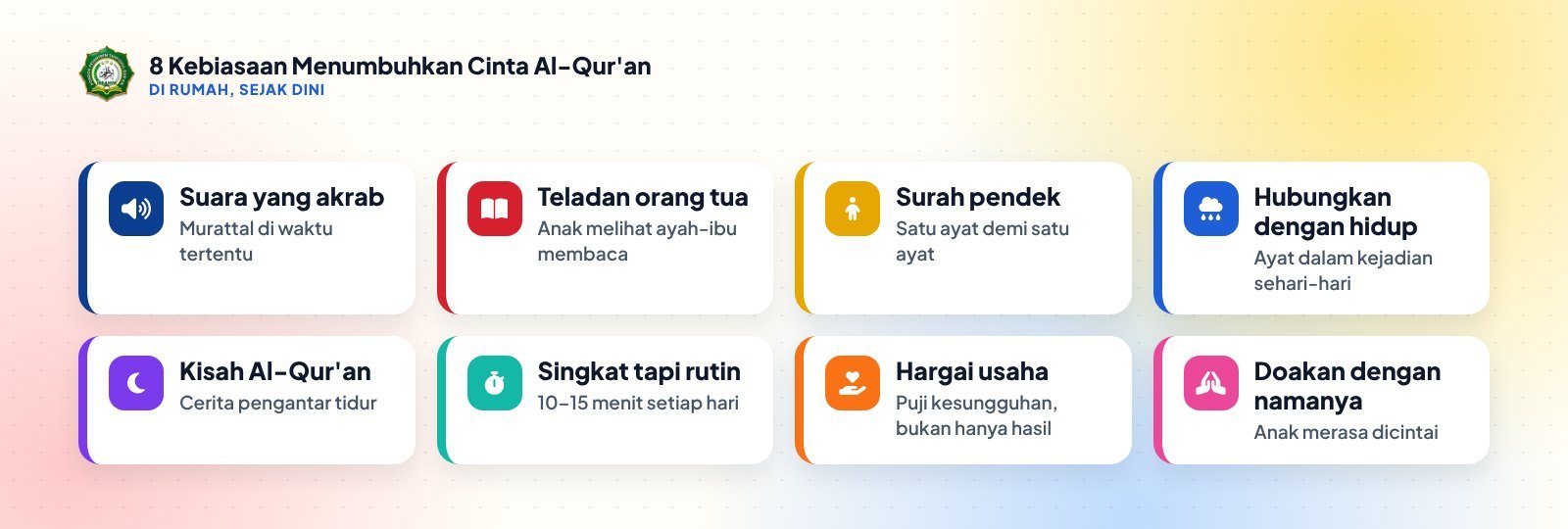
1. Make the Qur'an a familiar sound at home
Play murattal at certain times, such as in the morning before leaving or before bedtime. Choose a reciter with clear, measured recitation. For young children, a sound heard often slowly becomes a sound they recognize and long for.
2. Let your child see you reading the Qur'an
No advice is as powerful as example. If possible, make the time after Maghrib a time to read the Qur'an together, even if only a few verses. A child who sees his father and mother reading every day will see it as a natural part of life.
3. Start with short surahs
Al-Fatihah, An-Nas, Al-Falaq, Al-Ikhlas, and the other short surahs of juz 30 are a good start. Repeat them together in a cheerful voice, verse by verse. Do not hurry to add more before the earlier ones are truly fluent.
4. Connect verses with daily life
When your child shares food, tell him that Allah loves those who give. When he sees rain, help him remember that Allah sends it down. A Qur'an connected to daily experience feels close rather than foreign.
5. Tell the stories of the Qur'an
The stories of Prophet Ibrahim, Prophet Musa, Prophet Yusuf, the People of the Cave, and Luqman advising his son are very rich bedtime stories. Children love stories, and through stories they come to know the values of the Qur'an in the most natural way.
6. Set aside a short but regular time
Ten to fifteen minutes every day is far better than one hour once a week. Young children have short attention spans. A short but consistent time builds a habit without causing boredom.
7. Value effort, not only results
Praise your child's sincerity: "MashaAllah, you've really tried hard." Praise for effort encourages a child to keep trying, while praise aimed only at results sometimes makes a child afraid of failing. Small rewards may be given occasionally, but don't let a child memorize only for the sake of rewards.
8. Pray for your child by name
A parent's prayer is a strength that is often unseen. Make a habit of praying for your child after prayer, and now and then let him hear it. A child who knows he is prayed for feels loved and protected.
Teaching Prayer: A Gateway to the Qur'an
The first passages of the Qur'an most children memorize are those recited in prayer. Teaching prayer from childhood therefore also opens a door for a child to know the Qur'an. The Messenger of Allah ﷺ said:
مُرُوا أَوْلَادَكُمْ بِالصَّلَاةِ وَهُمْ أَبْنَاءُ سَبْعِ سِنِينَ
"Instruct your children to pray when they are seven years old." (Narrated by Abu Dawud, no. 495; graded hasan)
Age seven is mentioned as the beginning of instruction, not the beginning of introduction. Before that, a child can be invited to pray beside his parents, imitate the movements, and listen to the recitation, without pressure. When the time comes to be instructed, prayer is already something familiar to him.
Luqman's Advice: A Model for Parents
The Qur'an preserves a father's advice to his son in Surah Luqman. His first piece of advice concerns tawhid:
وَإِذْ قَالَ لُقْمَانُ لِابْنِهِ وَهُوَ يَعِظُهُ يَا بُنَيَّ لَا تُشْرِكْ بِاللَّهِ ۖ إِنَّ الشِّرْكَ لَظُلْمٌ عَظِيمٌ
"And remember when Luqman said to his son while advising him: O my dear son, do not associate anything with Allah. Indeed, associating others with Him is a great injustice." (Qur'an, Luqman 31:13)
Notice the way Luqman addresses him: yā bunayya, "O my dear son". The most important advice is delivered with the gentlest address. There is a great lesson here for all of us: how something is said is often as important as what is said.
The Often Forgotten Role of the Father
In many families, a child's Qur'an lessons are considered the mother's task. Yet the story of Luqman above shows a father advising his son. A father's presence in Qur'anic education sends a strong message: that the Qur'an belongs to the whole family, not only to the mother or the teacher.
A father does not have to be a recitation teacher. It is enough to be present: taking the child to pray in congregation at the mosque, listening to his memorization after work, or reading a verse before bedtime. Many adults remember the sound of their father reciting the Qur'an as one of the most soothing memories of their childhood.
Teach Meaning, Not Only Words
As children grow, they start to ask, "What does it mean?" That question is a golden opportunity. Explain the meaning of the verse in simple language suited to their age. For example, when memorizing Surah Al-Ikhlas, explain that Allah is One, needs no one, and nothing is like Him. When memorizing Surah Al-Ma'un, invite your child to think of friends or neighbors who need help.
Memorization whose meaning is understood sticks more firmly, and more importantly, is more easily put into practice. This is the bridge between the Qur'an memorized and the Qur'an brought to life.
Mistakes Best Avoided
- Forcing with anger. A child scolded every time he misreads may associate the Qur'an with fear. Correction is still needed, but deliver it patiently.
- Comparing with other children. "Look, so-and-so has already memorized three juz." Such words more often hurt than motivate.
- Chasing quantity and forgetting quality. Much memorization with incorrect recitation is hard to fix later. Pay attention to pronunciation and tajwid from the start, ideally with a teacher's guidance.
- Using the Qur'an as punishment. "If you're naughty, memorize a page!" Words like these make the Qur'an feel like a burden.
- Letting screens replace interaction. Apps and murattal videos can help, but they cannot replace a parent's voice and warmth.
Using Screens Wisely
Gadgets often become a shortcut to keep children quiet. Yet the World Health Organization (WHO), in its 2019 guidelines, recommends that children under two years old have no passive screen time, and that children aged two to four be limited to no more than one hour a day, with less being better.
This does not mean technology must be avoided entirely. Murattal from a speaker, a mushaf app for parents, or a video of the prophets' stories watched together can be beneficial. The key is together and limited: parents accompany, time is set, and the screen does not replace conversation.
Children do not need the most sophisticated screen. They need parents who are present.
Connecting Home with Kindergarten, Madrasah, and Pesantren
Home is the first school, but parents do not have to walk alone. A good Islamic educational institution can continue what has been planted at home.
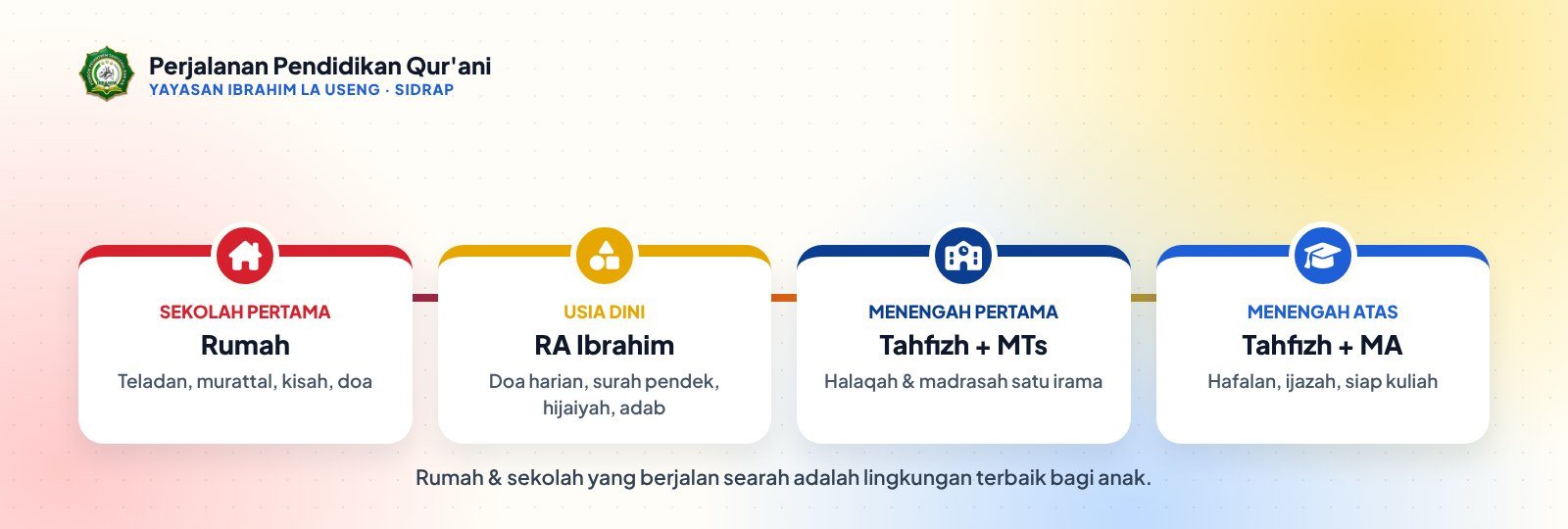
Within the Ibrahim La Useng Foundation in Sidrap, that journey can begin in early childhood:
- RA Ibrahim (Raudhatul Athfal, Islamic kindergarten), which received its founding charter from the Ministry of Religious Affairs in 2015, introduces children to daily prayers, memorization of short surahs, the hijaiyah letters, and good manners through play and storytelling.
- MTs Ibrahim and MA Ibrahim combine madrasah lessons with the tahfizh program for students of Pondok Pesantren Tahfizhul Qur'an (PPTQ) Ibrahim.
- PPTQ Ibrahim offers Tahfizh + MTs and Tahfizh + MA programs for boys and girls, with daily mutaba'ah records and tasmi' examinations before a Board of Experts.
What matters most is not where a child learns, but whether home and school move in the same direction. Good habits at school last when they continue at home, and vice versa.
A Simple Home Schedule
Here is an example that can be adapted to each family's rhythm:
- After Fajr (5 minutes): listen to or read one short surah together.
- On the way to school: review memorization by taking turns.
- After Maghrib (10–15 minutes): read the Qur'an together as a family, with the child reading his part according to his ability.
- Before bedtime: one story from the Qur'an and the prayer before sleeping.
- Weekends: a relaxed "recitation" to father or mother, followed by a fun activity.
It doesn't have to be perfect. If a day is missed, simply start again the next day. The Messenger of Allah ﷺ said:
أَحَبُّ الْأَعْمَالِ إِلَى اللَّهِ أَدْوَمُهَا وَإِنْ قَلَّ
"The deeds most beloved to Allah are those done most consistently, even if they are few." (Narrated by al-Bukhari and Muslim)
Frequently Asked Questions
At what age should a child begin memorizing?
There is no rigid age. Listening to the Qur'an can begin in infancy. Memorizing short surahs usually starts through play at preschool age. What matters most is an enjoyable atmosphere without pressure.
What if the parents themselves are not yet fluent in reading the Qur'an?
That is no obstacle. Parents can learn together with their child or find a good Qur'an teacher. A child who sees his parents unashamed to learn receives a very valuable example.
Does a child need to have memorized a lot before entering a tahfizh pesantren?
Not necessarily. Fluent recitation and a love for the Qur'an matter far more. At the pesantren, memorization targets are adjusted to each student's ability.
May I give rewards to motivate my child to memorize?
Occasionally, yes, as a form of appreciation. But try to let your child's main motivation gradually grow from within: joy, pride, and love for the Qur'an.
Closing
Nurturing love for the Qur'an is patient work, like planting a tree whose fruit is picked only years later. We may not see the results today. But every verse read with affection, every story told before bed, and every prayer offered with his name is shaping a child's heart.
If one day you wish to continue that journey at a tahfizh pesantren in Sidrap, information about PPTQ Ibrahim's programs can be found on the new student registration page. And if you are considering a pesantren, our article Pesantren in Sidrap: A Complete Guide to Choosing a Pesantren in Sidrap for Your Child may help.