There is one question that almost every parent carries from the very first day they drop their child off at a pesantren: "How is my child doing today?" Did they recite their memorization to the teacher? Did they wake up for the dawn prayer in congregation? Are they healthy, eating well, and settling into the rules of the dormitory? For years, the answers usually arrived only when parents visited, when a caretaker happened to call, or when the report card was handed out at the end of the semester.
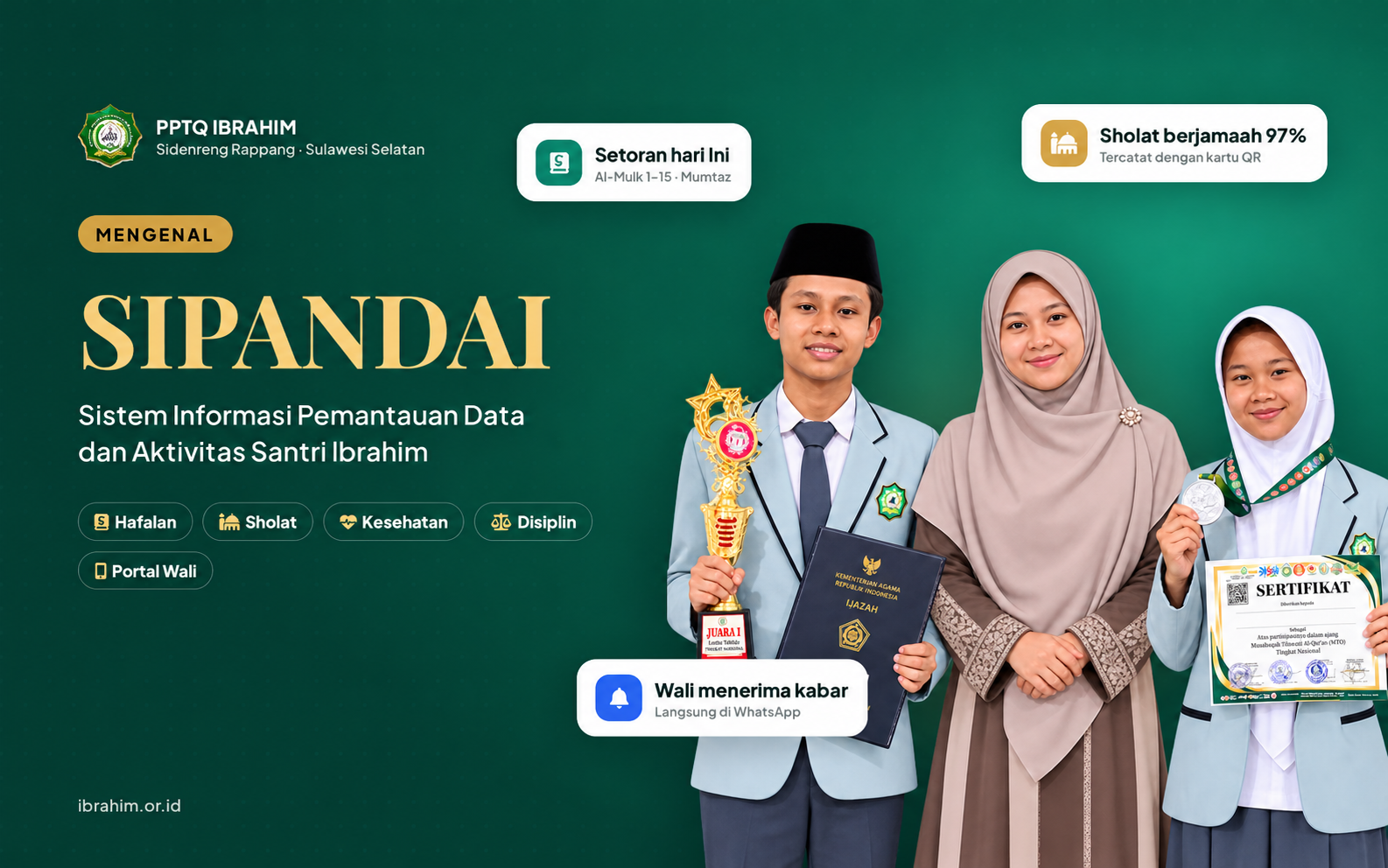
At Pondok Pesantren Tahfizhul Qur'an (PPTQ) Ibrahim in Uluale, Sidenreng Rappang, we chose a different path. Today, every part of our students' daily development is recorded in SIPANDAI, short for Sistem Informasi Pemantauan Data dan Aktivitas Santri Ibrahim, or the Ibrahim Student Data and Activity Monitoring System. This article explains what SIPANDAI is, how it works, and why a system like this matters to parents, students, teachers and mentors, as well as to the leadership of the pesantren and the foundation.
If you are looking for a Qur'an memorization (tahfizh) boarding school for your son or daughter, we hope this article also serves as an honest point of reference: not lofty promises, but a real picture of how children are guided here every single day.
What Is SIPANDAI?
SIPANDAI is a web-based application that serves as the pesantren's "digital master record." Every important note about a student is kept in one place: Qur'an memorization, halaqah attendance, congregational prayers, health, discipline, payments, and exam results. Each record is entered by the person actually responsible for it. Halaqah mentors record memorization sessions, the school clinic records health complaints, and the finance office records payments. The information is then shown to the people who are entitled to see it.
The name was chosen with intent. In Indonesian, pandai means capable and clever. Our hope is simple: well-kept records help everyone take wiser steps in educating our students. Mentors know which students need closer attention, parents know when to offer encouragement, and the leadership knows where guidance needs to improve.
SIPANDAI works on both computers and phones without installing any special app. Every user signs in with their own account, and what they see depends on their role. Parents see only their own child's data. Mentors see the students in their halaqah. The leadership sees the whole picture. This principle matters, because student data is a trust placed in our hands.
SIPANDAI is used across the entire Ibrahim La Useng Foundation: the Ibrahim Qur'an Memorization Boarding School, MTs Ibrahim (Islamic junior high school), and MA Ibrahim (Islamic senior high school). A student who recites memorization in the morning halaqah and attends classes at the madrasah in the afternoon is recorded in a single system. There is no longer a gap between the boarding school's records and the school's records, and parents only need one portal to follow both.
The system is also connected to the foundation's official website at ibrahim.or.id. New-student applications submitted on the website flow straight into SIPANDAI, and testimonials that parents send through the portal can appear on the website once approved by the administrators. Information that flows from a single source stays consistent and saves a great deal of retyping.
Why Does a Pesantren Need a System Like This?
A tahfizh boarding school runs on a demanding rhythm. In a single day, a student may go through five congregational prayers, several halaqah sessions, formal lessons at the madrasah, dormitory activities, and evening revision. Each of these produces records. When everything is still written in separate notebooks, a few problems are almost impossible to avoid.
First, information arrives late. A student whose memorization has stalled for three weeks may only come to the parents' attention at the end of the semester, when the time to fix it has already passed. The sooner a problem is known, the easier it is to address.
Second, compiling reports eats into teachers' time. Mentors who should be focused on listening to their students' recitation end up spending hours copying and adding up notes to produce reports. That time is far more valuable when spent on mentoring.
Third, decisions are easily swayed by impressions. Without complete records, judgments about a student can depend on memory or a passing impression. A student who happened to be reprimanded yesterday may look more troublesome than one whose misconduct went unnoticed. That is unfair to the student and to their parents.
Fourth, trust is hard to build without openness. Parents entrust us with their children, and with their trust. That trust grows when they can see for themselves what is happening, not merely hear that "everything is fine."
SIPANDAI was created to address these four problems. It does not replace the role of our teachers. Quite the opposite: it frees them from repetitive paperwork so that their attention can return to what matters most, which is guiding the students.
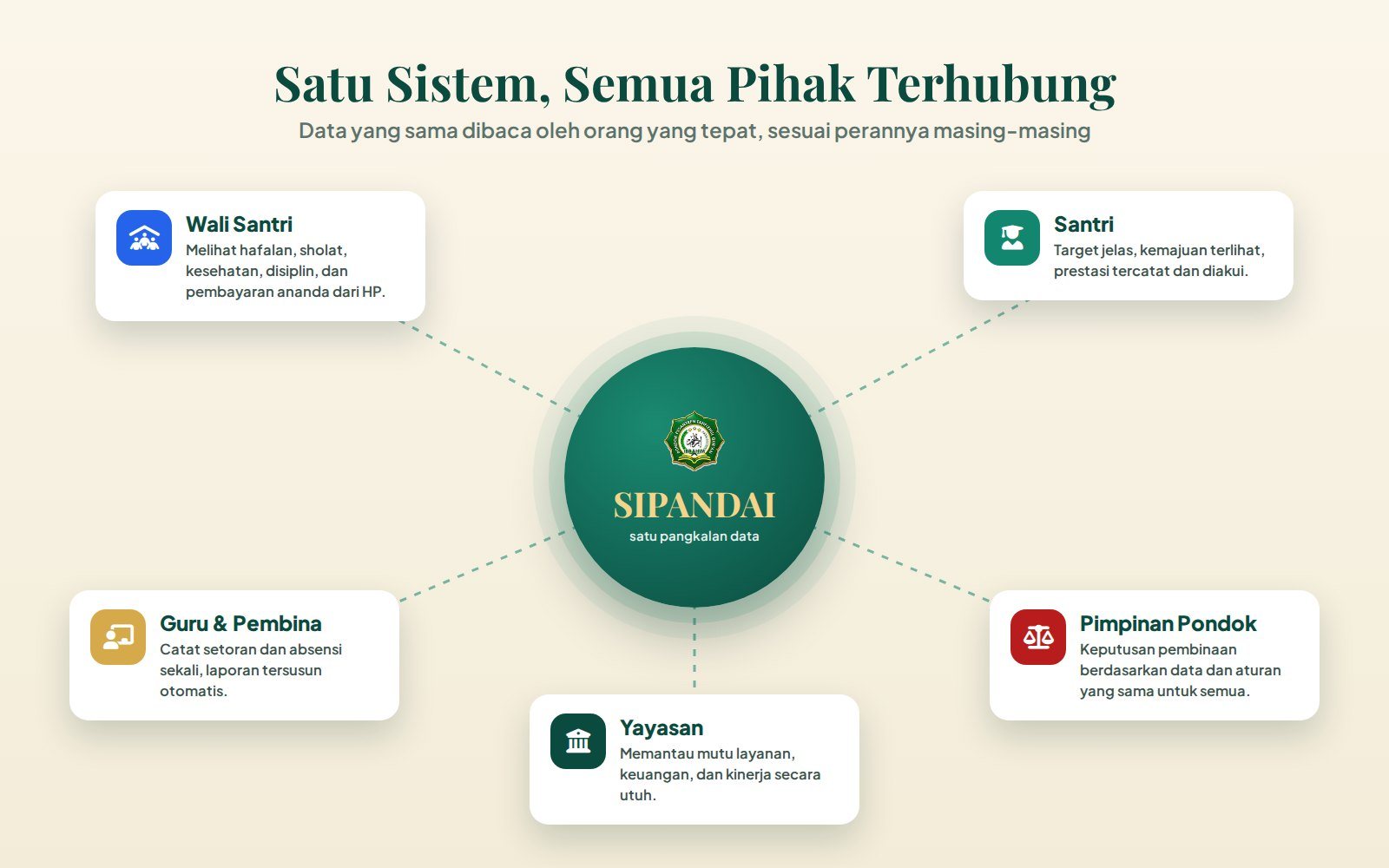
One database, read by each party according to their role.
A Tahfizh Pesantren Today Needs Well-Organized Management
Parents today live in a fast-moving world. Updates from work, a younger sibling's school, even a grocery order can all be tracked from the palm of their hand. It is natural for them to expect the same from the institution caring for their child. This expectation is not a sign of distrust but a sign of care. Parents want to stay involved in their child's education, even when they are far away.
At the same time, a pesantren carries a far broader responsibility than an ordinary school. It is not only responsible for lesson hours, but also for sleep, meals, worship, health, friendships, and the shaping of a student's character around the clock. A tahfizh pesantren adds one more responsibility that is both noble and demanding: safeguarding every student's memorization of the Qur'an, verse by verse.
Managing such a responsibility with scattered notes is not only exhausting but also risky. A student may slip through the cracks, a health complaint may be handled late, and policies may feel inconsistent. Good management is not about following trends. It is about fulfilling a trust as well as we possibly can. That is what we mean when we describe PPTQ Ibrahim as a tahfizh pesantren with modern management: the traditions of the pesantren are preserved, while its administration is orderly, measurable, and transparent.
How SIPANDAI Benefits Parents
For parents, SIPANDAI is like a small window into their child's life at the pesantren. Through the parent portal, you can open the following information at any time.
Daily memorization progress
Every time a student recites to a mentor, whether ziyadah (new memorization), muraja'ah (revision), or tasmi' (reciting a large portion from memory), the mentor records the surah, the verses, the score, and the grade: Mumtaz (excellent), Jayyid Jiddan (very good), Jayyid (good), or Naqis (needs improvement). Parents can see their child's total memorization, a 30-juz map showing which parts have and have not been memorized, and a day-by-day history of recitations. Daily mutaba'ah records, including the number of new pages and repetition (tikrar) activities, are available as well.
This way, parents do not just know that their child "has memorized so many juz." They can see the journey: when the child is motivated, when they are struggling, and when they need more prayers and encouragement.
Congregational prayer attendance
Every student has a student card with a QR code. When they enter the mosque, the card is scanned and their attendance is recorded automatically. Parents can see their child's attendance rate and which prayer times they tend to miss. For us, praying in congregation is not just an item on the timetable but a foundation of character.
Health records from the school clinic
If a student falls ill, the clinic staff record the complaint, the treatment given, and the recovery until the student is well again. Parents are notified and do not have to guess. Even a one-day fever is recorded, so your child's health history throughout their time at the pesantren is properly kept.
Transparent discipline
The pesantren has written rules that parents can read. Every violation is recorded with its date, type, points, and consequence. Parents can see these records and respond directly through the portal. There is no more sudden news without explanation, because every stage of guidance follows a set order and is documented.
Payments and savings
The history of the Monthly Student Contribution (IBS) is neatly recorded, so parents can confirm which payments have been received. The balance of the student's savings for use at the cooperative or canteen can also be monitored, so parents know how their child's pocket money is being spent.
WhatsApp notifications and complete report cards
Important updates such as memorization sessions, health notes, or disciplinary stages can be sent to parents via WhatsApp. At the end of each period, a student's report card can be printed monthly, quarterly, or per semester on F4 paper. It is comprehensive: a memorization summary, the 30-juz map, attendance, health, discipline, the mentor's notes, and an appendix listing every recitation.
Monthly, quarterly, and semester report cards
Report cards at PPTQ Ibrahim do not have to wait until the end of the semester. The pesantren can print monthly reports for routine monitoring, quarterly reports for a mid-semester evaluation, and semester reports as the official record. In addition to a summary of achievements, quarterly and semester reports include a month-by-month progress table, so parents can see whether their child's motivation is rising, holding steady, or slipping.
Report cards are signed by the tahfizh mentor and the parent or guardian, and acknowledged by the head of the pesantren. There is also a space for the mentor's handwritten notes, because a teacher's personal touch can never be replaced by numbers.
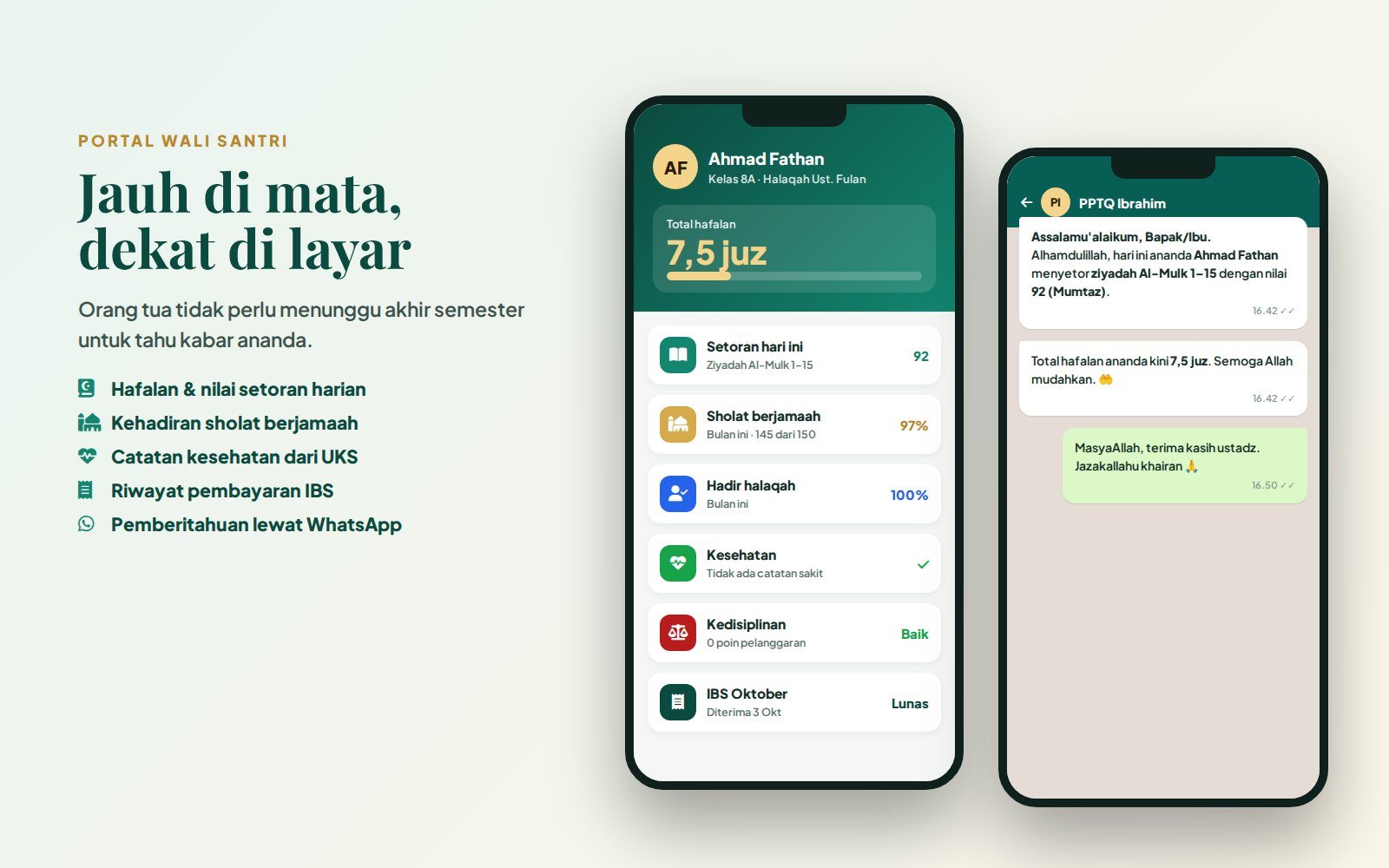
Illustration of the parent portal and WhatsApp notifications (names and figures are examples only).
We believe parents are the pesantren's most important partners. When parents understand their child's progress as a whole, the advice they give during calls and visits becomes more meaningful. Guidance at the pesantren and support from home move in the same direction.
How SIPANDAI Benefits Students
Students may not be the ones who open SIPANDAI most often, but they are the ones who feel its benefits the most.
Clear targets. Every student has a memorization target agreed upon with their mentor. The target is not a frightening burden but a roadmap. When students know exactly where they stand and where they are heading, their motivation stays alive.
Visible progress. Memorizing the Qur'an is a long journey. There are days when a student feels they are not moving at all. A 30-juz map that slowly changes color is a reminder that every page memorized is a real step forward. For young people, seeing their own progress is a powerful motivator.
Effort that is recognized. Every completed juz can be awarded a certificate. Students who pass the mutqin examination receive a badge and a syahadah (certificate of mastery). Achievements are no longer remembered for a moment and then forgotten. They are recorded and can be verified.
Fair treatment. Because the rules and points are the same for everyone, students know they are judged by what they do, not by who they are. This sense of fairness is essential in building trust between students and their teachers.
A student card that is genuinely useful. The student card is more than an ID. Its QR code is used for prayer attendance, savings transactions at the canteen, and identity verification. When scanned with an ordinary phone, it shows a brief student profile without revealing personal details such as an address or phone number.
How SIPANDAI Benefits Teachers and Mentors
Our teachers are the heart of the pesantren. SIPANDAI is designed to make their work lighter, not more complicated.
Record once, and reports build themselves. Mentors simply record recitations and attendance on their phones during halaqah. Daily and weekly summaries, all the way up to semester report cards, are compiled automatically from those records. There is no more copying the recitation book at the end of every month.
Seeing who needs attention. From their list of students, mentors immediately know whose recitations are declining, who is often absent, and who is close to reaching their target. Guidance becomes more personal.
Easier communication with parents. Notifications to parents can be sent directly from the system via WhatsApp. Mentors do not need to store hundreds of parents' numbers on their personal phones, and every message sent is recorded.
Mentor attendance recorded automatically. Mentors who fill in halaqah attendance, mutaba'ah, or recitation records on a given day are automatically marked present. If they are unable to attend due to illness, leave, or an official assignment, they simply submit it from their phone. Staff administration runs without adding to their workload.
At the madrasah, SIPANDAI also supports the teachers of MTs and MA Ibrahim through attendance, teaching journals, duty logs, performance reports, and academic supervision. The pesantren and the madrasah share one system, so the picture of each student is complete, both as a memorizer of the Qur'an and as a learner.
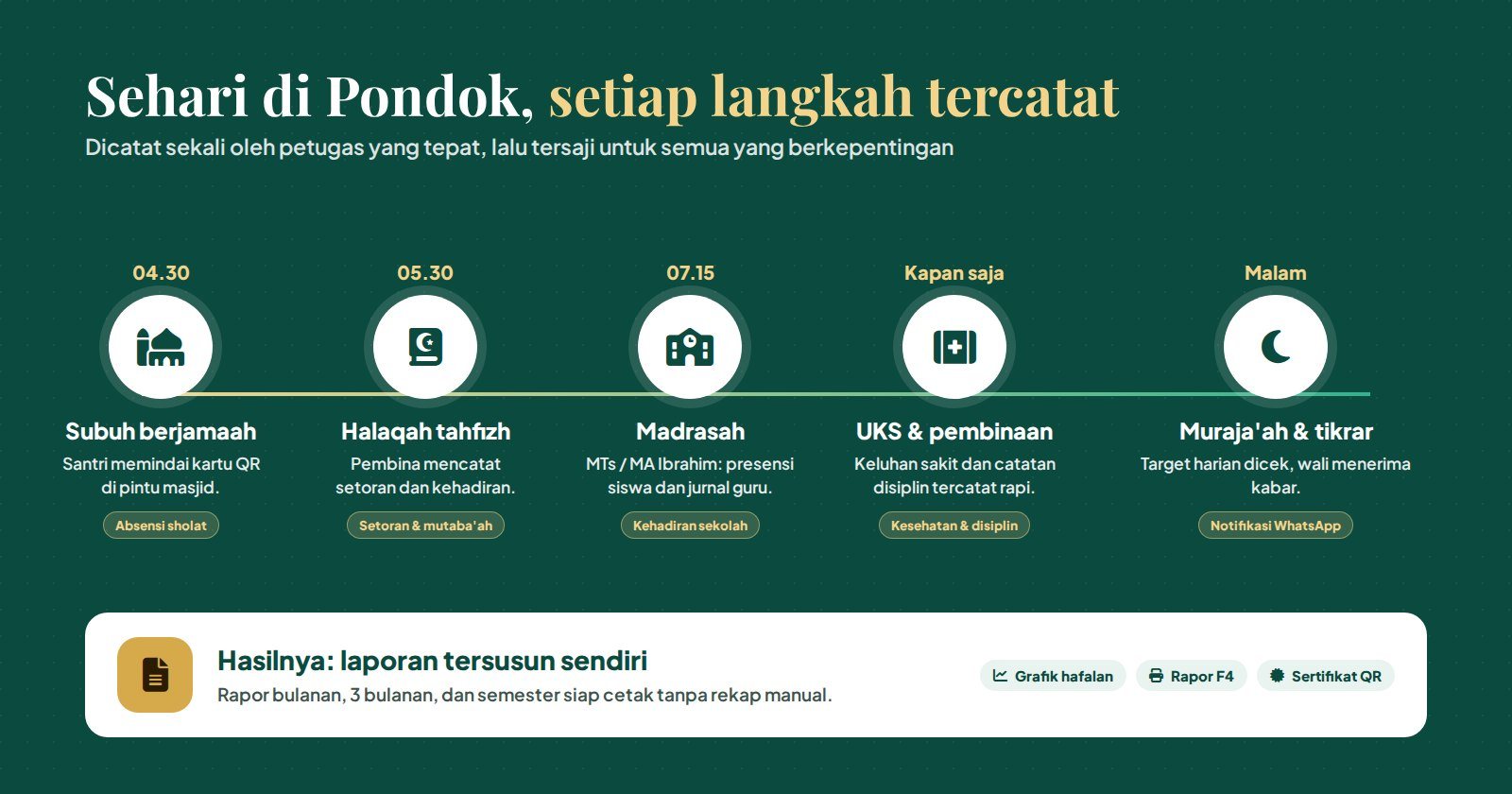
Students' daily activities are recorded once, then compiled into reports and report cards.
For the Leadership and the Foundation: Oversight and Fair Decisions
Leading a pesantren means making many decisions every day, from small matters like duty rosters to weighty ones such as the future of a student who has repeatedly broken the rules. Good decisions require complete and reliable information.
The whole pesantren on one screen
From the SIPANDAI dashboard, the leadership can see the number of recitations, halaqah attendance rates, congregational prayer attendance, students who are unwell, and disciplinary cases that need follow-up. Emerging problems become visible early, not after they have grown large.
The same rules for every student
One of the things we guard most carefully is fairness in guidance. At PPTQ Ibrahim, every type of violation carries a point value written in the code of conduct. These points determine the stages of guidance in order. At 25 points, parents are informed. At 50 points, parents are invited to a consultation. At 75 points, the student may be suspended. At 100 points, the decision is made by the head of the pesantren through deliberation.
Because these stages are driven by records, no student is treated more harshly or more leniently because of factors unrelated to their own conduct. The leadership decides with the full history in front of them: when the violations occurred, which consequences have already been carried out, and how the student has developed since. A decision such as "a final chance with a probation period" is fully documented, along with an agreement signed by the student, the parents, and the pesantren.
We do not claim that this system makes every decision perfect. People still do the weighing, with compassion and wisdom. But with complete data, those decisions at least stand on a fair foundation that can be accounted for, both to parents and before Allah.
Helping the foundation safeguard quality
For the foundation, SIPANDAI is a tool for ensuring that every unit runs as intended. Mentor performance, teacher and staff attendance, memorization progress per halaqah, and monthly financial reports can all be reviewed regularly. Orderly financial records are also part of the trust we owe to parents and donors.
Openness that builds trust
Parents' trust is a pesantren's greatest asset. It is not built with words but with consistent evidence. When parents can see their child's memorization, attendance, health, and payment records for themselves, suspicion fades and communication becomes healthier. When there is a difference of opinion, for example about the consequence for a violation, the conversation starts from the same record rather than from different stories.
Openness also protects educators. A mentor who works diligently has records that show their diligence. A leader who must make a difficult decision has a written basis that can be explained to anyone. In this way, the system protects everyone involved.
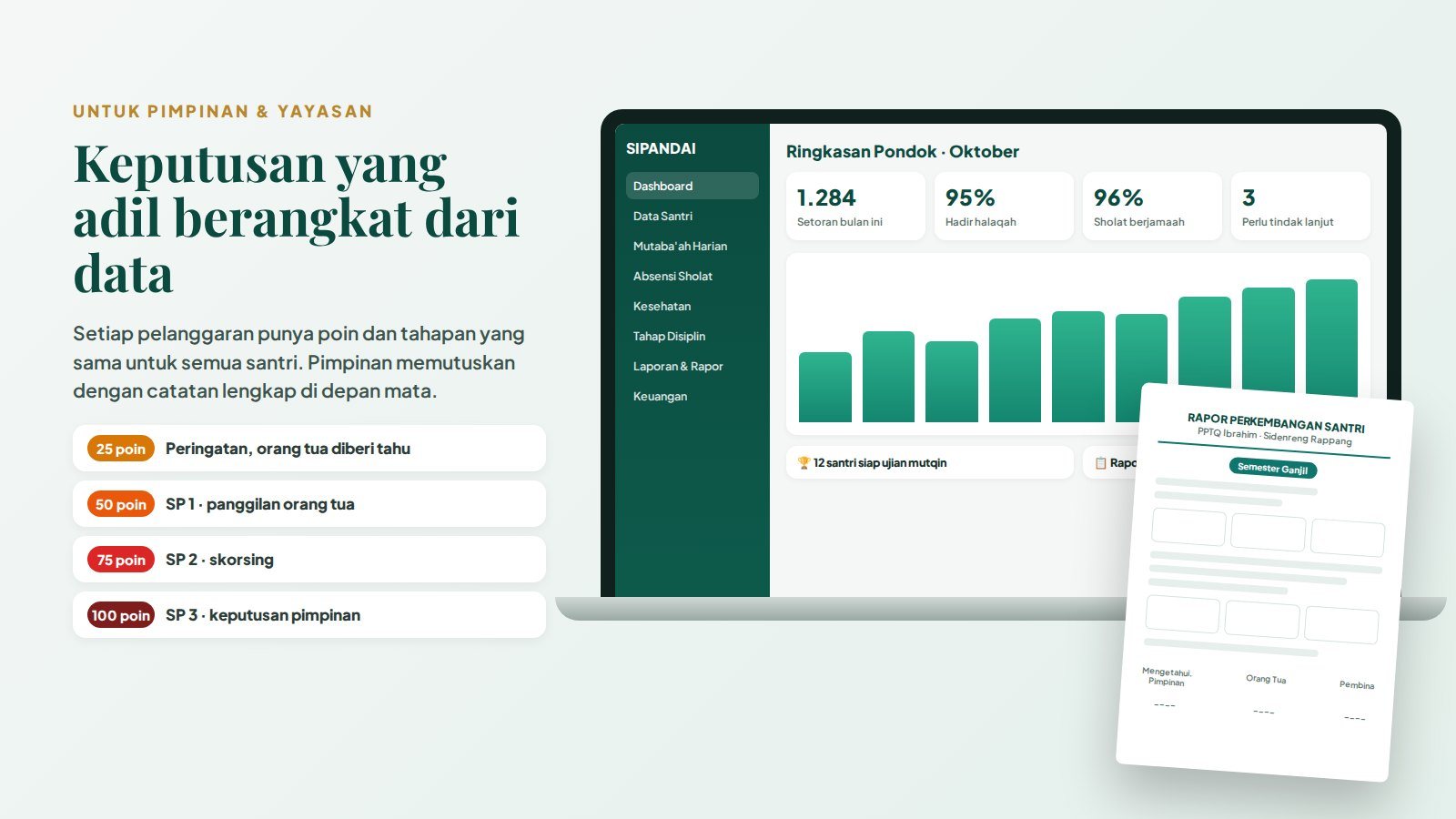
Illustration of the leadership dashboard and point-based guidance stages (figures are examples only).
Character Building: The Roles of Counselors, Dormitory Mentors, and Parents
Memorizing the Qur'an must go hand in hand with good character. A large amount of memorization without good manners is not the goal of a pesantren education. That is why character building at PPTQ Ibrahim involves many people working in harmony.
Dormitory mentors (musyrif and musyrifah) live alongside the students, know their habits, and are often the first to notice when something changes. The guidance and counseling (BK) teacher supports students who need special attention, from difficulties adjusting to boarding life to violations of the rules. Halaqah mentors watch over each student's motivation in memorizing. The head of the pesantren ensures that everything runs according to the rules and values of the pesantren.
SIPANDAI helps them all speak the same language. A violation recorded by a dormitory mentor can be read by the counselor. A drop in memorization recorded by a halaqah mentor can signal to the dormitory mentor that a student is going through something. And parents, as a child's first teachers, are involved from the start, not only once a problem has grown.
Our approach to discipline is to educate, not to punish. Every consequence is carried out with good manners and compassion, and without violence, whether physical or through demeaning words. Points for minor and moderate violations can be removed once the consequence has been carried out, as a form of second chance. Students are guided to understand their mistakes, take responsibility, and make things right.
Quality, Not Just Quantity: The Mutqin Examination by the Board of Experts
In the world of Qur'an memorization, there is a temptation to compete on numbers: how many juz have been memorized, how quickly a student can finish all 30. Those numbers matter, but they are not everything. Memorization that is extensive but fragile is easily lost once a student leaves the pesantren.
That is why PPTQ Ibrahim holds the Tasmi' Mutqin Examination. Mutqin means firm and secure. A student who has memorized 10 juz is examined by reciting those 10 juz from memory in a single sitting. The examination continues at the 20-juz and 30-juz levels. It is not conducted by the student's own halaqah mentor, but by the pesantren's Board of Experts:
- Ustadz Dr. Amiril Mueminin, S.Pd.I., M.Pd.I., Board of Experts and Tasmi' Examiner
- Ustadz K.M. Arham Basri Daud, S.Pd.I., Board of Experts and Tasmi' Examiner
Examiners from outside the halaqah provide a more objective assessment. Students, in turn, learn that the purpose of memorization is not merely to reach a target, but to preserve the Words of Allah as well as they possibly can.
SIPANDAI supports this process from start to finish. The system identifies students who are eligible for the examination based on their recorded memorization, records the schedule and results, and then issues mutqin badges (10, 20, and 30 juz) and a digital syahadah. Every certificate carries a QR code that anyone can scan to confirm its authenticity. Students also receive a certificate for every juz they complete.
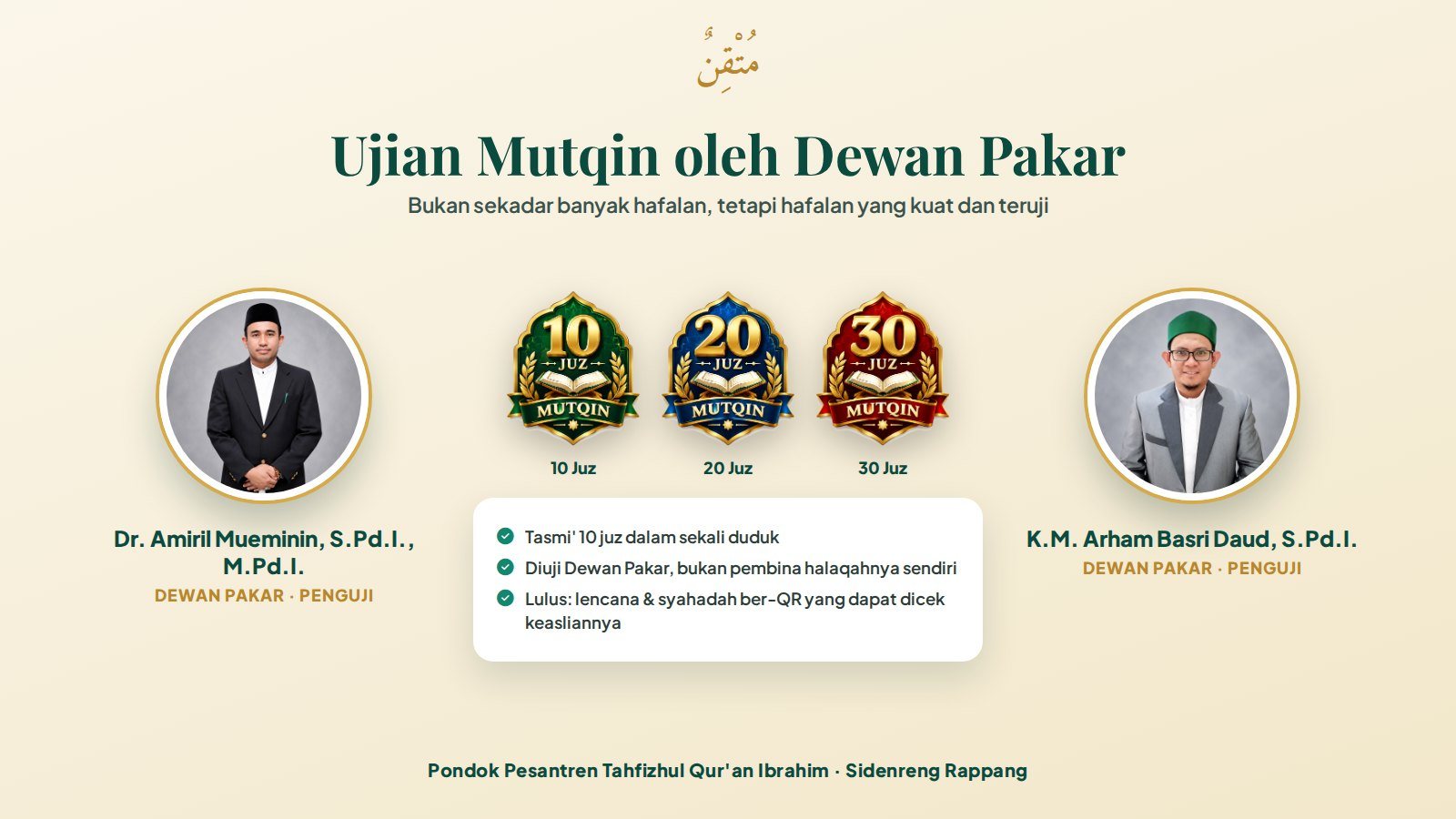
The Board of Experts who examine tasmi', and the 10, 20, and 30 juz mutqin badges.
For us, the success of a tahfizh program is not measured by how quickly students finish memorizing, but by how firmly that memorization endures.
From Records to Action: A Few Real-Life Examples
Data is only useful when it leads to the right action. Here are a few examples of how SIPANDAI is used in everyday life at the pesantren. The names below are illustrative, but the situations are very familiar to us.
When recitations start to slip. Over two weeks, the new memorization of a student, let us call him Fathan, falls below his usual pace. His scores also drop from Mumtaz to Jayyid. His mentor notices the pattern in his student list and sits down to talk with him. It turns out Fathan is homesick and having trouble sleeping. The mentor lets his parents know. His father calls that weekend, encourages him, and promises to visit the following month. Two weeks later, Fathan's recitations are back on track. Without daily records, the decline might not have been noticed for months.
When a student falls ill at night. A female student complains of a fever after the evening prayer. The clinic staff examine her, provide initial care, and record it in SIPANDAI. Her mother receives a notification that same night, so she does not hear the news secondhand. The next day the record is updated as she starts to feel better, and two days later her status is marked "recovered." Her mother is at ease, having followed her daughter's progress from the beginning.
When a rule is broken. A student is caught leaving the pesantren without permission. The violation is recorded according to its type and points in the code of conduct. Because his total points reach the threshold for summoning parents, the system immediately flags the case to the counselor and the leadership. A summons letter is printed with an official reference number, the parents are invited for a consultation, and the student signs a statement. Everything is recorded, so if questions ever arise later, the answers are clear.
When a student is ready to be examined. A student's recorded memorization reaches 10 juz. SIPANDAI marks her as eligible for the mutqin examination. The leadership schedules the examination with the Board of Experts. Once she passes, the mutqin badge appears on her profile, a QR-verified syahadah can be printed, and her parents receive the good news. A moment that might once have been remembered by only a few people now becomes a permanent record of achievement.
SIPANDAI's Main Features at a Glance
To make it easier to picture, here are the main features of SIPANDAI currently in use at PPTQ Ibrahim, MTs Ibrahim, and MA Ibrahim.
- Daily mutaba'ah and memorization targets. Records of new memorization, revision, and repetition for every student, along with personal targets agreed upon with their mentor.
- Recitations and assessment. Every recitation is recorded with its surah, verses, score, and grade, and linked to the 30-juz memorization map.
- Halaqah and congregational prayer attendance. Halaqah attendance is recorded by mentors, while prayer attendance is captured by scanning QR student cards. The pesantren's prayer and iqamah times are managed from the same system.
- Student health. Clinic records from the initial complaint and treatment, including referrals when needed, until the student has recovered, with notifications to parents.
- Discipline and code of conduct. Written rules, point-based violation records, automatic guidance stages, numbered official letters, and semester summaries.
- Mutqin examinations and certificates. Examinations scheduled with the Board of Experts, 10, 20, and 30 juz badges, per-juz certificates, and a digital syahadah with QR verification.
- Parent portal. Memorization, prayers, discipline, health, announcements, school attendance, savings, a digital student card, and a space for feedback and testimonials.
- Print-ready report cards. Monthly, quarterly, and semester report cards in F4 format, which can be printed individually or for an entire class at once.
- Orderly finances. Records of IBS payments, cash books, student savings and canteen transactions, plus monthly and annual reports for the foundation.
- Madrasah and staff administration. Teacher and staff attendance, teaching journals, duty logs, daily performance reports, academic supervision, and staff ID cards.
- New student admissions. Online applications that go straight into the system, so applicants' data never has to be retyped.
This list keeps growing. Whenever a new need arises on the ground, SIPANDAI can be developed further without waiting on an outside vendor, because its developer is part of the foundation itself.
Behind SIPANDAI: Built From Within the Pesantren
SIPANDAI was not bought off the shelf. It was designed and developed by Muh. Ikhsan, Chairman of the Ibrahim La Useng Foundation, who has long been active in education and technology. Because it was built from within, SIPANDAI has grown around the real needs of the pesantren, rather than the other way around.
Every feature was born from an everyday problem. When mentors struggled to compile recitation records, automatic summaries were created. When parents asked about their children's health, clinic records linked to the parent portal were added. When the leadership needed a clear basis for handling violations, a point-based disciplinary system was built. Feedback from teachers, administrators, and parents continues to shape its improvement.
Why not buy a ready-made application?
There are many school applications on the market, and some of them are excellent. But a tahfizh pesantren has distinctive needs: page-by-page memorization tracking, recitations graded with tahfizh predicates, tasmi' examinations by a Board of Experts, attendance for five daily congregational prayers, dormitory guidance, and terminology that is familiar in the pesantren world. General-purpose applications often have to be forced to fit, and even small changes can take a long time.
By developing its own system, the pesantren can adapt the software to the way its teachers work, rather than the reverse. When the pesantren's rules change, the system changes with them. When a mentor suggests a more practical way of recording something, the change can be made within days. Money that would otherwise go to expensive subscriptions can be redirected to the students' education.
Growing together with the pesantren
SIPANDAI is not a one-off project that was finished and then forgotten. It grows together with PPTQ Ibrahim. Every semester brings improvements, from screens that are easier to read on a phone and more concise reports to new features requested by teachers and parents. Our hope is that this system will remain a faithful servant of our students' education, not a new burden for their teachers.
Student data is a trust
Data security and privacy are also a priority. Each person can only access data according to their role. Pages that are publicly visible, for example when a student card is scanned, show only general information and never include an address, phone number, date of birth, or family details. We regard student data as a trust that must be protected, just as we protect the students themselves.
Looking for the Best Tahfizh Pesantren in Sidrap or South Sulawesi? Start With the Right Questions
Many parents type search terms such as best pesantren in South Sulawesi, best tahfidz Quran school, best Islamic boarding school in Sidrap, best modern pesantren, or best girls' pesantren in South Sulawesi when they begin looking for a school for their child. That is perfectly natural. Every parent wants the best, for their sons and their daughters alike.
Yet "the best" is not a title a pesantren can award itself. The best pesantren for a child is the one that best fits their needs and truly fulfills the trust of education. So rather than simply looking at rankings, we invite you to ask the following questions of any pesantren you are considering, including us.
- Is the tahfizh program measurable? Are there clear targets, daily recitation records, and objective examinations to ensure the quality of memorization?
- Is formal education guaranteed? Will your child continue studying at a state-recognized madrasah so that their academic future remains open?
- How is dormitory life supervised? Who accompanies the students around the clock, and how is their health looked after?
- How can parents follow their child's progress? Only when report cards are handed out, or on a regular basis?
- Are the rules clear and fair? Is there a written code of conduct with the same stages of guidance for every student?
- Are the costs transparent? Are all fees explained openly from the start, with no hidden charges?
These are the very questions we hold ourselves to in building PPTQ Ibrahim. SIPANDAI is one concrete expression of them: our way of making sure that the tahfizh program, dormitory guidance, and communication with parents are not just words in a brochure, but things that actually happen every day and can be shown.
We believe that a pesantren with modern management does not mean leaving tradition behind. A halaqah is still a halaqah, good manners are still good manners, and the bond between teacher and student remains the heart of pesantren education. Technology simply helps that trust to be fulfilled in a more orderly, open, and fair way.
Tips for Parents: Using the Parent Portal Wisely
Complete information is a blessing, but it should be handled wisely. Here are some suggestions to make sure the parent portal truly supports your child's growth.
- Look at trends, not a single day. A lower score on one day is normal. What deserves attention is the pattern over several weeks. Memorizing the Qur'an is a marathon, not a sprint.
- Lead with appreciation. When you call your child, start with the good things you have seen in the portal: new memorization, consistent prayer attendance, or good health. Sincere praise builds stronger motivation than reproach.
- Do not compare your child with others. Every student has different abilities and a different pace. Compare your child with who they were last month, not with their roommate.
- Treat the mentor as a partner. If a record worries you, raise it through the pesantren's official channels. Mentors and caretakers will gladly explain and work out a solution together with you.
- Respond to records calmly. A disciplinary note is not a verdict but part of the educational process. The parent portal gives you space to respond, and your response is read by the pesantren.
- Pray for them every day. However good a system may be, guidance and ease in memorizing come from Allah. A parent's prayer is the strongest support for a student striving to preserve the Qur'an.
A Tahfizh Pesantren for Boys and Girls, With Formal Madrasah Education
PPTQ Ibrahim operates under the Ibrahim La Useng Foundation, which also runs RA, MTs, and MA Ibrahim. Prospective students can choose the Tahfizh + Madrasah Tsanawiyah (MTs, junior high) program or the Tahfizh + Madrasah Aliyah (MA, senior high) program. Students memorize the Qur'an while completing state-recognized formal education, and after finishing three years of study they receive diplomas from both the pesantren and the madrasah.
The pesantren accepts both boys and girls, with separate dormitories. For the 2027/2028 academic year, the intake quota is 150 new students: 75 boys and 75 girls. Students are guided by dormitory mentors, supported by a school clinic and a cooperative, and take part in extracurricular activities at the madrasah.
Our pesantren is located on Jl. Jend. A. Yani (the Rappang–Parepare main road, km 11), Uluale Subdistrict, Watang Pulu District, Sidenreng Rappang (Sidrap) Regency, South Sulawesi, Indonesia. It is easy to reach from Sidrap, Parepare, Pinrang, Enrekang, Wajo, and other regencies across South Sulawesi.
What Is Life Like for Students at PPTQ Ibrahim?
For prospective students, the biggest question may be a simple one: "What will I actually do at the pesantren?" The description below roughly reflects a student's daily rhythm, although the detailed schedule may follow the pesantren and madrasah calendars.
The day begins before dawn. Students wake up and prepare for the dawn prayer in congregation at the mosque. After the dawn prayer, the tahfizh halaqah begins. This is the golden time for reciting new memorization, while the mind is still fresh. After breakfast, students head to the madrasah for formal lessons at MTs or MA Ibrahim with their madrasah teachers.
Midday is filled with the noon prayer in congregation, lunch, and rest. In the afternoon, students return to the halaqah for muraja'ah, reviewing what they have already memorized so it does not slip away. There are also days for extracurricular activities, sports, and public speaking practice. After the sunset and night prayers, the evening is used for repetition and preparing the next day's recitation before students go to rest.
Throughout the day, students are never alone. There is a halaqah mentor who listens to their recitation, a dormitory mentor who looks after them in the dormitory, madrasah teachers who guide their lessons, and clinic staff ready to help when they are ill. SIPANDAI connects all of them, so everyone who accompanies a student works from the same information.
Life at a pesantren certainly demands discipline. But it is from that discipline that independence, companionship, and a closeness to the Qur'an grow, and students carry these with them for the rest of their lives.
Admission Fees at PPTQ Ibrahim
We share our fees openly so that parents can plan from the start. Below are the details for new-student admissions for the 2027/2028 academic year at the time of writing:
- Registration fee: free.
- Initial admission fee: IDR 8,500,000, consisting of a building contribution of IDR 7,500,000 and three sets of uniforms with accessories for IDR 1,000,000.
- Monthly Student Contribution (IBS) for new students: IDR 850,000 per month, including students' meals.
- IBS for transfer students: IDR 800,000 per month.
- Sleeping facilities are provided free of charge: bed, mattress, pillow, bolster, sheets, and wardrobe.
- New student bonus: free wash-and-fold laundry for one year.
- MTs Ibrahim graduates continuing to MA Ibrahim do not pay the building contribution again; they only pay for uniforms and the IBS.
The first admission wave runs from 1 September 2026 to 30 July 2027, and the second wave from 1 to 31 August 2027. The latest details are always available on our New Student Admissions page.
Frequently Asked Questions
What is the difference between "tahfidz" and "tahfizh"?
Both refer to the same thing: a program for memorizing the Qur'an. The only difference is how the Arabic letter ظ is written in Latin script. Tahfizh is closer to the original pronunciation, while tahfidz is more common in everyday use. We use tahfizh, as in the name of our pesantren: Pondok Pesantren Tahfizhul Qur'an Ibrahim.
Do parents need to install a special app?
No. The SIPANDAI parent portal opens in the browser on a phone or computer, using an account provided by the pesantren. Important notifications are also sent via WhatsApp, so parents stay informed even if they rarely open the portal.
Is student data safe?
Each user can only open data according to their role. Parents see only their own child's data. Public pages, such as the result of scanning a student card, never show an address, phone number, date of birth, or family details.
What if my child falls behind in memorization?
This is exactly where SIPANDAI helps. Because memorization progress is recorded every day, mentors and parents can spot it early. The mentor will provide extra support, and parents can offer encouragement from home. Every child learns at a different pace, and what we safeguard is their sincerity and the quality of their memorization.
Can parents give feedback to the pesantren?
Yes. The parent portal includes a feedback and suggestions menu. Parents can also respond to disciplinary notes about their child. This feedback is read by the administrators and used for improvement, including the ongoing refinement of SIPANDAI itself.
How long does it take a student to memorize all 30 juz?
There is no single answer for every child. Some students complete all 30 juz in around a year and a half, while others need more than four years. More important than speed is consistency and the strength of the memorization. That is why we emphasize daily revision and the mutqin examination, so that what is memorized stays firm.
How do I apply?
Applications can be made online through our New Student Admissions page. Once the form is submitted, the admissions committee will contact parents via WhatsApp for the next steps. You can also ask us directly by phone or WhatsApp at +62 823 4544 9699.
Closing: A Trust We Keep Together
Entrusting a child to a pesantren is a big decision. Parents hand over part of their child's formative years to teachers, hoping the child will return as someone who has memorized and lives by the Qur'an, with good character, and ready to face the future. A trust that great deserves to be kept wholeheartedly, including through more orderly and open ways of working.
SIPANDAI is our effort to keep that trust. It helps parents stay close despite the distance, helps students see their own progress, helps teachers focus on mentoring, and helps the leadership and the foundation make fair decisions. The technology is only a tool. What we safeguard has remained the same from the beginning: the Qur'an, good character, and the future of our children.
If you are looking for a tahfizh pesantren for boys or girls in Sidrap and South Sulawesi with a measurable program and open communication, we warmly welcome your visit and your questions. Come and see our students' activities for yourself, talk with our teachers, or begin your application through our New Student Admissions page.
May Allah make our children a Qur'anic generation who bring blessings to their families, their community, and their nation.