

A few weeks before the first day at the pesantren, the house usually gets busy. Suitcases come out of storage, shopping lists are written on the back of the calendar, and the child suddenly grows quieter. Parents begin to wonder: what needs to be packed? How do we prepare his heart? What will happen in the first weeks?
This article is meant to help you prepare your child to enter a pesantren calmly. We have divided it into three parts: preparing the heart, preparing habits, and preparing belongings. It closes with a picture of the first weeks and a farewell prayer you can say at the pesantren gate.
The best preparation is not the fullest suitcase, but the readiest heart.
Walking the Path of Knowledge
Before discussing belongings and schedules, it helps to remember why this step is being taken. The Messenger of Allah ﷺ said:
مَنْ سَلَكَ طَرِيقًا يَلْتَمِسُ فِيهِ عِلْمًا سَهَّلَ اللَّهُ لَهُ بِهِ طَرِيقًا إِلَى الْجَنَّةِ
"Whoever takes a path in search of knowledge, Allah will make easy for him a path to Paradise." (Narrated by Muslim, no. 2699)
You can read this hadith to your child before departure. A child needs to know that he is not being "left" or "sent away" from the family, but is beginning a noble journey. The way a child understands his departure strongly affects how he endures the first weeks.
Part One: Preparing the Heart
Talk honestly
Talk with your child about the pesantren well before the day of departure. Describe what he will find: waking before Fajr, memorization circles, madrasah classes, friends from many places, and rules to follow. Do not describe only the pleasant parts. A child who knows from the start that there will be hard times is usually better prepared to face them.
Listen to his worries
Ask what makes him anxious. He may fear having no friends, worry about keeping up with memorization, or dread missing his mother's cooking. All these worries are natural. What a child needs is not an instant reassuring answer, but the feeling of being heard. A simple sentence such as "It's normal to worry; we felt the same once" is often more strengthening than a long lecture.
Visit beforehand
If possible, take your child to visit the pesantren before the first day. Let him see the mosque, the rooms, the classrooms, and the atmosphere of the study circles. A place already seen feels far friendlier than a completely unfamiliar one.
Avoid promises that are hard to keep
Some parents, unable to bear it, promise, "If you don't like it, we'll come and pick you up." Such a promise actually makes adaptation harder, because every time things feel heavy, the child will claim it. It is better to say gently but firmly that the hard days will pass, and that you will always pray for him and visit on schedule.
Part Two: Preparing Habits
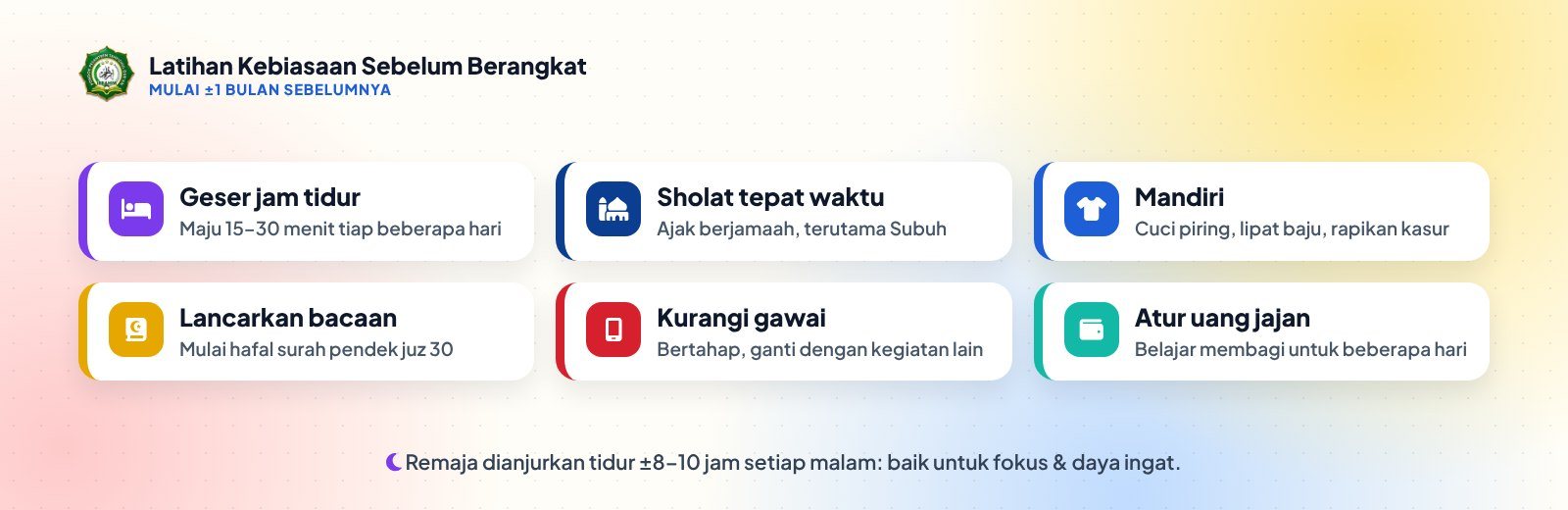
Life at a pesantren follows a regular rhythm. Children who have practiced little by little at home usually adapt faster.
Shift bedtime gradually
At the pesantren, students wake before Fajr. If your child usually sleeps late, start moving his bedtime 15–30 minutes earlier every few days, about a month before departure. The body clock shifts more easily step by step than when forced to change overnight. Sleep health experts also recommend that teenagers sleep around 8 to 10 hours each night; enough sleep supports concentration and memory, two things a memorizer of the Qur'an especially needs.
Get used to praying on time and in congregation
Take your child to pray in congregation at the nearest mosque, especially at Fajr. Besides building the habit, it also brings father and child closer before they part.
Practice simple independence
Washing his own plate, making the bed, folding clothes, putting things back in place, and managing pocket money. These look small, but for a child who has always been served, such simple skills will help a great deal in the dormitory.
Improve recitation and start light memorization
Your child does not need to have memorized much before entering a tahfizh pesantren. But fluent Qur'an recitation will make things much easier. If there is time, start memorizing the short surahs of juz 30 together at home. More important than the amount memorized is a growing love for the Qur'an.
Reduce dependence on gadgets
At the pesantren, the use of personal phones is regulated and requires permission. If your child is used to holding a phone for hours, reduce it gradually a few weeks before departure. Replace it with other activities: reading, sports, or helping with chores at home. A gradual change is much lighter than stopping abruptly on the first day.
Don't Forget to Prepare the Parents
Often the ones least ready are the parents. The house suddenly feels quiet, a chair at the dinner table is empty, and guilt arrives uninvited. These feelings are deeply human. Acknowledging them is the first step so that they do not spill over when you speak with your child.
Children are very sensitive to their parents' emotions. If a mother keeps crying on the phone, the child will feel that his departure is something sad, and he too will waver. On the other hand, a parent's calm sends the message that everything will be all right.
Prepare his siblings at home as well. Explain that their brother or sister is seeking knowledge, pray for him together, and if possible, involve them in writing an encouraging letter or voice message.
Part Three: Preparing Belongings
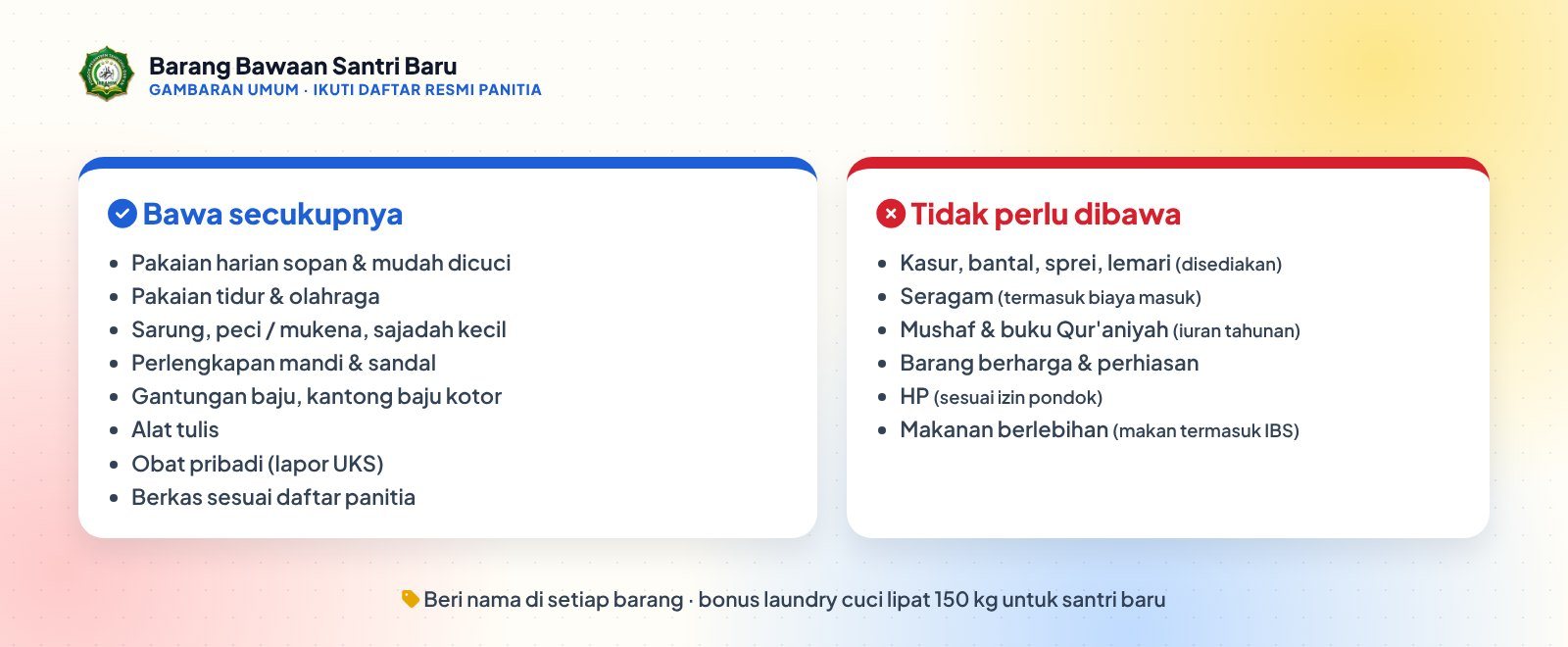
The list below is a general picture. The official list and latest rules will be provided by the admissions committee, so please follow it. The main principle: enough, simple, and labeled.
What to bring
- Everyday clothes in sensible amounts: koko shirts or robes, T-shirts, long trousers or long skirts, sarongs for boys, headscarves for girls. Choose modest, comfortable, easy-to-wash clothes.
- Sleepwear and sportswear.
- Prayer items: sarong and cap for boys, mukena (prayer garment) for girls, and a small prayer mat.
- Toiletries: soap, shampoo, toothbrush and toothpaste, towel, sandals, and a toiletry container.
- Personal items: clothes hangers, a small basket, nail clippers, a comb, and a laundry bag.
- Stationery for madrasah and study circles.
- Personal medicines if your child has special needs. Inform the health officer (UKS) and dormitory mentor from the first day.
- Administrative documents as requested by the committee.
What you do not need to bring
- Bed, mattress, pillow, bolster, sheets, and wardrobe. At PPTQ Ibrahim, these are provided at no extra cost.
- Madrasah and pesantren uniforms. Three sets of uniforms with attributes are included in the initial admission cost.
- Mushaf and Qur'anic books. These are included in the annual dormitory fee. If your child wishes to use his own mushaf, please ask the committee.
- Valuables and jewelry. Keep them at home so they do not become a burden or a source of problems.
- Phones and personal gadgets, except as allowed by pesantren rules and permission.
- Large amounts of food. Meals are included in the monthly fee (IBS). Some snacks are fine, as long as they follow dormitory rules.
Practical tips
- Label every item. Use a permanent marker or sewn-on labels. In a dormitory, many things look alike.
- Bring just enough. Dormitory wardrobes have limited space. Too many belongings make tidying harder for the child.
- Use the laundry service. New students at PPTQ Ibrahim receive a free wash-and-fold laundry bonus of up to 150 kg, so there is no need to bring too many clothes.
- Involve your child in packing. A child who prepares his own things knows where they are and feels more ready.
Departure Day: Small Things That Make a Difference
- Arrive on time. Arriving at the last minute creates a rushed atmosphere and adds to the child's anxiety.
- Help him settle, then say goodbye. Help arrange his belongings in the wardrobe, introduce him to his mentor, then say goodbye warmly. Lingering in the dormitory often makes parting harder.
- Tuck in a small letter. Write a few encouraging lines and slip them among his clothes. Many students say they kept such letters from their parents and read them again and again during the first nights.
- Smile. Let the tears fall on the way home. In front of your child, show a face that is confident and proud.
The First Weeks: What Usually Happens
Almost every new student goes through a similar pattern. Recognizing it helps parents stay calmer.
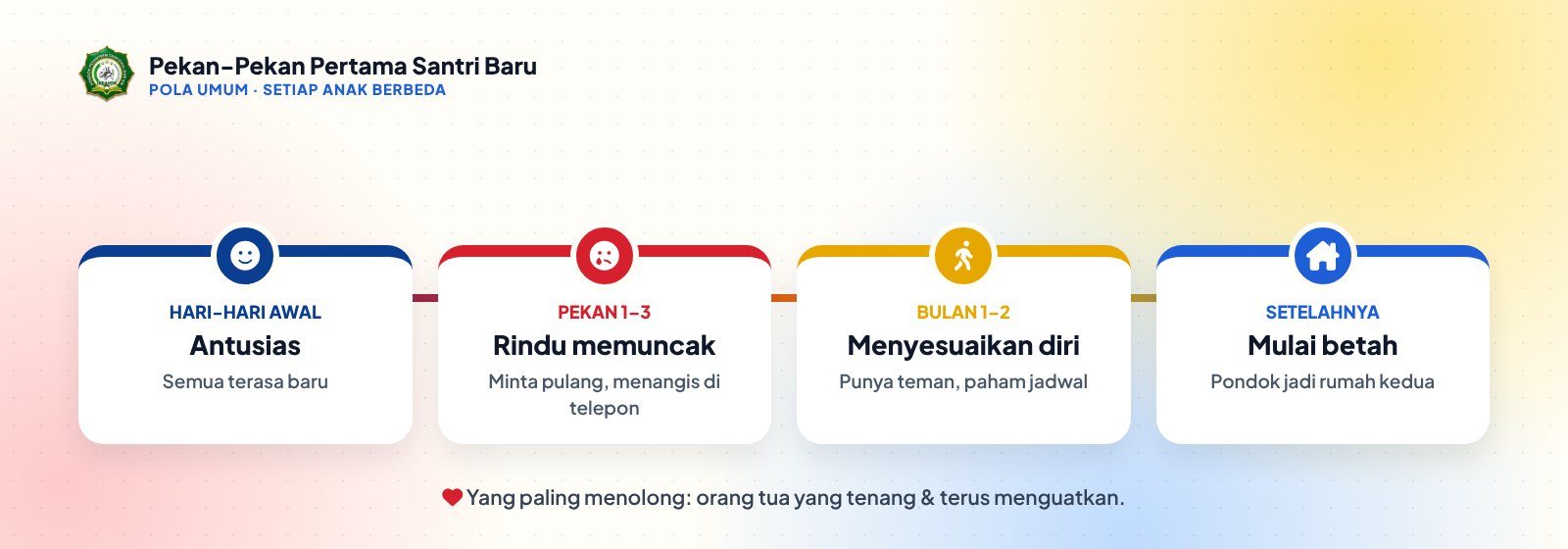
- The first days: excitement. Everything feels new: friends, rooms, and the atmosphere of the mosque. Many children look enthusiastic.
- Weeks one to three: homesickness peaks. The novelty fades, the routine feels heavy, and longing for home appears. Quite a few children cry on the phone or ask to come home. This is the phase that tests parents most.
- Months one to two: adjusting. The child begins to find close friends, understands the schedule, and feels small progress in memorization.
- After that: feeling at home. The pesantren slowly feels like a second home. The child starts to talk about friends and activities in a different tone.
Every child is different; some are faster, some slower. What helps most during the homesick phase is parents who stay calm, do not panic, and keep encouraging. We have written a full guide in our article When a New Student Misses Home.
Perhaps this is one of the first lessons the pesantren teaches parents: loving a child sometimes means holding back from rescuing him at once, so that he learns to stand on his own.
The Role of Parents After the First Day
- Follow the visiting and communication schedule. These rules exist so the child has time to adjust.
- Communicate with the mentors. If you have concerns, share them with the dormitory mentor rather than hearing only your child's side.
- Follow progress through the parent portal. At PPTQ Ibrahim, parents can see memorization progress, congregational prayer attendance, health, and leave permissions through the SIPANDAI parent portal.
- Send words of encouragement. "Mum is proud of you", "Allah sees your effort", or "Dad can't wait to hear your new memorization" are simple words that can sustain a child for days.
- Put your trust in Allah. After every effort has been made, leave the rest to Him.
وَمَنْ يَتَّقِ اللَّهَ يَجْعَلْ لَهُ مَخْرَجًا وَيَرْزُقْهُ مِنْ حَيْثُ لَا يَحْتَسِبُ ۚ وَمَنْ يَتَوَكَّلْ عَلَى اللَّهِ فَهُوَ حَسْبُهُ
"Whoever is mindful of Allah, He will make a way out for him, and provide for him from where he does not expect. And whoever puts his trust in Allah, He is sufficient for him." (Qur'an, at-Talaq 65:2–3)
A Farewell Prayer at the Pesantren Gate
When the moment of parting comes, you can say the prayer the Messenger of Allah ﷺ used to say when bidding farewell to someone about to travel:
أَسْتَوْدِعُ اللَّهَ دِينَكَ وَأَمَانَتَكَ وَخَوَاتِيمَ عَمَلِكَ
"I entrust to Allah your religion, your trust, and the final outcome of your deeds." (Narrated by Abu Dawud and at-Tirmidhi, graded authentic)
Say it while embracing him, then let him walk on. Tears at the pesantren gate are natural, from children and parents alike. But be certain that Allah is the best of those to whom anything can be entrusted.
Frequently Asked Questions
Must a child have memorized several juz before entering a tahfizh pesantren?
No. Fluent recitation helps a great deal, but memorization can begin from the start at the pesantren, with targets adjusted to each student's ability.
How many clothes should be packed?
Enough for a few days, taking washing time into account. Follow the committee's list, and remember that wardrobe space is limited.
May children bring phones?
The use of personal phones at the pesantren is regulated and requires permission. Please follow the rules provided by the pesantren.
What if my child has an allergy or a particular health condition?
Inform the committee, the health officer (UKS), and the dormitory mentor from the start, and provide any personal medicines needed.
When may children be visited?
Visits follow the pesantren's schedule and rules, which will be explained during new student admission.
Closing
The first day at a pesantren is one of the most memorable days in a child's life, and in the life of his parents. Pack just enough, train habits gently, and most importantly, strengthen his heart with love and prayer.
If you are considering a tahfizh pesantren in Sidrap or in South Sulawesi, full information about PPTQ Ibrahim's programs, costs, and registration can be found on the new student registration page, or contact the committee on WhatsApp at +62 823 4544 9699.