"If my child focuses on memorizing the Qur'an, what about his schooling? Will he fall behind in general subjects? Can he go to university?" This question comes up almost every time parents consider a tahfizh pesantren. The worry is entirely natural. Every parent wants their child to be close to the Qur'an, and also ready to face the future.
This article tries to answer that question honestly: how a tahfizh program and madrasah education can run together, what the challenges are, how students manage their time, and which doors remain open after they graduate.
Memorizing the Qur'an and studying at a madrasah are not two roads of which only one must be chosen.
Religious and Worldly Knowledge: Not Two Opposing Poles
In the Islamic tradition, knowledge is seen as one whole that leads people to Allah. The Qur'an honors those who possess knowledge:
يَرْفَعِ اللَّهُ الَّذِينَ آمَنُوا مِنْكُمْ وَالَّذِينَ أُوتُوا الْعِلْمَ دَرَجَاتٍ
"Allah will raise those who have believed among you and those who were given knowledge by degrees." (Qur'an, al-Mujadilah 58:11)
The Qur'an also reminds us not to forget our share of this world:
وَابْتَغِ فِيمَا آتَاكَ اللَّهُ الدَّارَ الْآخِرَةَ ۖ وَلَا تَنْسَ نَصِيبَكَ مِنَ الدُّنْيَا
"But seek, through what Allah has given you, the home of the Hereafter; and do not forget your share of the world." (Qur'an, al-Qasas 28:77)
Many Muslim scholars of Islam's golden age had memorized the Qur'an while also mastering medicine, mathematics, astronomy, or other sciences. For them, the Qur'an was not an obstacle to studying the world; it was the compass that guided it.
Perhaps what we need today is not to choose between the Qur'an and school, but to arrange both wisely.
How the Integrated Model Works
At PPTQ Ibrahim in Sidrap, the tahfizh program is combined with formal madrasah education within one foundation. Students follow two tracks at once:
- Tahfizh + Madrasah Tsanawiyah (junior high), together with MTs Swasta Ibrahim, established by Madrasah Founding Charter No. 360 of 2020 from the Ministry of Religious Affairs of the Republic of Indonesia.
- Tahfizh + Madrasah Aliyah (senior high), together with MA Ibrahim, established by a Madrasah Founding Charter from the South Sulawesi Provincial Office of the Ministry of Religious Affairs in 2025.
Because most madrasah students are also pesantren students, the madrasah schedule and the study-circle schedule are arranged in a single rhythm. Students do not need to travel far or chase the schedules of two institutions that clash.
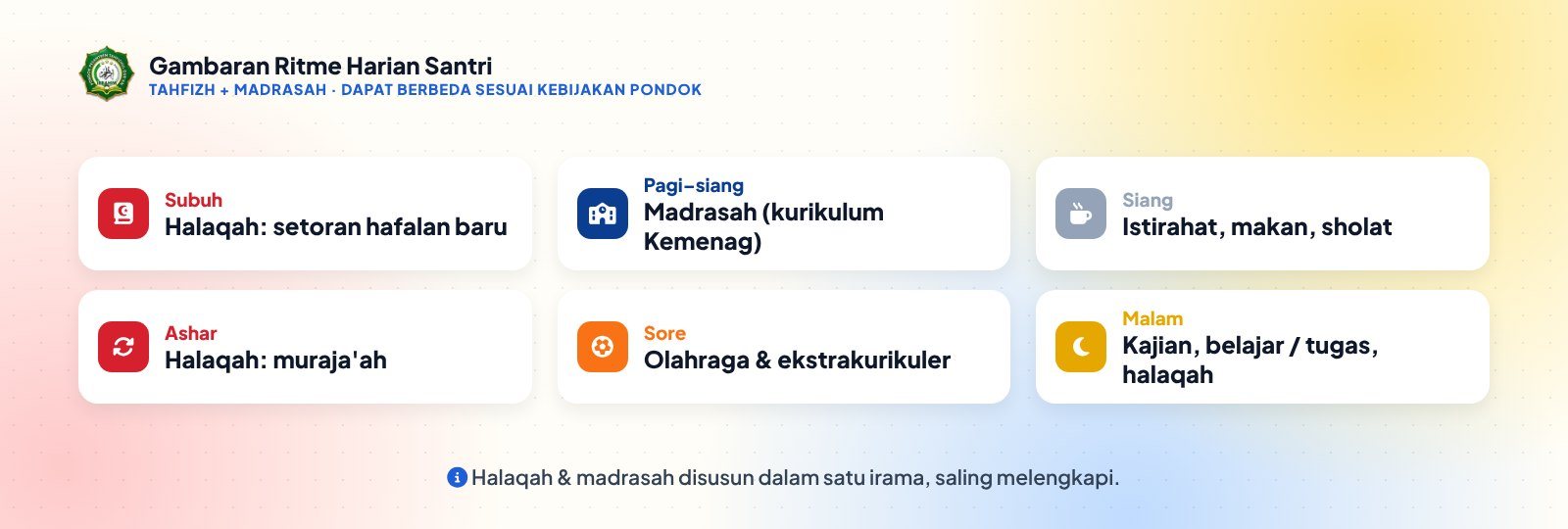
A picture of the daily rhythm
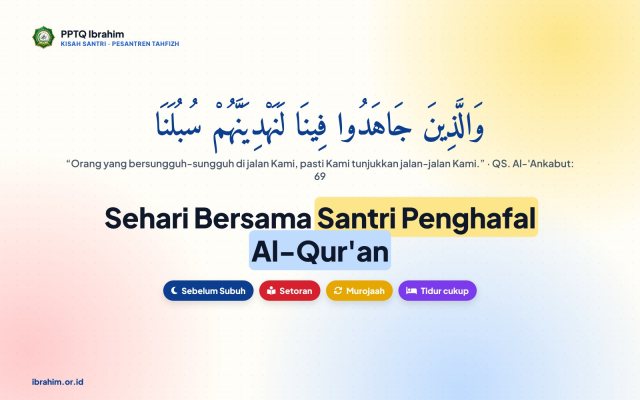
- Before and after Fajr: study circles to recite new memorization while the mind is fresh.
- Morning to midday: madrasah classes following the Ministry of Religious Affairs curriculum, covering both religious and general subjects.
- Midday: rest, meals, and prayer.
- After Asr: review circles to strengthen memorization.
- Evening: religious study, independent study or madrasah assignments, and a final circle before sleep.
The detailed schedule may differ according to pesantren policy and the academic calendar. What matters is that both programs are designed to complement each other, not to compete for time.
What Is Studied at the Madrasah
MTs and MA Ibrahim teach according to the Ministry of Religious Affairs curriculum: religious subjects such as Qur'an and Hadith, Creed and Morals, Jurisprudence, Islamic Cultural History, and Arabic, as well as general subjects such as Indonesian, Mathematics, Science, Social Studies, and English. Graduates receive an official madrasah diploma in addition to a pesantren diploma.
Outside the classroom, students can develop their talents through extracurricular activities such as tahsin and qiro'ah (beautifying recitation), muhadharah (public speaking practice), scouting, calligraphy, and sports. Literacy, technology skills, communication, and leadership are also trained through project assignments, presentations, and student organizations.
Will General Subjects Fall Behind?
This question deserves an honest answer. Following two programs at once does ask more of a student. There is less free time than for an ordinary school student, and without good organization, one of the programs can be neglected.
Yet the experience of many tahfizh pesantren shows that the habits formed by tahfizh actually help students in other subjects. Memorizing the Qur'an trains focus, perseverance, the habit of review, and time discipline. Study skills like these can be applied to learning anything.
Educational psychology also recognizes a principle in line with the tradition of muraja'ah: learning through scheduled, periodic review tends to produce longer-lasting memory than cramming everything in a short time before an exam. A student used to daily review is in fact practicing a way of learning that also benefits Mathematics or Science.
What needs to be maintained is balance. Mentors and madrasah teachers need to communicate with each other, and memorization targets should match each student's ability so that he does not run out of energy for other subjects.
Managing Time: A Lifelong Skill
One of the most important lessons of a tahfizh student's life is managing time. The Qur'an swears by time:
وَالْعَصْرِ إِنَّ الْإِنْسَانَ لَفِي خُسْرٍ إِلَّا الَّذِينَ آمَنُوا وَعَمِلُوا الصَّالِحَاتِ وَتَوَاصَوْا بِالْحَقِّ وَتَوَاصَوْا بِالصَّبْرِ
"By time. Indeed, mankind is in loss, except for those who have believed and done righteous deeds and advised each other to truth and advised each other to patience." (Qur'an, al-'Asr 103:1–3)
Some habits usually instilled in students:
- Using the golden morning hours for new memorization, while the mind is fresh.
- Completing madrasah assignments little by little, not piling them up before the deadline.
- Using spare moments, such as waiting for congregational prayer, for brief review.
- Getting enough sleep, because the brain strengthens memory during sleep. Staying up late to chase targets often does more harm than good.
- Knowing when to rest. Sports and joking with friends are not a waste of time, but part of keeping spirits up.
Students used to dividing the day between study circles, classes, worship, and rest are training a skill that will be very valuable later at university and in the workplace.
Real Challenges and How to Face Them
Following tahfizh and madrasah together certainly has its challenges. Recognizing them early helps students and parents prepare.
- Fatigue. A student's day is long. That is why enough rest and sleep are not a luxury but a need. A student who often looks tired needs attention to his sleep and eating patterns.
- Madrasah exam periods. When exams come, students need to divide their energy carefully: review continues so that memorization is not lost, while independent study time focuses on exam material.
- Feeling behind one's friends. Some students memorize quickly but struggle with Mathematics, and others the reverse. Every child has his own strengths. What needs protecting is the spirit to keep moving forward, not a race to beat one's friends.
- Boredom. A packed routine can feel monotonous. Extracurricular activities, sports, and time with friends help keep enthusiasm alive.
An Illustration: A Day in the Life of an MA Student
Let us call him Ahmad Fathan (an illustrative name). He is in senior madrasah and is memorizing the 18th juz. Early in the morning after Fajr, he recites half a page of new memorization to his teacher. After breakfast, he goes to class: that day there is Mathematics, English, and Jurisprudence.
During a break, he manages to review two pages of older memorization while waiting for Dhuhr. After Asr, he returns to the study circle for review. In the evening, after religious study, he works on a Biology presentation with his group, then goes to sleep on time because there is another recitation the next morning.
His days are not always smooth. Some days his memorization falters; some days his test scores are disappointing. But day by day, he learns something no book teaches: how to carry two trusts at once with patience.
Doors That Remain Open After Graduation
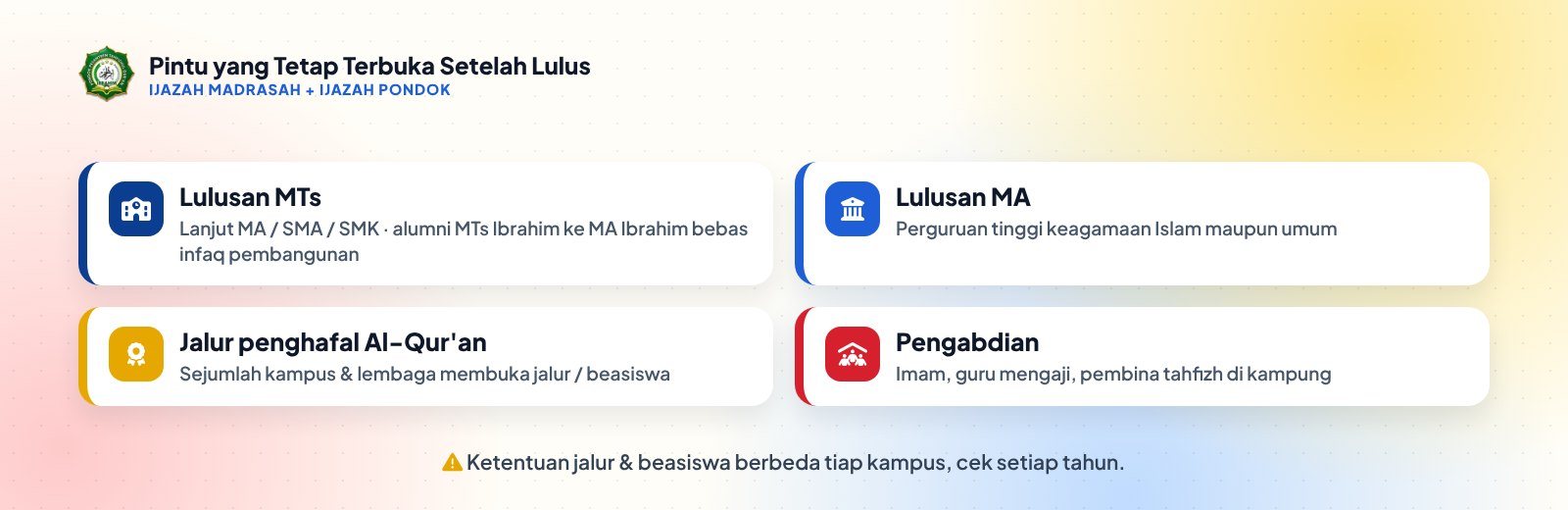
Because they hold official madrasah diplomas, graduates of the integrated program can continue their education like graduates of any other school:
- MTs graduates can continue to MA, SMA (general senior high), or SMK (vocational high school). Within the Ibrahim La Useng Foundation, MTs Ibrahim graduates who continue to MA Ibrahim are no longer charged the building contribution.
- MA graduates can continue to university, whether Islamic universities or general universities, according to each campus's interests and requirements.
- Admission tracks and scholarships for those who have memorized the Qur'an. A number of universities and institutions offer admission tracks or scholarships for Qur'an memorizers. Requirements differ, so they need to be checked each year.
- Service in the community. Graduates can become imams, Qur'an teachers, or tahfizh mentors in their villages while continuing their education.
MA Ibrahim also provides guidance for further study, leadership training, literacy, and communication to prepare students to continue to university or to take their place in society.
More Than Report Card Grades
The Messenger of Allah ﷺ said:
مَنْ يُرِدِ اللَّهُ بِهِ خَيْرًا يُفَقِّهْهُ فِي الدِّينِ
"Whoever Allah wishes good for, He grants him understanding of the religion." (Narrated by al-Bukhari, no. 71, and Muslim)
Report card grades matter, and the madrasah strives to help every student achieve his best academically. But some things are not recorded on a report card: honesty when reciting memorization, patience when targets feel heavy, and the habit of praying on time. These are often what determine whether a person's knowledge will one day bring benefit.
Knowledge without good manners easily turns into arrogance. Good manners without knowledge easily go astray. A tahfizh pesantren integrated with a madrasah strives to keep both together.
The Role of Parents in Keeping the Balance
- Ask about both. When talking with your child, ask about both memorization progress and madrasah lessons, so that he knows both are valued.
- Follow progress regularly. At PPTQ Ibrahim, parents can see memorization progress, congregational prayer attendance, discipline, and health through the SIPANDAI parent portal.
- Talk when something falls behind. If grades or memorization decline, discuss it with the mentor and homeroom teacher to find the cause and a solution together.
- Do not overload with targets. Targets that are too high in two areas at once can exhaust a child. Appreciate progress, however small.
Frequently Asked Questions
Do graduates receive an official diploma?
Yes. Students who complete their education receive a madrasah diploma (MTs or MA) and a pesantren diploma.
Can students continue to general universities?
Yes. With an MA diploma, graduates can apply to Islamic or general universities according to each campus's requirements.
What if a child struggles to keep up with both programs?
Memorization targets are adjusted to each student's ability, and support is provided jointly by mentors and madrasah teachers. Parents are also involved in finding the best solution.
Are there activities besides studying and memorizing?
Yes. Students take part in extracurriculars such as tahsin and qiro'ah, muhadharah, scouting, calligraphy, and sports, as well as student organizations.
Do MTs Ibrahim alumni receive any advantage when entering MA Ibrahim?
Yes. MTs Ibrahim alumni who continue to MA Ibrahim are no longer charged the building contribution. The latest cost details can be found on the registration page.
Closing
Memorizing the Qur'an and going to school are not choices that cancel each other out. With an organized schedule, mentors and teachers who work together, and supportive parents, both can run side by side and strengthen each other. The Qur'an gives direction, knowledge gives provision, and good manners keep both beneficial.
If you are looking for a tahfizh pesantren in Sidrap or in South Sulawesi that combines memorization with formal madrasah education, information about PPTQ Ibrahim's programs, costs, and registration can be found on the new student registration page. Full profiles of the madrasahs can be read on the MTs Ibrahim and MA Ibrahim pages.